
French Bulldog Puppy Training Schedule: 8 Weeks to 6 Months
Your puppy just came home, and already the questions are piling up. What should you teach first. What can wait. How much is too much for a dog that small, with a face that flat. This french bulldog puppy training schedule answers those questions week by week, from the first night home at 8 weeks through the steadier puppy you will have at 6 months.
The plan below follows two clocks that matter more than any single command: the socialization window, roughly 3 to 14 weeks, which is already running when your puppy arrives, and the first fear period, roughly 8 to 11 weeks, which overlaps it. That overlap is why the early weeks here are gentle and short. If you want the broader context, the French Bulldog Training Guide is the parent guide for this schedule.

The Two Clocks That Run This Schedule
The primary socialization period in dogs runs from approximately 3 to 12 to 14 weeks of age, depending on the source. During that time, positive experiences with many different people, animals, sounds, and environments are linked to fewer behaviour problems later. Sources disagree on the endpoint, 12, 14, or 16 weeks, so this schedule says roughly 3 to 14 weeks, closing by about 16 weeks. After it, socialization is still possible, just slower, and it continues for life.
The first fear period runs from about 8 to 11 weeks, right when most puppies leave the litter and join a new home. A puppy in this stage is extra sensitive to unfamiliar people, sounds, and environments, and a bad scare now can stick. The second fear period comes much later, around 6 to 14 months, with each episode typically lasting a few weeks. Forced exposure during a fear period can create lasting negative associations, so the response is gentle, low-pressure exposure at the puppy’s pace, never flooding.
Short, positive, puppy-led exposures win. Long, overwhelming ones cost you.
Quick Tip: A neutral experience counts. Your puppy does not need to play with every person or dog it meets. Watching the world go by from your arms, calm and unbothered, is socialization too.
Before You Start: Ground Rules for Every Stage
Three rules carry through the entire schedule. First, positive reinforcement only. Reward the behaviour you want, redirect the behaviour you do not, and skip physical corrections entirely. Second, keep sessions short and fold training into the day: a sit before you open a door, a wait at a doorway.
Third, respect the flat face. French Bulldogs are brachycephalic, with compressed airways that make breathing harder during exertion or heat. Long sessions, outdoor work on warm days, or anything that gets a Frenchie heavily panting risks overheating. Heavy panting, glazed eyes, or lying down mid-session means stop. Our heat stroke guide covers the warning signs in full. A harness, not a collar, is the standard choice for leash work with Frenchies, because a collar presses on the trachea and worsens breathing difficulty.
Session length by age is general trainer guidance, not a veterinary rule. As a rough guide, 8-week puppies manage about 5 to 10 minutes several times a day, 3-month puppies around 10 to 15 minutes a few times a day, and 4 to 6-month puppies around 15 to 20 minutes a couple of times a day, rising to up to 20 to 30 minutes twice daily at 6 months. If your Frenchie starts panting hard or loses focus, the session is over, whatever the clock says. A Frenchie that ignores a cue in a distracting place is usually selective, not stubborn, and needs better motivation and more practice in varied places, not louder cues.
One more timing point matters before the stages begin. Do not wait until the final vaccinations at around 16 weeks to start socializing. By then most of the window is gone. The American Veterinary Society of Animal Behavior holds that the primary and most important time for puppy socialization is the first three months of life, and that puppies should be exposed to as many new people, animals, stimuli, and environments as can be achieved safely and without causing over-stimulation. In AVSAB’s view, the behavioural risk of poor socialization outweighs the small disease risk of careful early socialization. You can read the AVSAB position statement on puppy socialization in full.
Safe socialization before vaccinations are complete means carried outings or a puppy stroller with no ground contact in public areas, clean private spaces, calm fully vaccinated adult dogs you know, and a vet-approved, well-run puppy class. It does not mean dog parks, pet-store floors, unknown faeces, shared bowls, or unknown dogs. Ask your vet for your puppy’s exact vaccination plan rather than treating any blog schedule as a prescription.
- Do: Keep early outings short, positive, and puppy-led, with treats for brave behaviour.
- Don’t: Drag a frightened puppy toward the scary thing, or let strangers crowd a puppy that is backing away.
Your French Bulldog Puppy Training Schedule, Stage by Stage
8 to 10 Weeks: Settle In, First Fear Period, Foundations
The first two weeks are about settling, not performing. Your puppy has just left its littermates, its mother, and the only home it has known, and it is landing in the middle of its first fear period. Keep the house calm, keep visitors low-key, and keep the routine boring in the best sense: same feeding times, same potty spot, same sleep spot, same potty phrase every time.
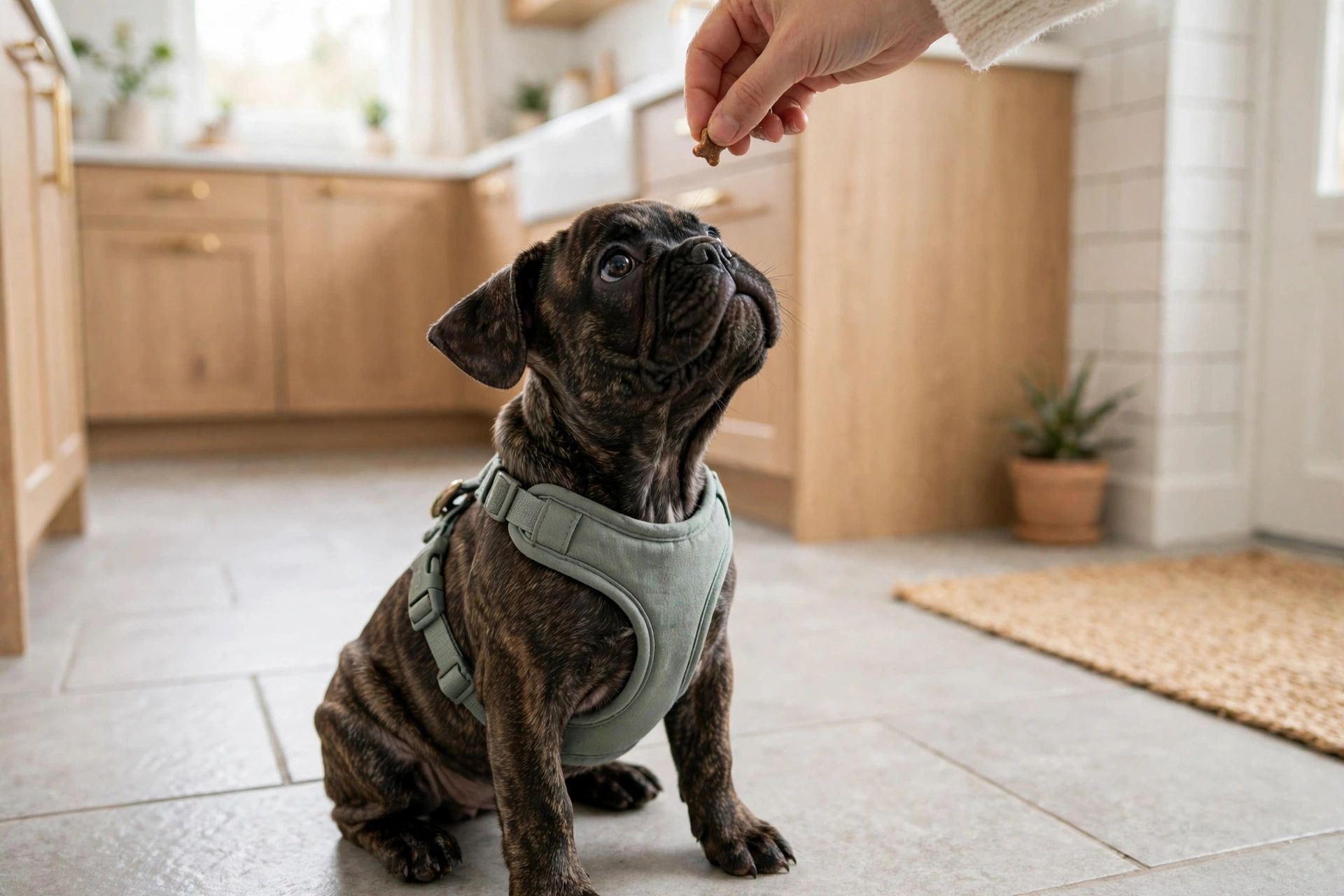
Teach name recognition first. Say your puppy’s name in a happy voice, and the instant those bat ears turn toward you, mark it with a word like “yes” and deliver a treat. Repeat it a few times a day in different rooms. Alongside it, build the potty routine with a consistent phrase at the same spot, and start gentle body handling in tiny increments: a touch of an ear, a look at a paw, a lift of a lip, each followed by a treat.
Redirecting is the other foundation skill of this stage. When tiny teeth land on a hand, a shoe, or a trouser leg, do not scold. Trade the forbidden object for a toy, praise the puppy for taking the toy, and move on.
Socialization at this stage is deliberately low-risk: household sights and sounds, visitors at home who sit quietly and let the puppy approach, carried outings where the puppy watches the street from your arms or a stroller, and calm fully vaccinated adult dogs in clean private spaces. Keep each exposure short and positive, and stop before tiredness or stress shows. A puppy that yawns, turns away, or tries to hide has told you enough.
The crate serves as the sleep and rest spot from day one. Full crating method lives in the companion French Bulldog Crate Training Guide, so this schedule keeps crate notes brief by design.
- Don’t rush: No dog parks, no pet-store floors, no forced greetings with strange dogs, no long training drills, and no flooding a fearful puppy with the thing that scares it.
Quick Tip: End every early session while your puppy still wants more. A puppy that finishes happy comes back eager. A puppy pushed past its limit learns that training is exhausting.
10 to 12 Weeks: First Real Commands, Leash and Harness, Bite Inhibition Begins
Somewhere in this window, the fog lifts a little. Your puppy knows the house, knows your voice, and starts offering attention instead of only reacting. This is when the first real commands land, and it is also when bite inhibition work begins in earnest.
Teach sit, a very short stay, drop, and recall indoors at short distances. Sit is the easiest win: hold a treat just above the nose, move it slowly back over the head, and the back end drops almost on its own. Recall is easiest now too, while your puppy is least independent and most likely to come anyway. Crouch down, call brightly, and reward the puppy well for arriving. Drop works as a trade: offer a treat for the toy, say “drop” as it falls, and hand the toy straight back.
Introduce the leash and harness indoors first. Let your puppy wear the harness around the house for a few minutes at a time, with treats and play, before you ever attach a leash. Then clip the leash on indoors and follow the puppy around the room. The garden comes next, once the harness is boring.
Bite inhibition step one starts now, and the goal matters: a softer mouth, not zero mouthing yet. When a bite hurts, say “Ouch!” in a normal voice, withdraw your attention briefly, and resume play once the puppy is calm. If the puppy does not ease up, leave the room for a few seconds. Some trainers note yelping excites certain puppies, and Dunbar’s own material acknowledges the yelp does not work for every puppy. The reliable core is the brief withdrawal of attention, with the yelp as step one, not a magic switch.
Alone-time building begins here too, in seconds and minutes, not hours. Step out of sight in a safe area, return before distress starts, and build gradually. A puppy that learns that you leaving predicts you returning stays calmer than one that only ever experiences long, sudden absences.
The crate stays the safe rest spot through this stage. Details are in the French Bulldog Crate Training Guide.
- Don’t rush: No off-leash recall outdoors in unfenced areas, no long stay durations, and no punishing mouthing in an attempt to eliminate it outright.

3 Months: Confidence, Greeting Manners, Teething Starts
Three months is the highest-value month in this schedule. The socialization window is at its peak and starting to close, your puppy has more confidence, and the first baby teeth are starting to loosen. VCA Hospitals puts the start of baby teeth falling out at around 12 weeks, so chewing will increase, and that is normal, not naughtiness.
Teach lie down, short fun retrieves, and firmer versions of “leave it” and “drop it” with trades. Lie down follows the same lure pattern as sit: treat at the nose, down toward the floor between the front paws, mark and reward the elbows touching the ground. Fetch at this age means two or three short throws in a hallway, with a big fuss when the puppy comes back.
Polite greeting foundations start now. Frenchies love people, and that love turns into jumping fast if jumping gets attention. Reward sitting when visitors arrive, and turn away calmly when paws leave the floor.
Socialization this month should be broad but still safe: brief visits to new places, new people of different ages and appearances, new sounds like the doorbell and the vacuum at a distance, and supervised play with well-matched, vaccinated puppies. A vet-approved puppy class can start around now, and many classes take puppies from 12 weeks with age-appropriate vaccinations, so check the class’s rules.
Mouthing continues, and bite inhibition step one continues with it. Redirect chewing to appropriate chews, and do not punish chewing itself.
Alone time extends gradually, in short absences only. The crate remains the rest spot, with the full method in the French Bulldog Crate Training Guide.
- Checklist for a 3-month outing: Treat pouch filled, harness fitted, a chew or toy for settling, a towel for wet grass, and a plan to leave before your puppy gets tired.
4 Months: Proofing Begins, Testing Boundaries, Teething in Full Swing
Four months is when the schedule shifts from teaching new cues to proving old ones. Your puppy knows sit in the kitchen. Does it know sit in the garden, on a quiet street, or when a neighbour stops to chat. That gap is the work of this month.
Teething is now in full swing. PetMD places baby teeth falling out across roughly 3 and a half to 5 months, with incisors first, then canines, then premolars, and molars erupting as adult teeth only. Chewing peaks, valuables need to go out of reach, and varied safe chews earn their keep.
This is also when regression commonly arrives. Trainers describe backsliding at 4 to 6 months as normal, not failure. A puppy that knew recall last week may ignore it this week. The fix is to go back a step, make the task easier, reward more generously, and stay patient. Regression is not a sign your puppy is bad or that training failed.
Socialization changes shape here. The window is closing around 14 to 16 weeks, so new experiences are still valuable, but quality and positivity now matter more than quantity. Keep exposures going at the puppy’s pace, and stop chasing a checklist of novelty for its own sake.
Alone time builds toward longer absences gradually, still not hours-long stretches. The crate remains the safe base, with details in the French Bulldog Crate Training Guide.
- Do: Practise one cue in one new place per session, and reward success there heavily.
- Don’t: Punish regression, or demand reliable obedience in distracting environments before the puppy has earned it step by step.
5 Months: Adolescence Approaches, Impulse Control, Real-World Practice
Five months is the impulse-control month. Your puppy is bigger, bolder, and faster, and the world is more interesting than you are. The theme of this stage is teaching the puppy to pause, choose, and check in before acting.
Teach wait at doors and gates until released, leave it on walks with real distractions on the ground, and drop it with real objects, not just training toys. Practise recall with mild distractions on a long line, never off-leash freedom in open areas.
Socialization shifts from new things to familiar things in new contexts. Same cues, new locations. Same people, different rooms. Continue meeting people and dogs, but with more structure than the free-for-all of the early months. A puppy that can sit calmly while a visitor enters the house has learned something more useful than a puppy that has met two hundred strangers but cannot hold still for any of them.
Teething is still active, with adult incisors and canines erupting across this period. Check your puppy’s mouth around this age. A baby tooth sitting beside an adult tooth, most often a canine, is worth a vet check, and small breeds are flagged for retained canines in particular. Most puppies have a full adult set of 42 teeth by around 6 to 7 months, replacing the 28 baby teeth they started with.
Alone time keeps building, and some puppies manage a couple of hours by now if they are settled and potty trained, though individual variation is wide and no number here is a promise. The crate stays the calm base, with the full method in the French Bulldog Crate Training Guide.
Quick Tip: Train impulse control at the moments it actually matters, like the front door and the food bowl, rather than only in quiet training sessions. A wait that only works in the living room is not a wait yet.
6 Months: Consolidation, Not Graduation
Six months looks like a milestone, and in some ways it is. Trainers describe a typical 6-month puppy as knowing the daily routine, being familiar with varied people, dogs, and environments, taking treats and toys gently, working on loose-leash manners in low-distraction settings, and being comfortable being held and touched by the vet. Treat every one of those as a typical pattern, not a deadline.
This month has no big new cues. The work is reinforcement: all cues, gradually more distractions, recall proofing on a long line, and steadier manners in real places. Looking ahead, the second fear period, roughly 6 to 14 months, may begin around now. Renewed wariness, sometimes without an obvious cause, is normal, so keep exposures gentle and positive.
Consider the next formal step. The AKC S.T.A.R. Puppy program is open to puppies under 1 year, runs as a 6-week class, and ends with an evaluation covering sit, down, come, walking on leash, tolerating handling and grooming, accepting petting by strangers, staying with another person, and reaction to distractions. A basic obedience class is the other natural next step, giving your adolescent structure at exactly the age when structure starts to slip.
The crate remains available as a rest den, with details in the French Bulldog Crate Training Guide.
- Don’t rush: No finished-dog expectations, no off-leash reliability in open areas, and no strenuous exercise or heat exposure for a Frenchie that is still a puppy in every way that matters.
Commands at a Glance
| Stage | New cues | Reinforce and proof |
|---|---|---|
| 8 to 10 weeks | Name, potty phrase, redirect | Routine, gentle handling |
| 10 to 12 weeks | Sit, stay (brief), drop, recall indoors | Name, potty, bite inhibition step one |
| 3 months | Down, fetch, leave it, bell (optional) | Sit, recall, greeting manners |
| 4 months | Wait (longer), loose-leash basics | All cues in new low-distraction places |
| 5 months | Impulse control on walks: wait, leave it, drop it | Recall with mild distractions on a long line |
| 6 months | No new cues: consolidation | All cues with distractions, S.T.A.R. Puppy as next step |
Two things to hold off on before 6 months, whatever other puppies seem to manage: reliable off-leash recall in open areas, and long-duration stays in distracting environments.
Bite Inhibition: Soft Mouth First, Then No Mouthing
Ian Dunbar calls teaching bite inhibition the most important aspect of a puppy’s entire education, and his sequence is specific. Step one is inhibiting the force of bites, so the puppy learns to mouth gently. Step two, only after that, is decreasing the frequency of mouthing until it stops. Do not try to eliminate biting outright before the puppy has learned a soft mouth.
The method is simple. A “Ouch!” when a bite hurts, a brief time-out or leaving the room if the puppy does not ease up, then resume play once the puppy is calm. Over days and weeks, expect gentler and gentler mouthing, and only then start ending play for any mouthing at all.
What not to do is just as clear. No alpha rolls, no holding the muzzle shut, no biting the puppy back, no physical punishment. Trainer consensus is that these responses risk more biting and fear of handling near the muzzle, which is the opposite of what a Frenchie owner needs from a dog that will need its face, ears, and skin folds handled for life. Our health problems guide explains why that routine handling matters so much for this breed.

Leash Introduction: Indoors, Garden, Quiet Street
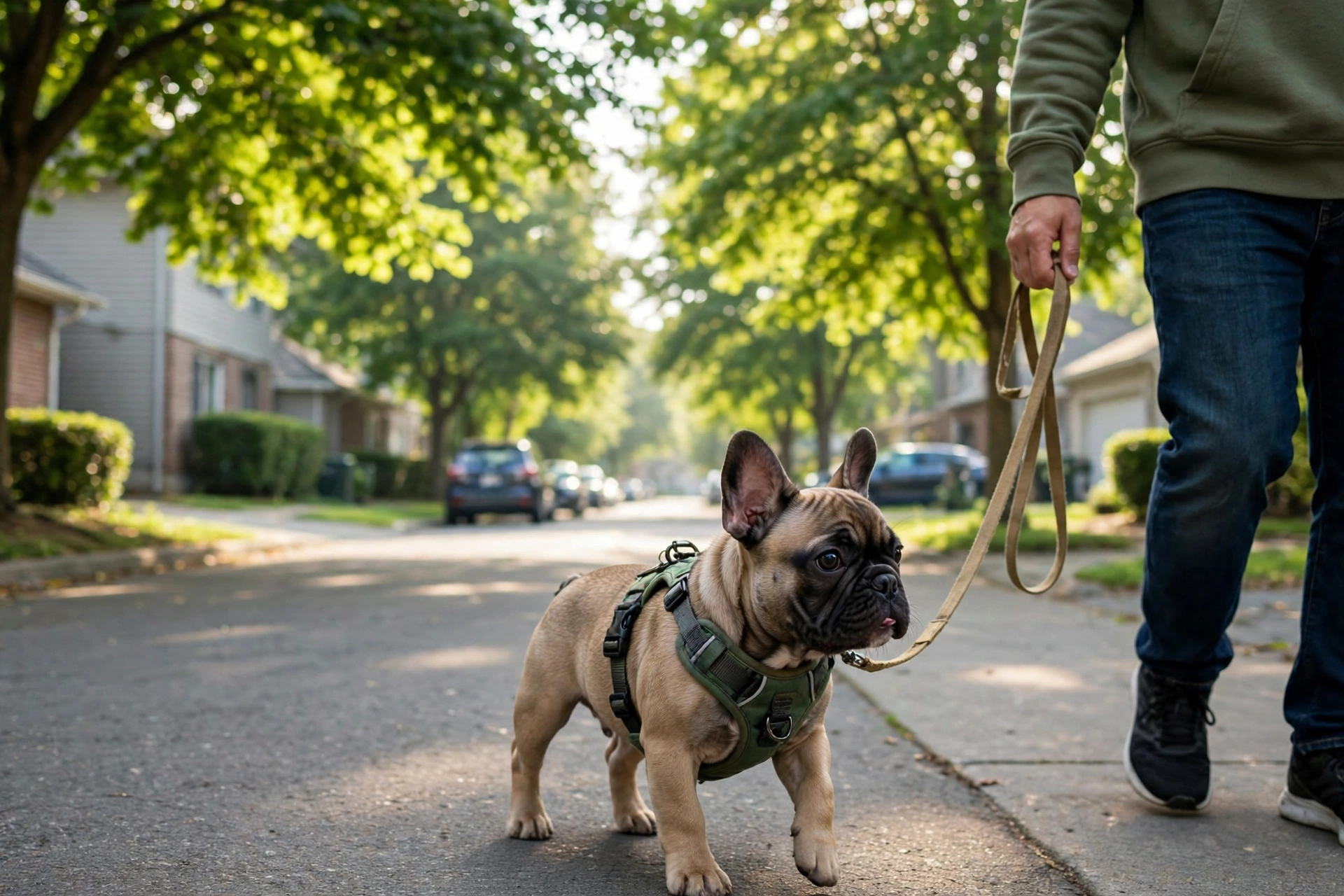
Leash training is a months-long project, not a week-one win, and the order matters. Harness on indoors, with treats and play, until the harness is boring. Leash clipped on indoors, following the puppy around the room, until the leash is boring. Garden next, with short sessions and frequent rewards for walking near you. Quiet street last, in cool weather, for a few minutes at a time.
Reward the position you want: puppy near your side, leash loose, attention flicking back to you. When the leash tightens, stop, wait for the puppy to check in or step back, then move again. Do not drag a Frenchie forward by the leash, and do not let pulling become the way the puppy gets to the interesting thing.
Heat rules the outdoor calendar for this breed. Train in the cool of the morning or evening, carry water, and stop at the first sign of heavy panting. A Frenchie that lies down mid-walk is not being lazy. It is telling you to stop. For the full picture on breathing limits, our BOAS guide covers the condition behind those limits.
- Do: Keep early walks short, cool, and reward-heavy, in a harness.
- Don’t: Use a collar for leash training, train hard in heat, or expect loose-leash walking in busy places before it is solid in quiet ones.
Alone-Time Building: Minutes First, Hours Much Later
Alone time is built, not announced. Start with seconds out of sight in a safe area: step behind a door, return before distress starts, and reward calm. Stretch to minutes, then to a short trip out of the house, always returning before the puppy falls apart.
If your puppy panics, drools, barks nonstop, or injures itself trying to escape, stop building and talk to your vet or a qualified trainer. This schedule does not diagnose separation anxiety, and distress that severe needs professional eyes, not a blog timeline.
Frenchie-Specific Training Notes
Everything in this schedule works for most puppies, but Frenchies add three wrinkles worth naming plainly. The first is breathing. Short, cool sessions are not a preference for this breed, they are a safety rule. Watch for heavy panting, glazed eyes, or lying down mid-session, and stop at once. Signs of heat stroke during any outdoor training include excessive open-mouth panting, bright red gums, stumbling, vomiting, and collapse. Stop immediately, cool with cool water on the groin and armpits, never cold water, and get to a vet.
The second wrinkle is motivation. Frenchies respond to food, play, and attention, and they check out fast when a drill repeats past the point of fun. Keep sessions short, vary the rewards, and end on a win. A Frenchie that ignores a cue in a distracting environment usually needs better motivation and more practice in varied places, not a louder voice. The third wrinkle is handling: a Frenchie will need its face, ears, paws, and skin folds handled for life, so the gentle handling work from the 8 to 10 week stage underpins every vet visit and grooming session. Our owner’s guide has the broader new-puppy context if you are still setting up the basics at home.
Quick Tip: Train in the shade, in the morning or evening, and keep a water bottle in your treat pouch all summer. A Frenchie that is cool and comfortable learns. One that is hot and panting cannot.
What Not to Rush
- Don’t wait until 16 weeks to socialize. The window is mostly closed by then. Start safe socialization at 8 weeks.
- Don’t expect a finished dog at 6 months. Adolescence and the second fear period are still ahead.
- Don’t eliminate mouthing by punishment before teaching a soft mouth. Dunbar’s sequence matters: gentle first, then none.
- Don’t flood a fearful puppy. Forced exposure, especially in the 8 to 11 week fear period, creates lasting fear.
- Don’t rush off-leash freedom, long stays, or obedience in distracting places. Proofing is gradual, and regression at 4 to 6 months is normal.
- Don’t over-exercise a Frenchie puppy. Short, cool sessions, stop at heavy panting, harness not collar, and never train hard in heat.
- Don’t use punishment-based methods. Alpha rolls, muzzle-holding, and physical corrections increase biting and fear.
- Don’t leave a young puppy alone for hours. Alone time is built in minutes, gradually.
- Don’t skip the vet. Vaccination timing, retained teeth, and breathing checks all sit with the vet, not a blog schedule.

At 6 Months: What Comes Next
Six months is a checkpoint, not a finish line. The sensible next steps are a basic obedience class or the AKC S.T.A.R. Puppy evaluation, continued socialization at the puppy’s pace, and steady proofing of every cue in busier places. A suddenly nervous adolescent that was bold at 5 months is not broken. It is growing, and gentle, positive exposure is still the right answer.
If you followed this french bulldog puppy training schedule from the start, your puppy now has a name it answers to, a handful of cues that work in quiet places, a soft mouth, a harness it accepts, a growing comfort with the world, and a routine it trusts. That is a strong foundation. The next six months build the reliability on top of it.
Frequently Asked Questions
Can I socialize my puppy before vaccinations are complete?
Yes, safely, and you should. AVSAB’s position is that the behavioural risk of waiting outweighs the small disease risk of careful early socialization. Use carried outings, a stroller, clean private spaces, known fully vaccinated adult dogs, and vet-approved puppy classes. Avoid dog parks, pet-store floors, unknown faeces, and shared bowls until your vet clears wider contact.
How long should training sessions be?
Short. As general guidance, not a rule, 8-week puppies manage about 5 to 10 minutes several times a day, rising to around 15 to 20 minutes a couple of times a day by 4 to 6 months. Fold cues into the day as well: sit before doors, wait at gates, recall across the garden. A Frenchie that is panting hard or has checked out is done, whatever the clock says.
My puppy regressed at 5 months. Is that normal?
Yes. Backsliding at 4 to 6 months is widely described by trainers as normal, not failure. Go back a step, make the task easier, reward more, and stay patient. Regression during adolescence is a reason to simplify, not to escalate corrections or declare the training a failure.
When can my Frenchie go to the dog park?
After full vaccination and once recall and control foundations are in place, and your vet’s call on timing matters most. Even then, start with quiet times, watch body language closely, and leave before play tips into exhaustion or overwhelm.
A Schedule You Can Actually Keep
The best training schedule is the one you will still be following in a month. Short sessions, folded into the day, with treats in your pocket and patience in reserve, will take a Frenchie puppy further than any heroic weekend of drilling. Expect wobbles at 4 to 6 months, expect teething chaos, expect days when recall vanishes in the park. Go back a step, make it easier, and carry on. Save this schedule, pin it to the fridge, and work through it one stage at a time. Your puppy is learning from you every single day, whether you plan the lesson or not, so you might as well make the lessons good ones.