How to Train a Stubborn French Bulldog (What Actually Works)
You say sit. Your Frenchie stares at you, sniffs a patch of carpet, and wanders off toward a sunbeam. You say it again, louder. Nothing. Learning how to train a stubborn french bulldog starts with a hard truth: in most of those moments, your dog is not defying you. The reward you offered lost to something better, the room got too distracting, the session ran too long, or the dog never learned that word in that place. This article is about method, not a list of commands: what stubborn really means in this breed, why punishment makes it worse, and the approach that gets a Frenchie cooperating again. For command tutorials, routines, and crate and potty coverage, see the full Training hub, which this piece deliberately does not repeat.
What “Stubborn” Actually Means in a Frenchie
The official picture and the living-room picture do not match at first glance, and both are worth holding at once. The French Bull Dog Club of America breed standard describes Frenchies as well behaved, adaptable, comfortable companions with an affectionate nature and even disposition. The American Kennel Club calls them smart, social, affectionate companions that are eager to please their owners. Trainer sources, meanwhile, keep using the same word: stubborn. PetPlace says training a French Bulldog can be a little challenging because Frenchies have a stubborn streak, then adds that they are people pleasers who are fairly easy to train with proper motivation, like treats. Pedigree UK says much the same, pointing to positive reinforcement with treats, praise, and toys.
These accounts are not contradictory once stubborn is defined correctly. A Frenchie can be people-focused and still weigh up whether cooperating is worth it in a given moment. That is low biddability under low reward, not an inability to learn. Trainer sources agree Frenchies learn quickly when motivated. The dog that nails sit in the kitchen and blanks you at the park has not forgotten the word. The kitchen version paid well and the park version did not, or the park version was never actually taught. A treat that works at home may lose to another dog or a dropped sandwich. That is a reward-value problem, not a character flaw.
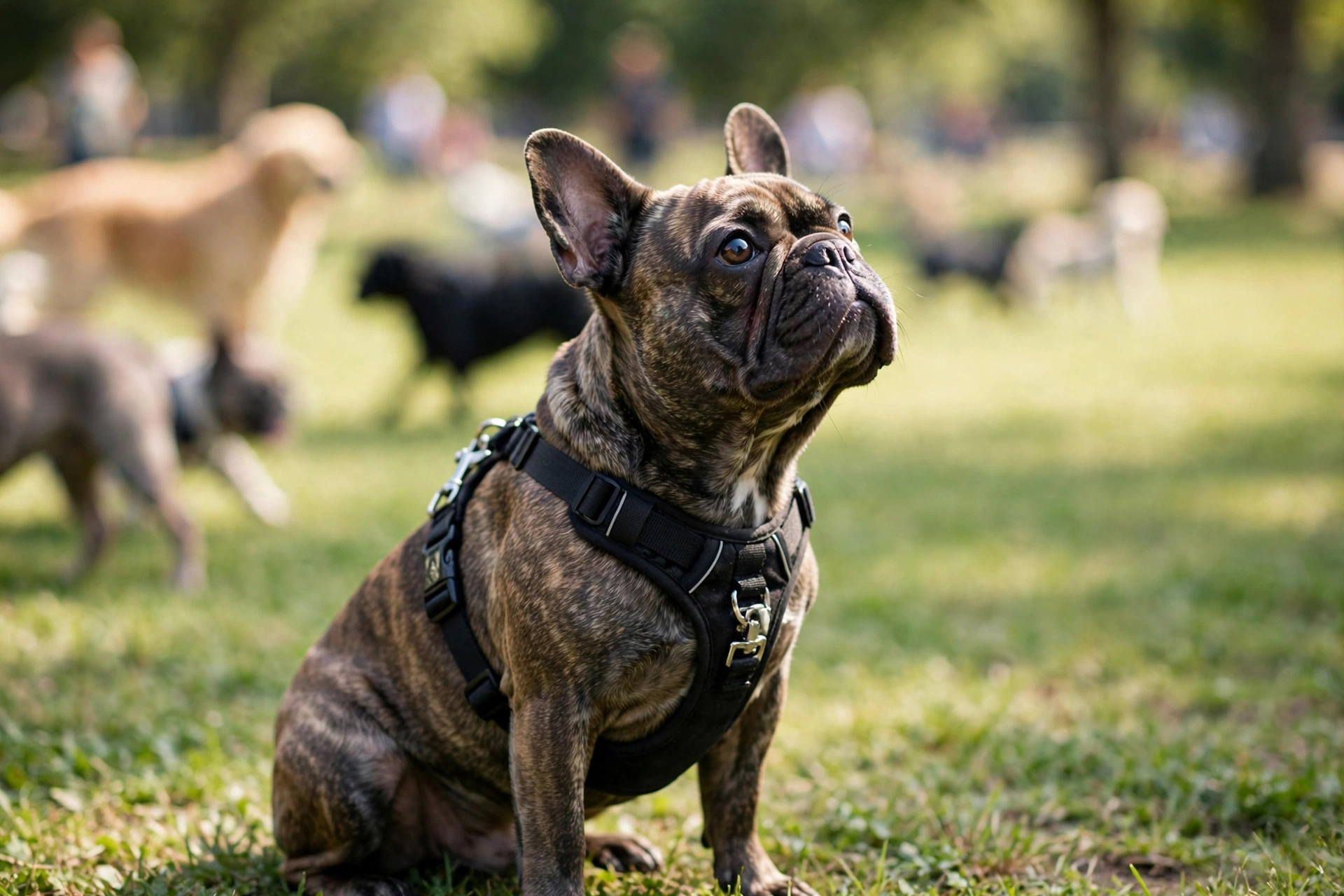
Selective hearing is usually a context problem, and there is a simple test for it. Ask for the behaviour indoors, with a high-value treat, in a quiet room. If the dog does it instantly there, the training has not been proofed yet: it has not been practised in enough places, at enough distances, and around enough distractions. A Frenchie that walks away, sniffs the floor, or lies down mid-session is usually bored, tired, warm, or under-rewarded. Bully Max puts the reputation down to three things: sessions that run too long, rewards that are not exciting enough, and environments that are too distracting or too warm.
Stubborn is not dominance, not a power struggle, and not a dog trying to be boss. That framing is retired here, for reasons the next section sets out. Individual variation matters too. Most Frenchies are food-driven, but some are toy-driven, praise-driven, or attention-driven. Find your dog’s currency in the first week.
Quick tip: Before your next session, test one behaviour indoors with your best treat. If it works there and fails outside, you have a proofing problem, not a stubborn dog.
Why Punishment Backfires With This Breed
Punishment feels effective in the moment, which is exactly why it is so tempting. A sharp voice or a lead jerk can stop a behaviour cold. The trouble is what it stops, what it leaves behind, and what it teaches the dog about you. The strongest guidance available is blunt. The American Veterinary Society of Animal Behavior, in its 2021 position statement on humane dog training, reaffirmed in 2025, says only reward-based training methods should be used for all aspects of dog training and behaviour modification. It says aversive methods, including electronic collars, prong collars, choke chains, leash corrections, and other forms of physical or psychological punishment, should not be used under any circumstances, and that there is no evidence aversive training is necessary.
The peer-reviewed evidence behind that position comes from general-dog studies, not Frenchie-only studies, and this article says so plainly. No study in the research for this piece tested punishment specifically on French Bulldogs. What the general-dog evidence shows is still serious. In a 2020 study published in PLOS ONE, Vieira de Castro and colleagues studied 92 companion dogs from seven Portuguese training schools. Dogs trained with aversive and mixed methods displayed more stress-related behaviours, such as crouching and yelping, and showed greater increases in cortisol levels after training than dogs trained with rewards. In a cognitive-bias test outside the training context, aversive-group dogs responded more pessimistically to ambiguous situations. Two caveats belong with that finding. The pessimism effect was clearest for the high-aversive group, and mixed-method dogs also showed more stress behaviour and panting than reward-only dogs. That does not mean every aversive-trained dog is permanently damaged.
A second study points the same way. Herron, Shofer, and Reisner surveyed 140 client-owned dogs at the University of Pennsylvania veterinary behaviour clinic in 2009. Confrontational techniques drew aggressive responses at striking rates: hitting or kicking 43 percent, growling at the dog 41 percent, forcing release of an item 39 percent, the alpha roll 31 percent, staring the dog down 30 percent, and grabbing jowls or scruff and shaking 26 percent. Choke or pinch collars drew aggressive responses in 11 percent of cases and shock collars in 10 percent, while clicker training drew none in this sample. Caveats apply. It was owner-reported and retrospective, and it drew on a behaviour-clinic population of dogs already referred for problems. It does not prove a given technique will cause aggression in a given Frenchie, and it is not Frenchie-specific. It shows risk, not certainty.
Beyond the numbers, there is a mechanism that explains why punishment can look like it worked. Punishment often suppresses the visible behaviour without changing the underlying emotion. A dog punished for growling may stop growling, while the fear that produced the growl stays put. The dog has simply lost its way of saying it is uncomfortable, through growling, stiffening, or turning away. Later escalation then looks as if it came out of nowhere, when in fact the warning was trained out first. That suppression point is the single most safety-relevant idea in this article.
Frenchie trainer sources describe the same shutdown in plainer language. PetDaily says harsh corrections can make Frenchies anxious, cause them to shut down, and damage the bond with the owner. Frenchie cooperation runs on trust and motivation, on people-focus plus food. A dog that is afraid of the trainer stops offering behaviour and stops coming when called. Owners then misread that withdrawal as more stubbornness and punish harder: punishment leads to less trust, less trust leads to less cooperation, less cooperation leads to more punishment. The honest claim is not that punishment is worse for Frenchies than for other breeds. No study supports that. It is that punishment carries the general risks above and undermines the motivation-based approach Frenchies respond to best.
Do this, not that:
- Do: Mark and reward the behaviour you want, within a second or two.
- Do: Change the setup when a behaviour fails: move closer, lower distraction, or raise reward value.
- Don’t: Repeat a cue louder, jerk the lead, or use a collar designed to hurt or startle.
- Don’t: Punish a growl, a stiffening, or a dog that finally comes back late.
How to Train a Stubborn French Bulldog: What Works Instead
The method has four parts, and they work as a set: food motivation, short sessions, household consistency, and making cooperation pay. None of the four works well alone. Fix the weakest part first.
Food Motivation, Used Strategically
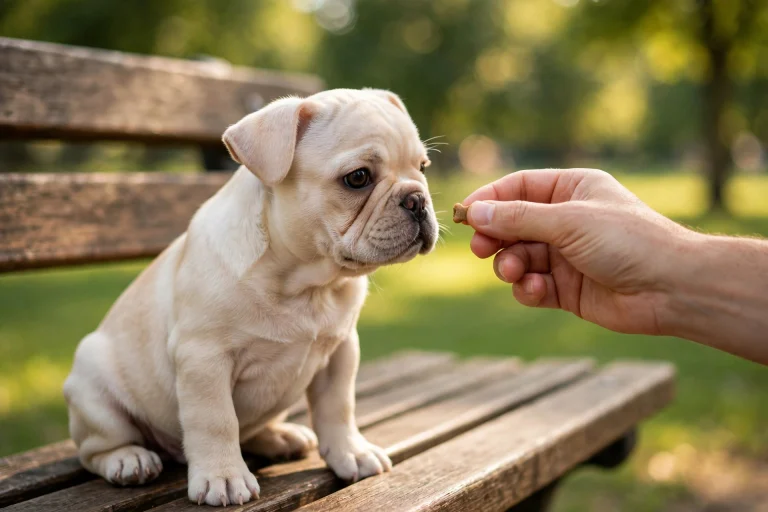
Start by finding your dog’s high-value reward, and be specific about it. Trainer sources repeat the same examples: small pieces of cooked chicken, cheese, or freeze-dried liver. Reserve the highest-value reward for the hardest context, such as recall outdoors, not for a sit the dog already knows in the kitchen. Ordinary kibble often loses to a competing distraction, which is why a dog that works for kibble at home can look uninterested at the park. VCA Animal Hospitals makes the point plainly: puppies repeat behaviours that have a good result. Your job is to make cooperation the better deal.
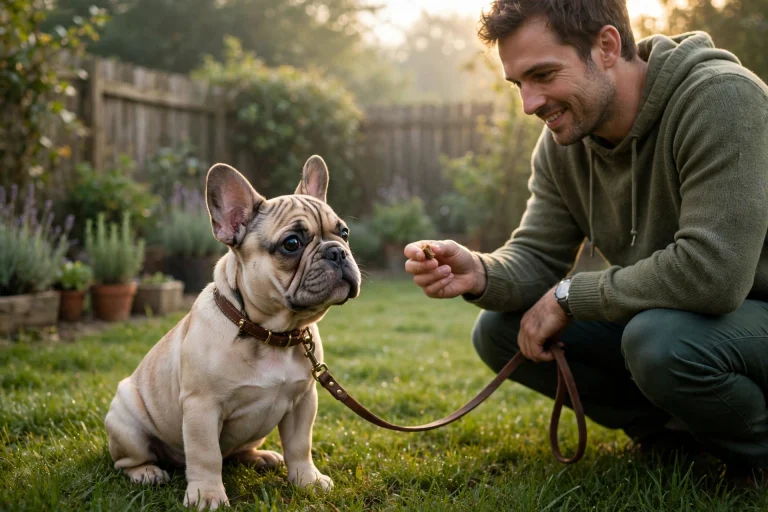
Use tiny, soft, fast-to-eat pieces so the session keeps moving. Reward within one to two seconds of the behaviour, with a marker word such as Yes or a clicker, so the dog connects the exact action to the reward. VCA notes that verbal praise alone may not be enough to sustain a strong response to trained cues, and that primary reinforcers, rewards that are innately valuable like food treats, should be continued long-term, at least intermittently. Fading is gradual and intermittent, not a date on the calendar.

Weight is the guardrail on all of this. Frenchies gain weight easily, and extra weight worsens breathing and joint load. Keep treats pea-sized, count them against meals, and use part of the day’s food ration as training rewards where the dog will work for kibble. No daily calorie budget is given here. If the dog is not food-motivated in the moment, check heat, tiredness, stress, or a just-eaten meal before concluding the dog is not food-motivated at all.
Short Sessions, Ended on a Win
Every Frenchie and bulldog trainer source in the research for this piece agrees on one thing: short, frequent sessions beat long ones. The exact number is less settled than most articles admit. Several guides say five to ten minutes, multiple times a day. Pedigree UK says ten to fifteen minutes, multiple times a day rather than an hour-long marathon. No source in this research measured Frenchie attention span experimentally. The practical centre is about five to ten minutes, several times a day, with one or two behaviours per session. The real rule is not the clock. Stop while the dog is still succeeding.
Ending on a win is the most repeated practical rule in the Frenchie trainer sources. End while the dog is still succeeding, on a behaviour the dog already knows well, such as a crisp sit, with a good reward, even if the new behaviour did not click that session. A short, happy session protects the next session’s enthusiasm. If a session goes wrong, do not push through to force a success. Drop to the easiest known behaviour, reward it, and stop. Add one difficulty variable at a time: distance, duration, or distraction, never all three at once.
Frenchie bodies set hard limits that other breeds do not face in the same way. The AKC notes that Frenchies’ short faces make their breathing less efficient than that of long-nosed breeds, so they are less tolerant of heat and strenuous exercise. Train indoors or in cool conditions, stop if panting becomes heavy or the dog slows sharply, and use a harness rather than neck pressure for lead work. Most Frenchies are typically under 28 pounds and about 11 to 13 inches tall. The site’s heat stroke guide and BOAS guide cover those risks in full. If heat or breathing is ever the reason a session failed, that is not stubbornness.

Consistency Every Person in the House Can Keep
Inconsistency is repeatedly named as the fastest way to teach a Frenchie that cues are optional, and it is the easiest problem to fix. Everyone in the house uses the same word for the same behaviour, the same hand signal, and the same rule. Sit is sit, not sit, sit down, and down used interchangeably for three different things. Write the household’s cue list down and keep it on the fridge if needed. Sit, down, come, wait, leave it, and off cover most daily life.
Consistency also means consequences are predictable. Dogs learn that their behaviour choices will predictably lead to something they love, whether food, pets, praise, or play. Intermittent rewarding of an unwanted behaviour is the fastest way to make that behaviour persistent. A dog that sometimes gets on the couch and sometimes gets fed from the table has learned that persistence pays, because sometimes it does. If a behaviour is not allowed, it is not allowed for anyone, on any day. Agree the word, the signal, and the rule for each behaviour, agree the calm reset when the dog gets it wrong, and put the list where everyone sees it.

Checklist: the fridge list
- One word per behaviour, written down, used by everyone
- One hand signal per behaviour, agreed at the same time
- One rule per behaviour, with no day-to-day exceptions
- One reset plan: a calm retry at an easier level, never a scolding
Make Cooperation Pay
For a companion breed, access is often just as powerful as food. Attention, play, and being near the owner are themselves rewards for many Frenchies. Sit, then the door opens. Wait, then the lead goes on. Recall, then release back to play. A dog that learns sitting makes the door open will sit at doors without being nagged, because sitting works.
Mark and reward offered good behaviour, not only cued behaviour. A dog that chooses to sit, check in with a look, or come close unprompted should hear about it. That builds a dog that offers cooperation instead of waiting to be told. Proofing belongs here too, because it is where cooperation usually breaks down. Dogs do not generalise well. A cue learned in the kitchen is not automatically known in the park. Reliability comes from varying duration, distance, and distraction, one variable at a time.
Troubleshooting the Stuck Points
Troubleshooting starts with diagnosis, not with trying harder. When a behaviour fails, run through five questions in order. Can the dog actually do it in this context? Is the distraction, distance, or duration harder than the last successful level? Is the reward worth more than the competing thing? Has the cue been repeated until it became background noise? Is pain, tiredness, heat, or breathing difficulty a factor? Only after those five is the dog choosing not to a useful frame, and even then the fix is motivation and setup, not force. A sudden change deserves a vet check first.
Recall Fails Outdoors but Works Indoors
Recall is the stuck point owners feel most keenly, because it feels personal when a dog runs the other way. Diagnose it in order: proofing gap, poisoned cue, or reward too low for the distraction. A cue becomes poisoned when it predicts something the dog dislikes, such as the end of play, a bath, or a nail trim, or when it is repeated while the dog ignores it, teaching the dog that the first call does not matter. If come has come to mean fun ends, the dog declines it, because it predicts a bad deal.
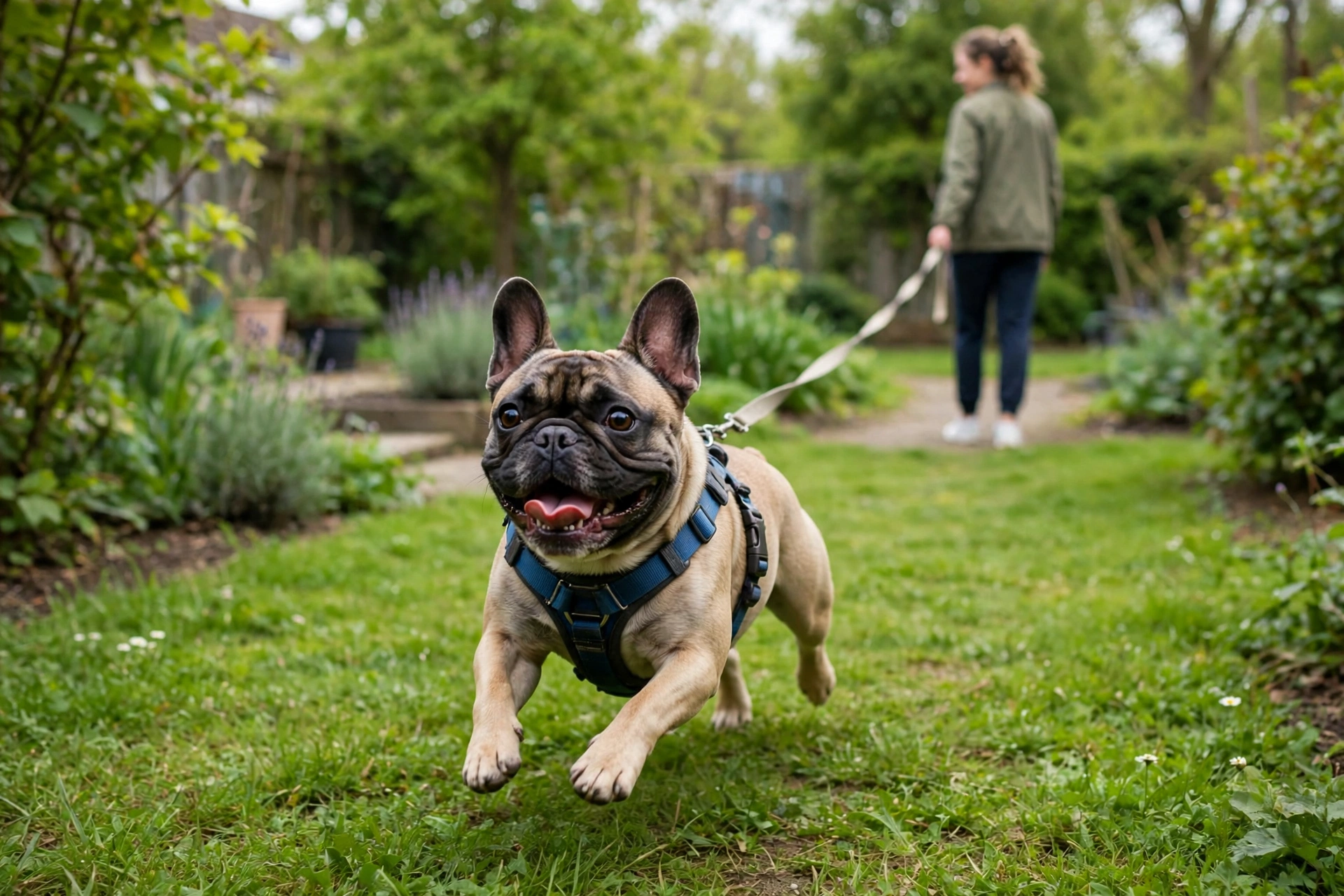
Fix it in sequence. First, stop calling when you know the dog will not come. Go and get the dog instead, so you stop rehearsing failure. Second, rebuild indoors with high-value rewards. Third, move to the garden on a long line, then a quiet street, then a busier park, one step at a time. Trainer sources give the long line as 15 to 30 feet, used outdoors until reliability is proven. Fourth, sometimes release the dog back to play after a recall, so recall does not always mean fun ends. Fifth, if come is already ruined, start fresh with a new word, such as here, or a whistle. Never punish a slow or late return.
The Dog Ignores a Cue It “Knows”
Say it once, wait a beat, and watch. If there is no response, do not repeat it louder or more times. Repetition teaches the dog that the first call is optional and the third call is the real one. Instead, make success easier: move closer, reduce distraction, or raise reward value, and try again. If it fails twice at the easier level, go back to the last level where the dog succeeded reliably, and rebuild from there. Check the household too: is someone else using a different word?
Training Plateau: Progress Stalls for Days or Weeks
Plateaus are normal, and the worst response to one is also the most common: adding new behaviours or escalating pressure during the dip. Do neither. Return to the last level where the dog succeeded reliably, reward heavily there, and rebuild one variable at a time. As a rough yardstick, not a study result, if the dog is succeeding on roughly eight out of ten tries at a level, that level is about right. If success falls well below that, drop back.
Two special cases hide inside plateaus. The first is the extinction burst. When a previously rewarded behaviour stops paying off, it often gets worse briefly before it fades, because the dog tries harder with the old trick. If owners give in during the burst, they teach persistence. Hold the line calmly, and do not punish the burst. The second is adolescence. In general-dog sources, regression roughly between six and eighteen months commonly shows as selective hearing, especially recall, and boundary-testing. The fix is to drop criteria back a level, reward heavily in low-distraction settings, and maintain rather than advance. Those timelines are general-dog, not Frenchie-measured, so no Frenchie-specific window is stated here.
The Dog Shuts Down, Walks Away, or Lies Down Mid-Session
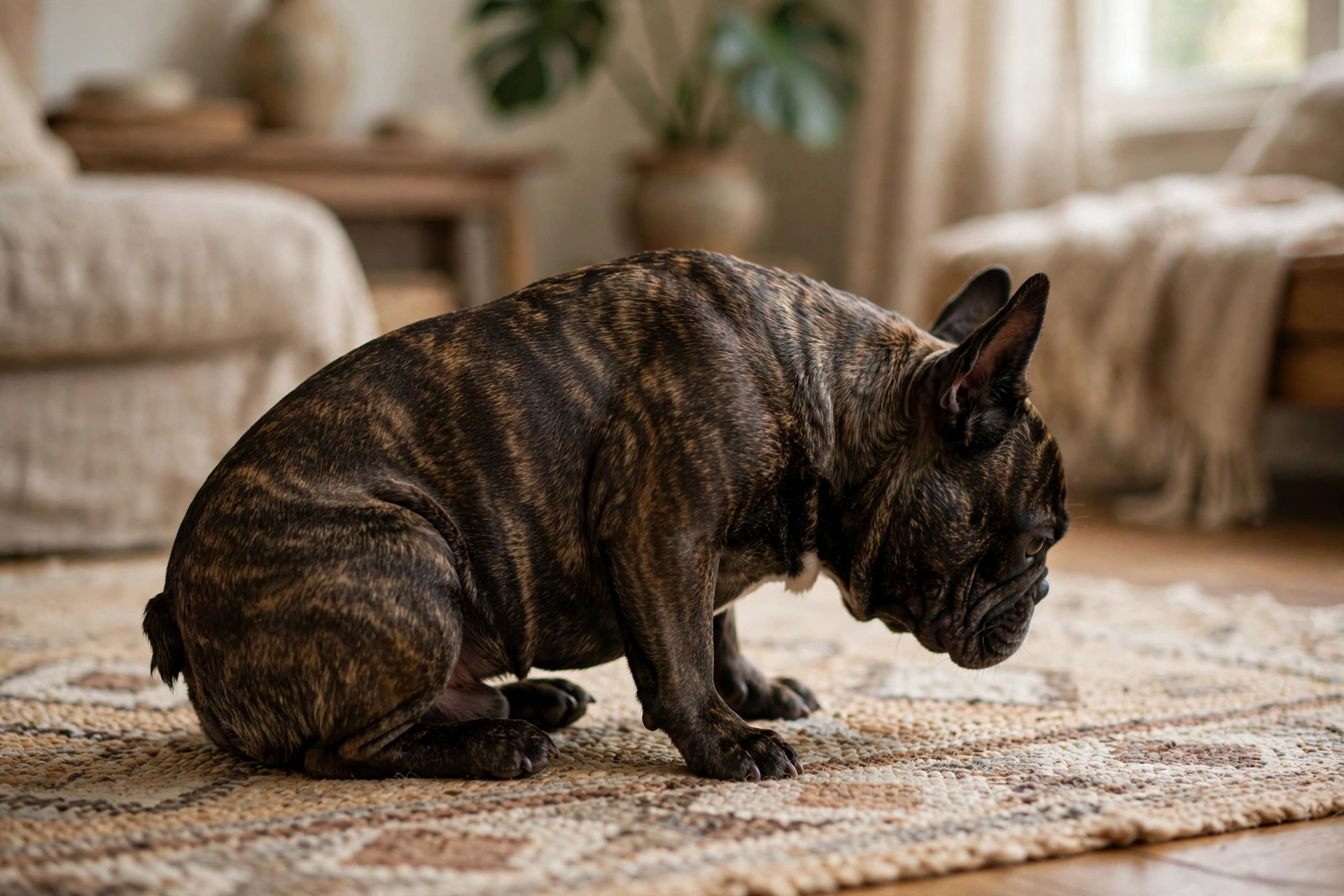
Stop. This is information, not defiance. Likely causes: the session is too long, too repetitive, too hard, too hot, the reward is too low, or the dog is stressed by corrections. End on an easy win if one is available, or simply end calmly, and run a shorter, easier, higher-reward session next time. If shutdown follows corrections, that is the punishment-backfire loop from earlier in this article. A dog that lies flat or walks to a corner is communicating. Listen, do not override it.

Quick tip: When a dog walks away mid-session, end calmly, note what went wrong, and run the next session shorter, easier, and richer in rewards.
What Progress Really Looks Like
No verified timeline exists for a stubborn Frenchie specifically, and this article will not invent one. The commercial timelines found in research for this piece were single-source marketing claims, not research. Most Frenchies learn a new behaviour quickly in a quiet room with a good reward. The hard part is reliability outdoors, around distractions, and with different family members. That is proofing, and it takes repetition across places, not just repetition in the kitchen. Progress is rarely linear, and a behaviour that works at home is not yet learned for the park.
Reliability is a spectrum, not a finish line. A Frenchie may be excellent indoors, good in the garden, and still unreliable at a busy dog park, and that is a training stage, not a failure. Adult and rescue Frenchies can learn too. The French Bulldog Owner’s Guide and the French Bulldog health problems guide give the wider context for breed traits and health limits that shape progress.
When to Get Help
Most stubbornness resolves with better rewards, shorter sessions, consistency, and proofing. Some situations need a professional. If aggression, biting, or fear is escalating, if the dog is shutting down consistently despite reward-based methods, or if there is any bite history, see a certified professional who uses reward-based methods, or a veterinary behaviourist. AVSAB guidance notes that complex cases may need behaviour modification, management, and sometimes medication alongside training. A blog article is not a substitute for that help.
Checklist: signs to get help now
- Aggression, biting, or fear that is escalating
- Shutdown that persists despite reward-based methods
- Any bite history, or a sudden behaviour change with pain signs
Frequently Asked Questions
Is my Frenchie stubborn or just untrained?
Usually, neither label fits on its own. Test the behaviour indoors with a high-value treat. If it works there, the training is unproofed. If it fails everywhere, the behaviour was never fully taught, or the reward is not worth the effort.
Does my Frenchie need a firmer hand?
No. Veterinary behaviourists recommend reward-based methods only, and the studies covered here link confrontational methods to stress and to aggressive responses in a substantial minority of clinic dogs. Change the reward, the session length, or the difficulty instead.
Why does recall work at home but not at the park?
Because the dog has not generalised it there yet, the reward at the park loses to the distraction, or the cue has come to predict the end of fun. Rebuild on a long line, reward the whole return, and only call when success is likely.
A Last Word Before Your Next Session
Learning how to train a stubborn french bulldog is less about winning a contest with your dog and more about changing the deal on offer. Short sessions, rewards worth working for, one word used by everyone, and proofing one step at a time will carry most Frenchies further than any amount of insistence. Your dog is already telling you what works. Listen to that feedback, keep sessions cool and kind, and save this article for the next plateau.