BOAS in French Bulldogs: Breathing Problems, Signs & Surgery Options
TL;DR
BOAS in French Bulldogs is the cluster of airway abnormalities behind the breed’s famous snoring, snorting, and heat intolerance. A 2026 Kennel Club study of 1,917 Frenchies found 15.6% clinically affected, though the true number is likely higher because most owners mistake symptoms for normal breed traits. Surgery to open the airway costs $1,500 to $5,000 in the US and helps most dogs breathe noticeably easier. Pet insurance usually covers it, but only if you enroll before any breathing symptom appears in your dog’s vet records.
That Snore Is Not Cute
Everyone says it. Strangers stop you on the street to tell you how adorable your snorting Frenchie sounds, and honestly, part of you agrees. Here is the uncomfortable truth most French Bulldog owners learn too late. That noise is not a quirky breed trait. It is the sound of a dog working hard for every single breath.
I am not saying this to scare you. Most Frenchies with BOAS live full, happy lives, especially when their owners understand what is going on. But the difference between a dog that merely snores and a dog that is quietly struggling often comes down to whether the owner knows what to watch for.
This guide covers all of it. What BOAS actually is, how common it really is, the 3-minute test vets use to grade it, what surgery involves and costs in 2026, the anesthesia numbers nobody quotes, and the insurance timing trap that costs owners thousands.
What BOAS Actually Is
BOAS stands for brachycephalic obstructive airway syndrome. The name is a mouthful. The concept is simple. Selective breeding gave the French Bulldog its flat face, but the soft tissues inside did not shrink to match. The result is an airway with up to four separate blockages stacked on top of each other.
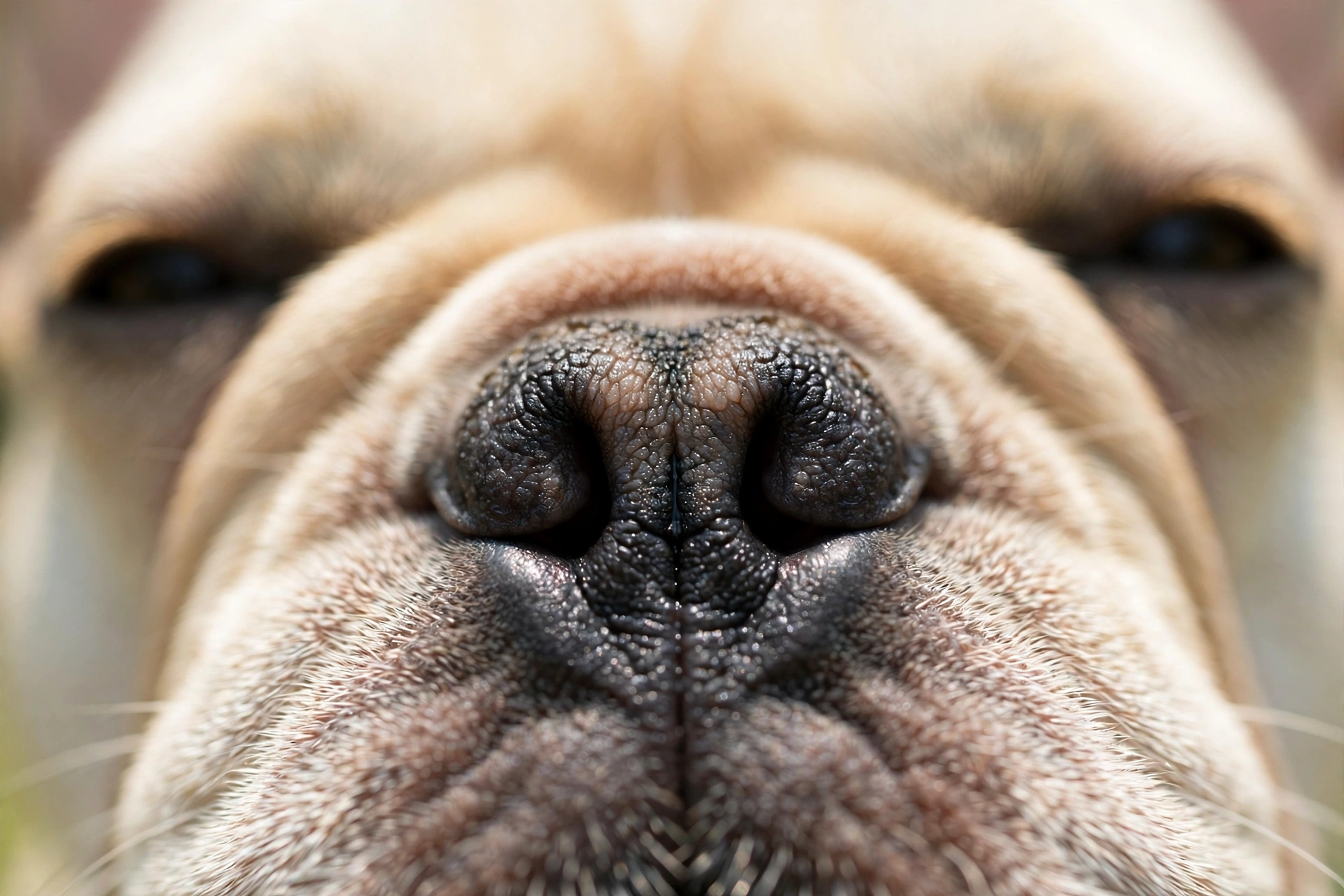
The four blockages:
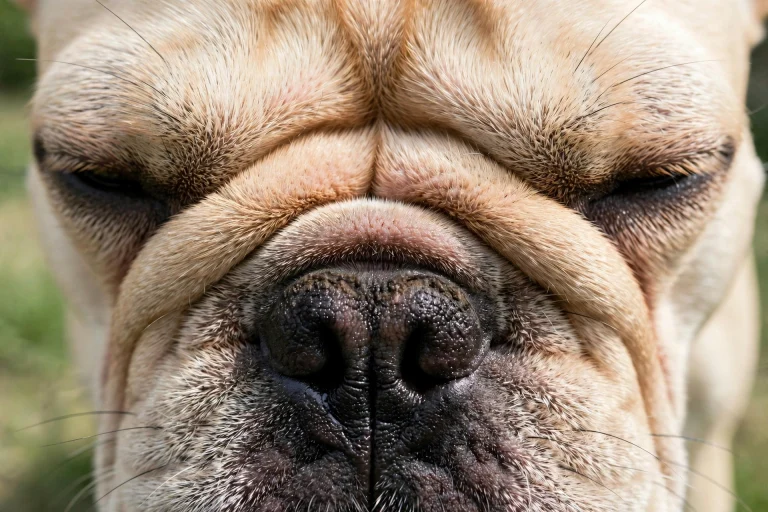
- Stenotic nares. Narrow, pinched nostrils. You can see this one yourself. Compare your Frenchie’s nostrils to a Labrador’s and the difference is obvious.
- An elongated soft palate. The flap of tissue at the back of the throat is too long for the shortened skull, so it drapes over the windpipe opening like a curtain.
- A hypoplastic trachea. The windpipe itself is narrower than it should be. Nothing can be done surgically about this one, which is why vets grade the overall picture rather than promising a total fix.
- Everted laryngeal saccules. Small pouches near the vocal cords get sucked inside out by the constant effort of pulling air through the narrowings above. These are secondary damage, caused by the other three.
There is a fifth piece most guides skip. Digestive trouble. The extreme suction created by breathing through a narrow airway pulls stomach contents upward, so reflux and regurgitation are extremely common in Frenchies with breathing problems. If your Frenchie vomits foam, gags after eating, or swallows repeatedly for no clear reason, that can be part of the same syndrome rather than a separate stomach issue (it is also why some Frenchies are famously gassy, which we cover in our guide to why French Bulldogs fart so much). The encouraging part is that digestive signs often improve after airway surgery, according to a detailed veterinary review of the condition.
Quick tip: Look at your Frenchie’s nostrils in good light. If the openings are slits rather than open ovals, that is stenotic nares, the most visible piece of BOAS. It is worth mentioning at the next vet visit even if your dog seems fine.
BOAS in French Bulldogs: How Common Is It, Really?
This is where most articles give you one number and move on. The honest answer is messier, and you deserve the messy version.
The best recent data comes from a 2026 Kennel Club study published in PLOS ONE. Researchers analyzed breathing grades from 1,917 French Bulldogs and found 15.6% were clinically affected. That is the most rigorous number we have, and it is lower than older estimates.
Before you feel relieved, read the caveats, because they matter. The study covered Kennel Club registered dogs in the UK only, and most French Bulldogs are not registered anywhere. Testing was voluntary and breeder driven, which means healthier, well managed dogs are the ones that show up for voluntary screening. The authors themselves note that few flat faced dogs get screened unless they already show symptoms.
Across the wider literature, reported prevalence spans 3.5% to over 60%, depending on how researchers define and measure the condition. A UK study using whole body plethysmography put roughly half of French Bulldogs, Pugs, and English Bulldogs in the affected range. A VetCompass analysis of English vet records found French Bulldogs had 30.9 times the odds of a BOAS diagnosis compared with non French Bulldogs (O’Neill et al., 2021).
Perhaps the most telling statistic is this one. Around 58 to 60% of owners of affected dogs do not recognize their dog has a breathing problem. The snorting gets normalized. “That is just how Frenchies sound” becomes the reason nobody investigates. If you are reading this article, you are already ahead of most owners.
Quick tip: Do not let a single prevalence number reassure or alarm you. What matters is your individual dog’s breathing, graded by a vet who knows what to listen for. The section on the 3-minute test below explains exactly how that works.
Signs: Normal Frenchie Noises vs. Warning Signs
Every French Bulldog makes noise. The question is which noises are conversation and which are a cry for help.

| Normal for the breed | Get it checked |
|---|---|
| Light snoring during deep sleep | Snoring so loud it wakes you through a closed door |
| Occasional snorts when excited | Struggling to catch breath after mild play |
| Sniffly sounds while eating | Gagging, retching, or vomiting foam regularly |
| Panting after a walk, settling within minutes | Panting that will not settle, or blue tinged gums |
| Sleeping on the back, mouth open | Refusing to lie flat, sleeping sitting up or with chin propped |
A few signs owners routinely miss:
- Exercise intolerance. Your Frenchie sits down two minutes into a walk while other dogs keep going. That is not laziness.
- Sleeping position. Dogs with serious airway obstruction avoid lying flat. They sleep propped up, chin on a pillow edge, or sitting. It keeps the airway straighter.
- Heat distress. Heavy panting, thick ropy drool, and restlessness on a warm day can be the first obvious sign of a breathing problem that was always there. Our heat safety guide goes deeper on this.
- Digestive signs. As noted above, frequent regurgitation and repeated swallowing can be BOAS related, not a stomach problem.
- Snoring volume creep. If the snoring has gotten louder over months, that is progression worth mentioning. Our piece on Frenchie snoring helps you tell the difference.
Quick tip: Film your Frenchie breathing at rest, after a short walk, and while sleeping. Thirty seconds of video tells a vet more than ten minutes of description. Bring the clips to the appointment.
The 3-Minute Test: How Vets Grade BOAS in French Bulldogs
There is a standardized test for this, and it is refreshingly low tech. The Respiratory Function Grading Scheme was developed at the University of Cambridge with the UK Kennel Club, and it is now available in North America through the OFA.
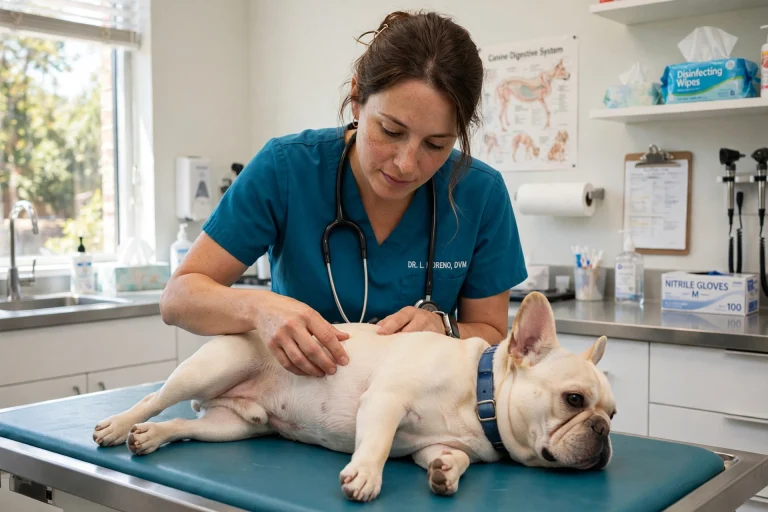
Here is what happens. A trained assessor takes a short breathing history and listens to your dog’s airway with a stethoscope while the dog is calm. Then your dog trots at a brisk pace for 3 minutes. You, the vet, or a nurse can handle the leash. The assessor listens again immediately after the exercise and applies a set protocol that combines the sounds at rest, the sounds after exercise, and the breathing effort.
The result is a grade from 0 to 3:
- Grade 0. Clinically unaffected. No respiratory signs of BOAS.
- Grade 1. Clinically unaffected, but mild respiratory signs that do not limit exercise.
- Grade 2. Clinically affected, moderate. The dog should be monitored and may need treatment.
- Grade 3. Clinically affected, severe. Needs veterinary assessment and treatment, and should not be bred from.
Dogs can be graded from 12 months of age, and because BOAS is progressive, reassessment every two years is recommended. At Crufts, the bar keeps rising. From 2026, dogs graded 2 or 3 are ineligible to compete, tightened from the old grade 3 only rule.
In the US, breed club clinics typically charge $60 to $70 plus a $15 OFA registration fee, with all in testing at events running roughly $75 to $150. Private practice prices vary, so call ahead. You can find trained assessors through the OFA’s website.
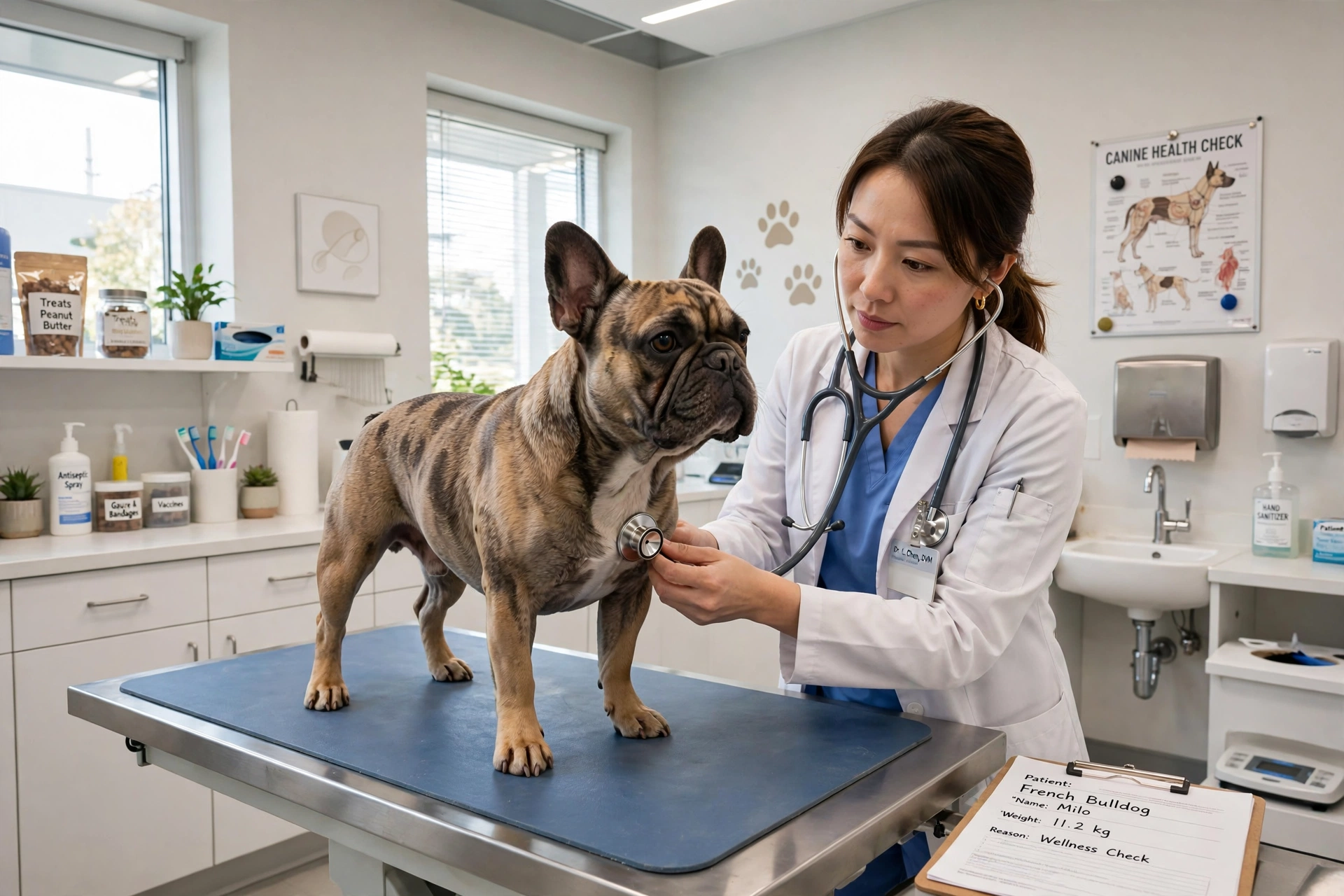
Quick tip: Even if you never plan to breed, a grade gives you a baseline. If your dog is grade 1 at 18 months and grade 2 at three years, you have objective proof the condition is progressing, and that is powerful information when deciding about surgery.
How Vets Diagnose BOAS
The grading test tells you how bad the breathing is. A full diagnosis maps out exactly what is wrong and where, which is what a surgeon needs before operating.
A typical workup includes a conscious airway exam, chest X-rays to check the trachea and look for aspiration pneumonia, and bloodwork ahead of any anesthesia. In some cases the vet will recommend examining the throat under light sedation, which lets them see the soft palate length and check for everted saccules directly.
A breathing assessment at a clinic runs roughly $75 to $150. A full pre-surgical workup with imaging and bloodwork costs more and varies widely by region. Ask for an itemized estimate before you agree to anything. It is a reasonable question and good clinics expect it.
Quick tip: If your regular vet seems unsure about BOAS specifics, ask for a referral to a board certified surgeon for the assessment. Airway surgery is a specialty, and the person grading the problem should ideally be someone who fixes it weekly.
Can You Manage BOAS Without Surgery?
For mild cases, often yes, at least for a while. For moderate to severe cases, management buys comfort but does not fix anatomy. Here is what actually moves the needle, ranked by impact.
Weight control matters more than anything else you can do at home. Fat deposits in the tongue and throat tissues narrow an already narrow airway. Research puts overweight dogs at roughly 1.8 times the odds of BOAS. UK vets point out that even half a kilo of excess weight narrows the airway measurably. You should be able to feel your Frenchie’s ribs easily under a thin layer of fat. If you cannot, that is the first thing to fix, and it costs nothing.
Switch to a harness and never look back. A collar puts pressure directly on the windpipe of a dog whose windpipe is already compromised. A well fitted Y-front harness spreads the load across the chest. Every major veterinary source recommends this. There is no randomized trial proving it, because nobody is going to run a trial comparing collars on dogs with narrow tracheas, but the anatomy makes the case on its own.
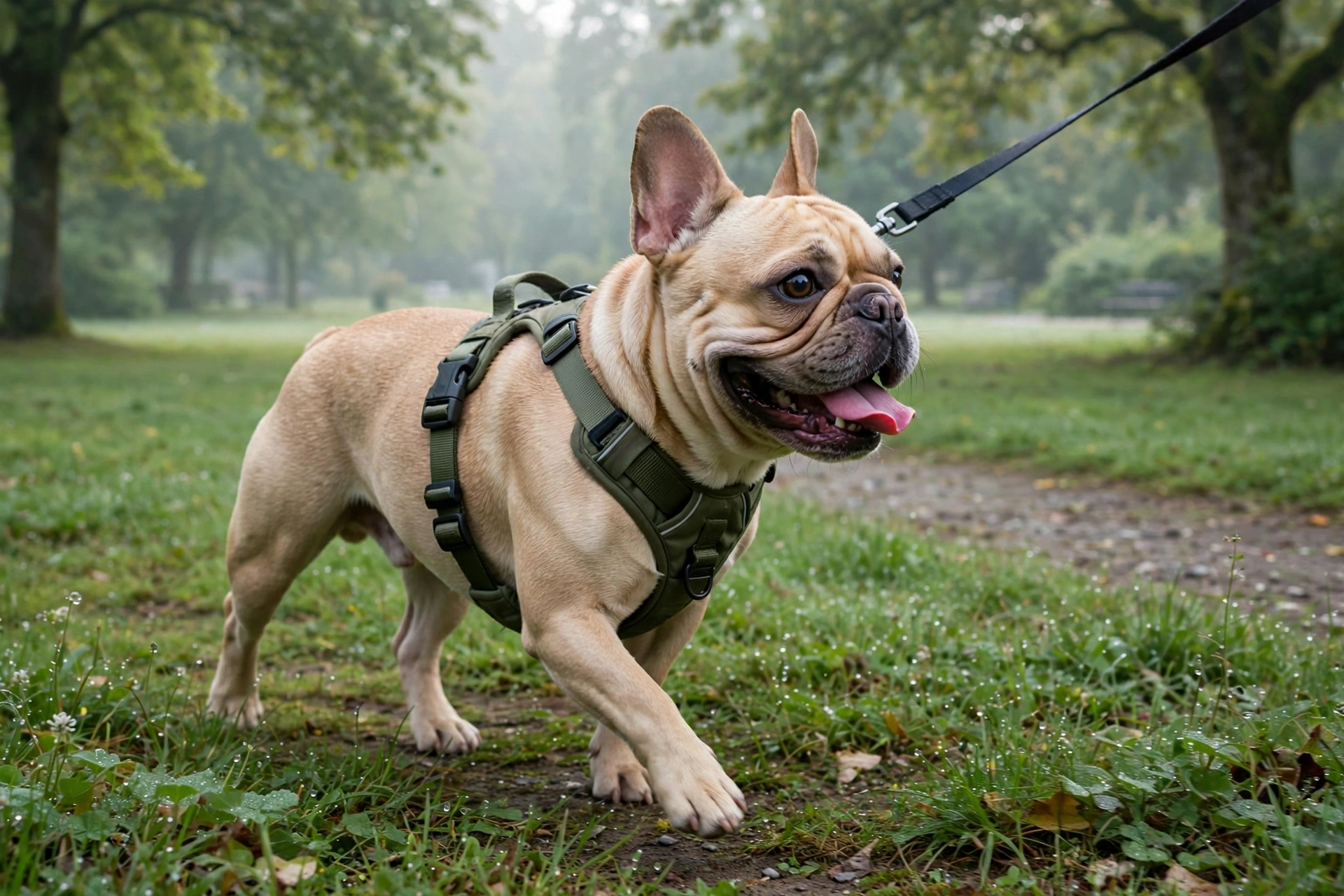
Restructure exercise. Short, frequent walks in cool parts of the day beat one long midday march. Let your dog set the pace. A Frenchie that plants its feet is telling you something, so listen.
Manage the environment. Keep the house cool in summer. Never leave your dog in a parked car, not for a minute, not with the windows cracked. Stress and excitement worsen breathing, so keep greetings calm and avoid situations that wind your dog up.
Do this, not that:
– Do keep your Frenchie lean enough to feel the ribs. Do not free feed a breed prone to weight gain.
– Do walk early morning or late evening in warm months. Do not exercise at midday in summer.
– Do use a Y-front harness. Do not use a collar, a slip lead, or anything that tightens around the neck.
Heat: The Danger Every BOAS Owner Must Respect
This section could save your dog’s life, so read it carefully.
Dogs cool themselves by panting, which means evaporating moisture from the airway. A Frenchie with BOAS has a compromised airway, which makes panting inefficient, which makes overheating faster and harder to reverse. A Royal Veterinary College study found French Bulldogs face six times the baseline risk of heatstroke. That is not a typo.
Know the thresholds. A useful rule of thumb from veterinary guides: for a flat faced dog, conditions get dangerous when the temperature in Fahrenheit plus the relative humidity percentage climbs past 100. In practical terms, above 68F watch closely on walks. Above 77F, exercise only in the early morning or late evening. In humid conditions around the mid 70s, keep walks to ten minutes or skip them. Above 82F, keep activity minimal and stay indoors. Above 90F, exercise extreme caution even at rest. Humidity makes everything worse. A humid 77F day can be more dangerous than a dry 86F one.
Know the stages. Heavy panting, drooling, and restlessness come first. Then excessive panting, thick ropy saliva, vomiting, and weakness. Then collapse, seizures, and purple gums. That last stage is an emergency. Organ damage begins when body temperature passes 106F. Normal is 100 to 102.5F.
Know the cool down protocol. Move the dog to shade or air conditioning immediately. Apply cool, not cold, water to the body and put a fan on the dog. Offer small amounts of cool water to drink. Stop active cooling when the temperature reaches 103F, then get to a vet. Never use ice water, which constricts blood vessels and traps heat inside.
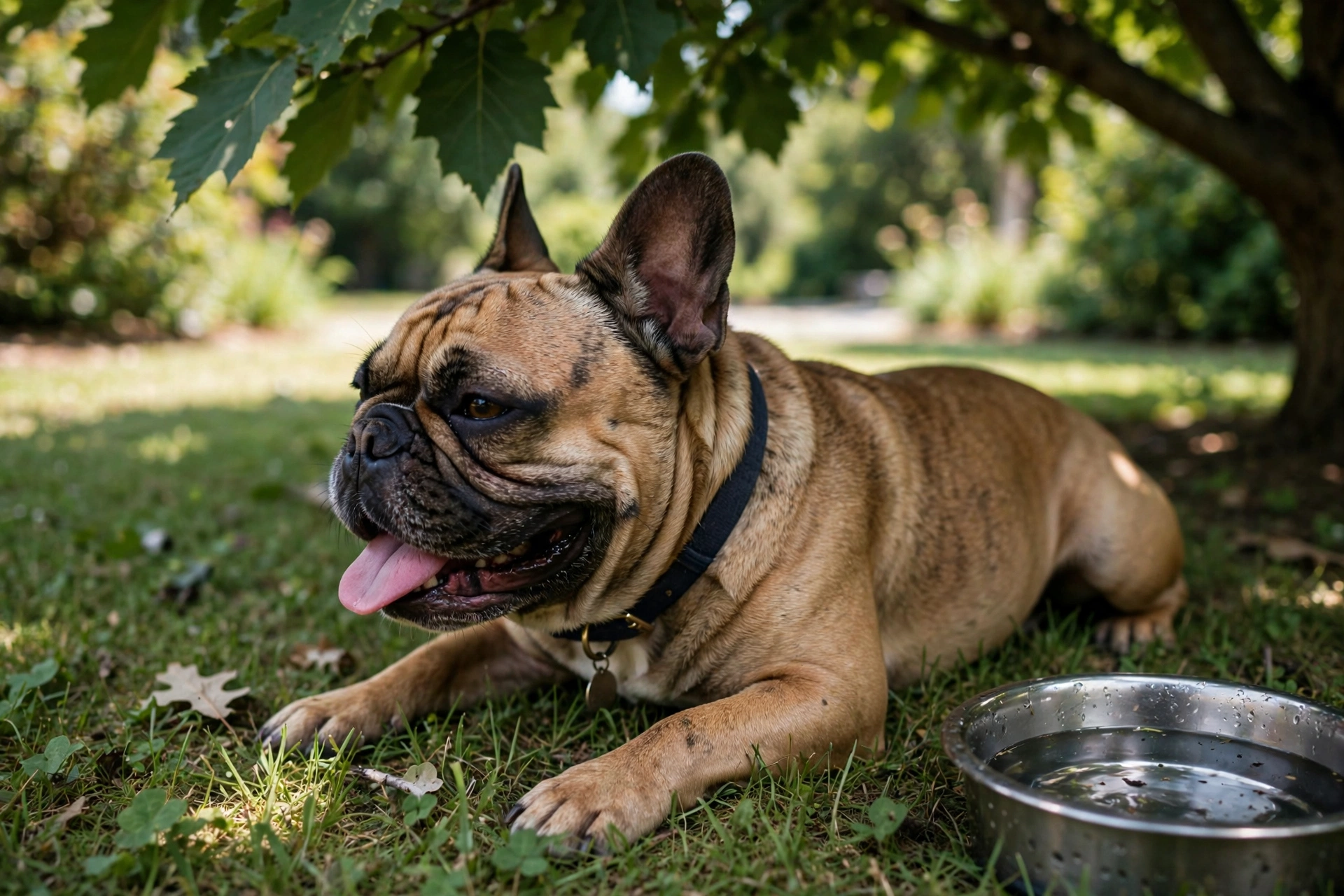
Quick tip: Fans cool people, not dogs. We sweat, dogs do not. A fan helps only when combined with wetting the dog down. A cooling mat and frozen treats for indoor enrichment do more for a Frenchie on a hot day than a fan alone.
BOAS Surgery: What Actually Happens
When management is not enough, surgery opens the airway at as many of the blockage points as possible. It is usually a single operation that combines two or three procedures.
Widening the nostrils. The surgeon removes a small wedge of tissue from each nostril to create a wider opening. Several wedge techniques exist, and some surgeons use a CO2 laser instead of a scalpel. A few specialists recommend doing this as early as 12 to 16 weeks in severely affected puppies, to prevent the secondary damage that years of straining cause.
Shortening the soft palate. The surgeon trims the overlong soft palate so it no longer drapes over the windpipe. Techniques range from traditional cut and sew to laser to newer folded flap methods that also thin the palate. Here is an honest controversy. A 2007 study found no long term difference in outcomes between laser and traditional surgery, while a large retrospective found the old cut and sew method carried a higher risk of major complications than laser or vessel sealing devices. The Animal Medical Center in New York considers laser and vessel sealing roughly equivalent and both preferable to cut and suture. Surgeon skill and case selection matter more than the tool.
Removing everted saccules. This one divides surgeons. Some remove the damaged pouches routinely. Others do it only when necessary, citing a commonly quoted figure that only about 40% of cases show clear clinical improvement from this step alone. Your surgeon should explain their own approach and why.
Most owners report their dog breathing noticeably easier within days of surgery. Quieter sleep, more willingness to play, less gagging. The change owners describe most is simple. Their dog seems comfortable for the first time.
Quick tip: Ask your surgeon three questions. How many BOAS procedures do you perform per year. What is your complication rate. What does overnight monitoring look like here. The answers tell you everything about where to have this done.
Anesthesia: The Honest Numbers
This is the part that worries owners most, and most guides dodge it with vague phrases like “higher risk.” You deserve the actual numbers.
A 2025 multicentre study of 55,019 dog anesthetics found crude mortality of 0.82% in brachycephalic breeds versus 0.65% in non brachycephalic breeds. But when researchers adjusted for how sick the patients were, the excess risk was no longer statistically significant. In plain terms, much of the headline risk reflects that brachycephalic patients tend to be sicker going in, not that the anesthesia itself is dramatically more dangerous in a well managed case. The full study is published and readable.
Why is there any extra risk at all? The chronic struggle to breathe creates suction that pulls stomach contents upward, giving flat faced dogs roughly four times the risk of aspiration pneumonia. The most dangerous window is emergence, the minutes after the breathing tube comes out, when post surgical swelling can narrow the airway fast.
Good practices manage this aggressively. Pre-oxygenation, low stress handling, anti reflux medication around the procedure, minimal opioid use, recovery in a body position that keeps the airway straight, and a nurse stationed cage side through emergence with re-intubation equipment ready. This is what you are paying for at a specialist center, and it is worth asking about.
Published surgical mortality for BOAS procedures ranges from 0 to 3.3%, with post operative complication rates of 6.5 to 26.2% across studies. One 2025 referral center study reported 31% complications, but referral centers see the hardest cases. A published risk score flags the highest risk patients: older dogs, the very overweight, dogs with advanced laryngeal collapse, and cases combining airway surgery with unrelated procedures.
Quick tip: Ask whether the practice has a written brachycephalic anesthesia protocol and who monitors your dog during recovery. “The surgeon watches them” is not an answer. “A dedicated nurse, cage side, until fully awake” is.
How Much Does BOAS Surgery Cost in 2026?
US prices for full corrective surgery typically run $1,500 to $5,000, according to 2026 cost data from Vety. The spread is wide because the procedure, the provider, and the region all move the number.
- Nostrils alone: $500 to $2,500.
- Nostrils plus soft palate: $1,500 to $3,500.
- General practice, full correction: $2,000 to $3,500.
- Board certified surgeon: $3,000 to $5,000.
- Complex cases with extended hospitalization: $5,000 and up.
- Teaching hospitals: the University of Florida quotes an average of $2,800 to $3,500 for diagnosis plus surgery, which can be the best value if you live near one.
Urban specialty centers in major cities charge the most. Rural and suburban general practices charge the least. Always get an itemized written estimate that includes anesthesia, monitoring, hospitalization, and rechecks, so you are comparing complete prices.
One common question is whether to combine the airway surgery with a spay or neuter. VCA notes this is commonly recommended, partly to keep affected dogs out of the breeding pool. But the published risk data flags concurrent unrelated procedures as a risk factor for complications, so this is a case by case judgment, especially in older or severely affected dogs. Discuss it with your surgeon rather than assuming.
Quick tip: If the quote shocks you, call the nearest veterinary teaching hospital. Their prices are often lower, the surgeons are residents supervised by board certified specialists, and they handle brachycephalic airways constantly.
Recovery: The First 48 Hours Matter Most
Here is what most guides underplay. The first two days after surgery are the highest risk period. Post operative swelling peaks, and most airway emergencies happen in this window. The quality of overnight monitoring is not a footnote. It is the main event.
At specialist centers, expect ICU or 24 hour staffed hospitalization with supplemental oxygen available and re-intubation equipment at hand. At a minimum, demand continuous cage side observation through emergence and the first night, plus a clear plan for what happens if the airway obstructs. In a small percentage of cases, a temporary tracheostomy, a breathing hole in the neck, is needed. Ask whether the facility can do one before you need one.

The standard home protocol:
- Soft or wet food for about two weeks. Many vets suggest rolling it into small meatballs that slide down easily.
- No running, jumping, or off leash play for two weeks. Short leash walks only, five to ten minutes, twice a day.
- Keep the dog calm and cool. Excitement is the enemy of a healing airway.
- Rechecks typically at 3 to 5 days and again at 10 to 14 days.
- Harness only. No collars, ever again.
- Mild coughing, gagging, and throat clearing are normal at first as the tissues heal.
Full tissue healing takes up to six weeks, though most dogs are back to normal activity in two to three. The improvement owners notice first is usually the quiet. A dog that snored like a freight train sleeps silently, and the household has to adjust to the silence.
Red flags. Call your vet or an emergency clinic if you see: labored breathing, blue or grey gums, panting that keeps worsening, persistent vomiting, refusal to eat, fever, discharge from the incision, or any sudden downturn. Swelling can peak late in the first 48 hours, so a dog that looked fine on day one still needs watching on day two.
Checklist for discharge day:
– Written medication schedule with doses and times
– The surgeon’s direct emergency contact number
– Recheck appointments booked at 3 to 5 days and 10 to 14 days
– Soft food purchased and ready at home
– A calm, cool recovery space set up away from other pets and kids
Does Pet Insurance Cover BOAS Surgery?
Usually yes, and this is where timing becomes everything. Under most comprehensive accident and illness policies, BOAS surgery is covered as an illness, provided it is not pre-existing. MetLife explicitly lists brachycephalic airway syndrome as covered when the dog is enrolled before symptoms appear.
Now the traps, because there are several:
The pre-existing trap. Insurers do not need a formal BOAS diagnosis to exclude it. Any breathing symptom noted in the vet records before the policy’s effective date can trigger the exclusion. That includes snoring. If your vet has ever written “noisy breathing” in the notes, that can be enough. Because BOAS is anatomical, insurers generally treat it as incurable once pre-existing, meaning it is unlikely to ever be covered later even after a long symptom free stretch.
The waiting period trap. Most policies have a 10 to 15 day waiting period for illness. Symptoms that appear during the waiting period count as pre-existing. Enroll the puppy, then keep vet visits away from airway notes until the waiting period clears, unless something is genuinely urgent.
The fine print trap. Most mainstream insurers cover hereditary and breed specific conditions as long as they are not pre-existing. The big exception is Nationwide, which treats BOAS as a congenital condition and does not cover the surgery. Budget plans that exclude hereditary conditions entirely are, for a French Bulldog, close to worthless. Read the sample policy before you buy, not after the claim is denied. MoneyGeek’s BOAS coverage breakdown is a solid place to compare the fine print.
The cost reality. French Bulldog premiums run roughly $70 to $90 per month, versus $45 to $65 for the average dog. Against a potential $1,500 to $5,000 surgery, the math favors enrolling early. The ideal window is at 8 weeks, before any vet has written anything about the puppy’s breathing. For a deeper comparison of plans, see our pet insurance guide for French Bulldogs.
Quick tip: At the first puppy visit, ask the vet to keep the notes factual and minimal about breathing unless there is a genuine concern. You are not hiding illness. You are avoiding a casual “snores a bit” note that could cost you thousands later.
Buying a Frenchie Puppy? Ask About Airway Grades
Here is a use for the grading scheme that nobody talks about. It was designed for breeders, but it works just as well as buyer due diligence.
Ask the breeder for the RFGS grades of both parents. A breeder who health tests will have certificates and will be glad you asked. A breeder who has never heard of the scheme, or who tells you breathing tests are unnecessary, has told you everything you need to know. This matters because BOAS has a real heritable component. The 2026 Kennel Club study put the heritability of breathing grade between 0.21 and 0.49, which means better breathing genuinely passes down.
Also ask what the breeder does with grade 2 or 3 dogs. The Kennel Club’s position is that grade 3 dogs should not be bred from. A responsible breeder follows that without being asked.
In the US, the OFA now licenses the scheme, so American breeders can have their dogs graded too. It is still voluntary everywhere, which means the breeders doing it are self selecting for responsibility. That is exactly the signal you want. Our French Bulldog puppy buying guide covers the rest of the checklist.
Quick tip: Ask for the parents’ grades in writing before you place a deposit. A breeder who produces the certificates quickly is a breeder who has nothing to hide.
The Bigger Picture: Flying, Breeding, and Where Things Are Headed
BOAS does not only affect vet visits. It shapes what your Frenchie can do.
Flying. Airlines have been tightening brachycephalic rules for years, and 2026 brought the strictest yet. From October 1, 2026, Alaska Airlines no longer accepts brachycephalic breeds in the cargo hold at all, including on Hawaii routes. American Airlines bans snub nosed breeds as checked baggage. British Airways bans Bulldogs, Pugs, and Pekingese from the hold entirely. The background is grim. Before cargo restrictions, roughly half of in flight pet deaths involved brachycephalic breeds. Most Frenchies can still fly in the cabin on US and European carriers if they fit under the seat, but check the specific airline’s current policy before booking anything.
Breeding. The direction of travel is toward stricter standards. Crufts now bars grades 2 and 3. The UK government is consulting on breeding reform. The EU’s new welfare rules require breeding programs to minimize the negative consequences of extreme conformation. Norway’s courts have restricted Bulldog breeding, and the Netherlands bans breeding dogs below a set skull ratio. There are no US federal changes, but the cultural shift is real. Buying from a health testing breeder is both an ethical choice and a financial one.
The future. Researchers are working on everything from better breeding selection using the heritability data to experimental treatments. One to watch is an injectable therapy nicknamed Snoretox, modeled on Botox, which won a 2025 innovation award. It is investigational, not a product, so do not wait for it. The tools that exist now, grading, weight control, and surgery, are what help dogs today. Purdue’s canine welfare group publishes accessible summaries of the science as it develops.
Quick tip: If you fly with your Frenchie, book early morning flights in summer, confirm the in-cabin policy in writing, and carry a vet letter describing your dog’s airway status. Gate agents have discretion, and documentation helps.
Frequently Asked Questions
Is BOAS in French Bulldogs painful? Dogs do not describe pain the way we do, but chronic airway obstruction causes real distress. Struggling for air, repeated gagging, and the exhaustion of poor sleep all reduce quality of life. Most owners say their dog seems visibly more comfortable after treatment, which tells its own story.
Can BOAS be cured? Surgery corrects the operable blockages, and most dogs improve dramatically. But the narrow trachea cannot be widened, and BOAS is progressive, so ongoing weight control and heat management remain lifelong. Think of surgery as a major improvement, not a reset button.
At what age should a Frenchie have BOAS surgery? Most surgeries happen between one and three years, once the dog is fully grown and the severity is clear. Severely affected puppies may have nostril widening as early as 12 to 16 weeks. There is no single right age. The right time is when the breathing is limiting the dog’s life and a specialist agrees the anatomy is operable.
Will my Frenchie snore after surgery? Probably less, often dramatically less. Some residual noise is normal. The goal is comfortable, unlabored breathing, not total silence.
Does pet insurance cover BOAS surgery if my dog already snores? If the snoring is already in the vet records, most insurers will treat BOAS as pre-existing and exclude it. This is why enrolling at 8 weeks, before any symptoms are documented, matters so much.
Is BOAS the same as brachycephalic syndrome? Essentially yes. Brachycephalic syndrome and brachycephalic airway syndrome are older names for the same cluster of abnormalities. BOAS is the current preferred term.
Final Word
BOAS in French Bulldogs is common, measurable, and treatable, which puts it in a better category than most breed health problems. The owners who do best are the ones who learn the signs early, get a proper grade rather than guessing, keep their dog lean, respect heat, and sort insurance before it is needed. Surgery sounds frightening until you see a dog breathe easily for the first time in its life. Then it just looks like relief.
Bookmark this guide and bring it to your next vet visit. A short video of your Frenchie breathing at rest is worth more than any description. And if you are still deciding whether surgery is right for your dog, our companion guide walks through how to make that decision.