Why Does My French Bulldog Snore So Loud? (2026)
TL;DR
Why does my French bulldog snore so loud? Because the breed’s flat face squeezes a full set of airway soft tissue into a much shorter skull, so the throat vibrates with every breath during sleep. Soft, rhythmic snoring in deep sleep is typical for Frenchies. Snoring that is new, steadily louder, happens while awake, or comes with gasping pauses, nasal discharge, or daytime exhaustion is not normal and deserves a vet visit. The fixes that help most cost nothing: a healthy weight, a sleeping position that keeps the airway straight, and cool, slightly humid air.
It’s 2 AM and Your Frenchie Sounds Like a Chainsaw
It’s 2 AM. You’re staring at the ceiling. Six feet away, behind a closed bedroom door, your French Bulldog is producing a sound somewhere between a chainsaw and a bag of gravel in a cement mixer. You’ve recorded it for friends. They laugh. You don’t, because part of you is wondering what every Frenchie owner wonders at 2 AM: is this actually normal?
Short answer: some of it is. French Bulldogs are the loudest sleepers in the dog world, and a certain amount of snoring comes with the flat face. But “normal for the breed” and “healthy” are not the same thing, and snoring exists on a spectrum from harmless background noise to a genuine medical red flag. This article helps you tell which end your dog is on, what makes the noise worse, what quiets it down, and exactly when to call the vet.
Why Does My French Bulldog Snore So Loud? The Short Anatomy Answer
Snoring is the sound of tissue vibrating as air squeezes past it. In most dogs the airway is a wide, straight pipe and the tissue stays still. In a French Bulldog the skull shortened dramatically through selective breeding, but the soft tissue inside did not shrink to match. The result is a crowded airway: narrow nostrils, a soft palate that runs long for the space, and a windpipe narrower than the breed standard would suggest. Every breath in sleep rattles that crowded tissue. That rattle is the snore.
That is the whole anatomy lesson this article needs. One thing it explains, which owners ask about constantly: why one Frenchie sounds like a distant hum while another sounds like a woodchipper. The answer is that the crowding varies dog to dog. Nostril width, soft palate length, throat shape, and body weight all differ between individuals, so two Frenchies from the same litter can snore at completely different volumes. A louder snore does not automatically mean a sicker dog, but it does mean a more crowded airway, which is worth knowing.
If you want the full medical picture, the four separate blockages, how vets grade them, and what surgery involves, our BOAS guide covers it in depth. What follows here is the practical owner’s version: which sounds are fine, which are not, and what you can do about the noise tonight.

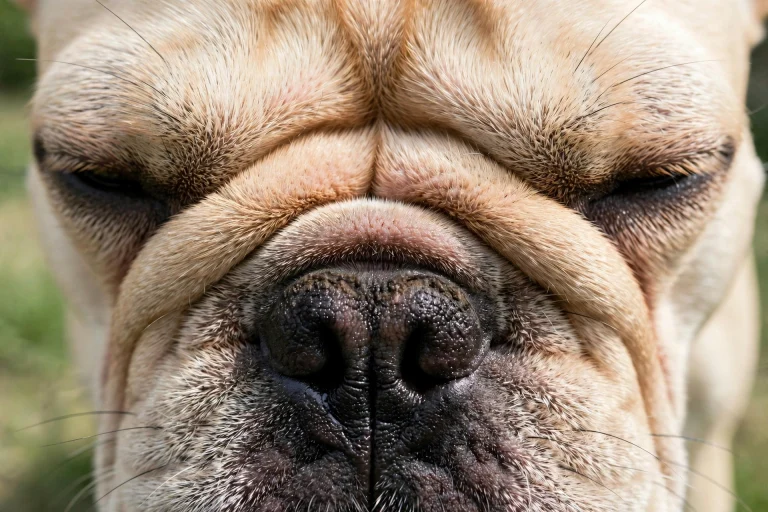
Quick tip: The single biggest predictor of snore volume is how crowded the airway is, and you can see part of it yourself. Look at your Frenchie’s nostrils in good light. Slits instead of open ovals mean narrow nostrils, and dogs with tighter nostrils almost always snore louder.
Normal vs. Not: Decoding Your Frenchie’s Nightly Soundtrack
Not every noise means the same thing. Here is how to read the soundtrack.
| Sound | What it usually means | Worry level |
|---|---|---|
| Soft, rhythmic snoring in deep sleep | Tissue vibration in a crowded airway | Low, typical for the breed |
| Snorts and grumbles when excited or playing | Air forced through narrow nostrils | Low |
| Rapid honking inhales (reverse sneeze) | Irritation spasm, usually passes in under a minute | Low, unless frequent or long |
| High-pitched whistle on the inhale | Air squeezing through a narrowed passage | Schedule a vet visit |
| Gasping, choking, or pauses in breathing | Possible sleep apnea | See a vet promptly |
| Snoring plus nasal discharge or sneezing | Infection, allergy, or foreign body | See a vet promptly |
| Snoring that is new or suddenly much louder | Something changed in the airway | See a vet promptly |
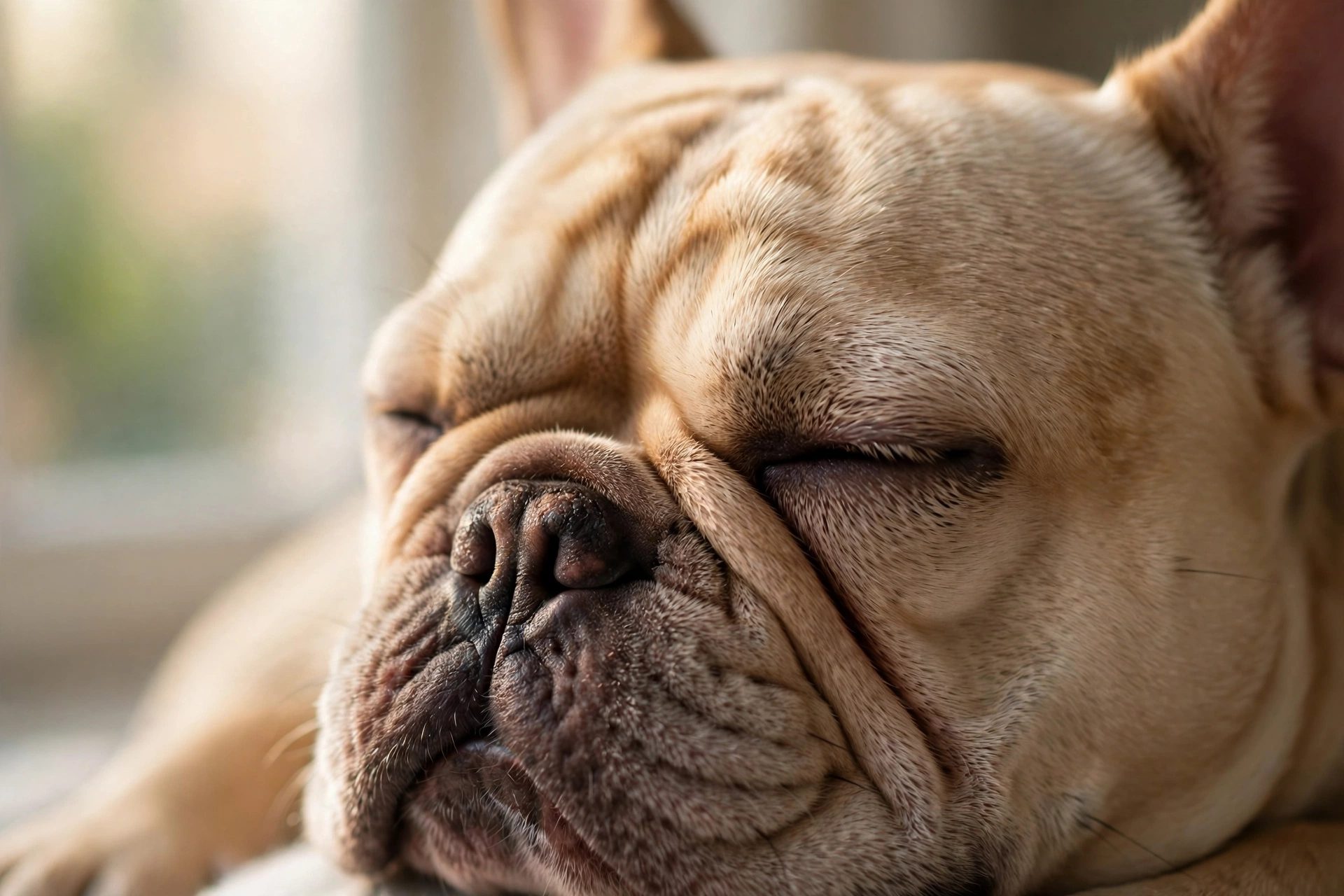
A word on reverse sneezing, because Frenchies do it constantly and it terrifies first-time owners. A reverse sneeze is a burst of rapid snorting inhalations through the nose, often described as honking. It looks dramatic and sounds worse than it is. In a healthy Frenchie it usually passes within a minute, and gently stroking the throat or offering a drink of water often ends it sooner. Film the first episode you see and show it to your vet so they can confirm it is reverse sneezing and not coughing or choking. After that, only worry if episodes get more frequent or longer, if there is discharge or blood from the nose, or if breathing stays noisy between episodes.
Quick tip: Your phone is a diagnostic tool. Record 30 seconds of the snoring that worries you, noting whether your dog was asleep or awake. Vets consistently say video tells them more than any verbal description.
6 Everyday Reasons the Snoring Gets Louder
Anatomy sets the baseline. These six things move the volume knob.
1. Sleeping on the back. When a Frenchie flops onto their back, paws in the air, gravity pulls the soft palate backward across the airway opening. The passage narrows, the vibration intensifies, and the snoring can double in volume. Dogs that sleep curled on their side are consistently quieter.

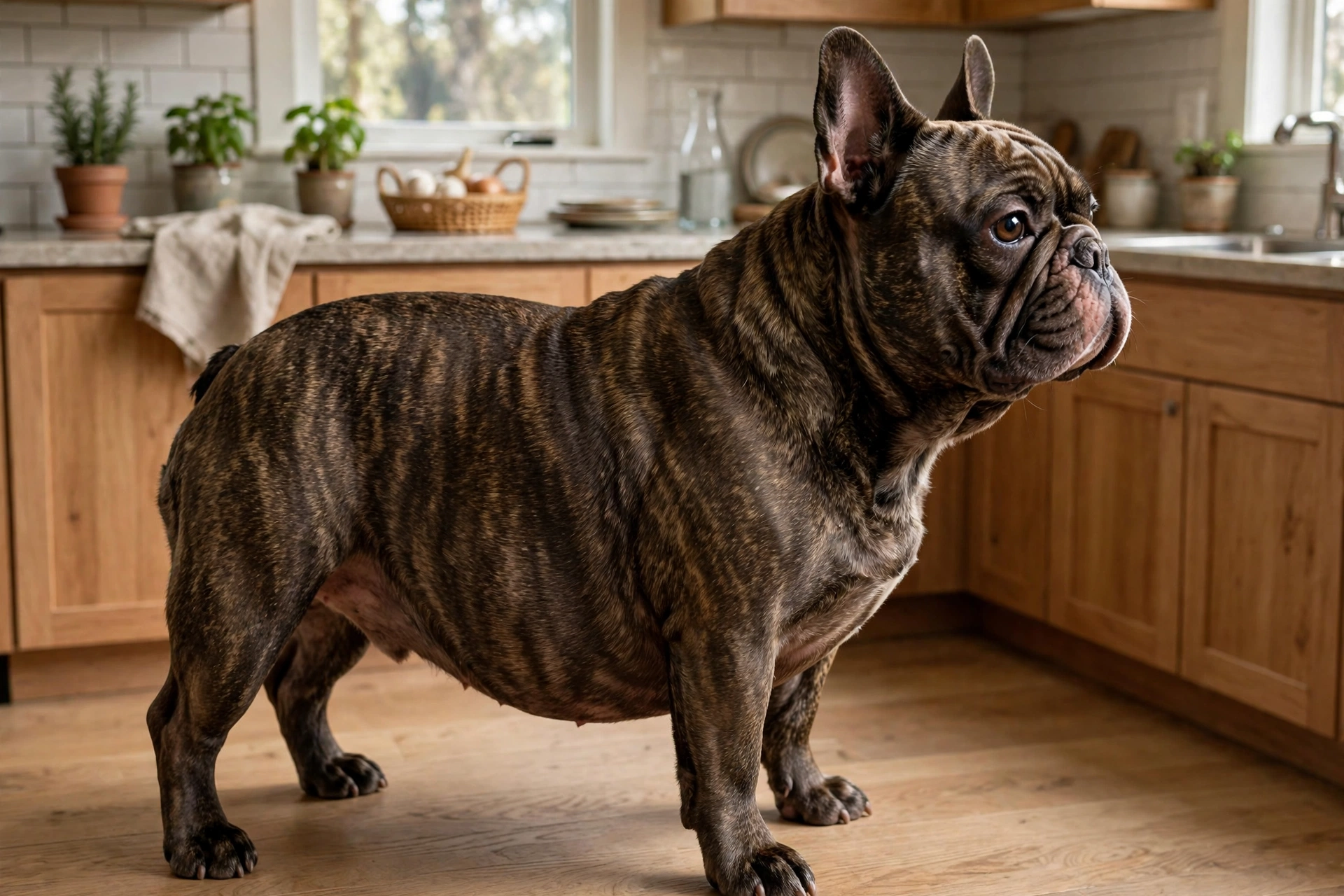
2. Extra weight. Fat does not only collect around the belly. It pads the throat and neck too, pressing inward on an already narrow airway. Veterinary sources list obesity among the top reversible causes of snoring, and the fix is the same advice as everywhere else in Frenchie ownership: you should be able to feel the ribs easily under a thin layer of fat.
3. Allergies and seasonal congestion. Dogs get allergies much like people do, and the result is the same: inflamed, swollen nasal passages that narrow the airway further. Frenchies are a notably allergy-prone breed, so this one hits them twice. If the snoring spikes every spring or after walks through tall grass, and comes with sneezing, watery eyes, itchy paws, or ear scratching, allergies are a strong suspect. Pollen, dust mites, and grass are the usual culprits. A vet can confirm with a workup and discuss management, from antihistamines to environmental changes.
4. Dry air. Winter heating and air conditioning both strip moisture from the air. Dry air irritates the nasal passages, the tissue swells slightly, and the snoring gets harsher. This is the one cause with the simplest fix, covered below.
5. Getting older. Throat muscles lose tone with age in dogs just as in people. A Frenchie that snored politely at three may develop a full freight-train rumble by eight or nine, with no disease involved at all. Senior dogs also tend to sleep more deeply, spending longer in the deep-sleep phases where snoring is loudest. Louder-with-age snoring still deserves a mention at the next checkup, because it can mask a developing problem, and older dogs are also the ones most likely to develop the nasal masses and dental issues that change the sound.
6. Irritants: smoke, dust, strong scents. Cigarette smoke, dusty bedrooms, scented candles, and heavy air fresheners all irritate the airway lining. Frenchies with their narrow passages notice irritants that a Labrador would shrug off. If someone in the house smokes indoors, the dog’s snoring is one more reason to take it outside.
Quick tip: When the snoring suddenly worsens, run the recent-changes checklist before panicking: new detergent on the bedding, heating just switched on for winter, a few extra pounds, or allergy season starting. Most loud phases have a boring explanation.
What Actually Helps: The Quiet-Night Toolkit
You cannot re-engineer the skull. You can engineer the bedroom. These are the fixes with the best effort-to-quiet ratio, roughly in order.
Raise the head. An orthopedic bed with raised edges, or a bed slightly propped at one end, keeps the head elevated and the airway straighter. Owners consistently report this as the single most effective non-medical change. A cool room between 68 and 72 degrees helps too, since overheated dogs pant and snore harder.
Add moisture to the air. A humidifier in the sleeping area keeps the nasal passages from drying out, especially in winter. Moist air soothes irritated tissue and reduces the harsh edge on the snore. Clean it weekly, since a moldy humidifier trades one irritant for another.
Keep the weight in check. This one pays off everywhere: breathing, joints, heat tolerance, and snoring. If the ribs have disappeared under padding, a vet-supervised diet quiets more than the nights.
Switch the collar for a harness. Daytime collar pressure irritates the windpipe, and an irritated airway snores louder at night. A Y-front harness removes the problem at the source.

Checklist: the snore-friendly bedroom
– Orthopedic bed with raised edges, head slightly elevated
– Room cool, 68 to 72 degrees, with decent ventilation
– Humidifier running in dry months, cleaned weekly
– Bedding washed in unscented detergent
– No smoking, heavy candles, or plug-in fresheners in the room
– Fresh water nearby, since snorers wake thirsty
Skip the gimmicks. You will find anti-snore sprays, nose strips, and “silent night” drops marketed for dogs. None of them have credible evidence behind them, and anything sprayed into or around the nose risks irritating the very passages you are trying to calm. Save the money for the humidifier, which actually does something.
The 3-Night Test: Bedroom Problem or Dog Problem?
If you are not sure whether the snoring is just how your Frenchie is or something fixable, run a three-night experiment. Change one thing each night and rate the volume in the morning. Dogs are creatures of habit, so give each change a full night.
Night 1: position. Encourage side sleeping with a bolstered bed, or gently roll your Frenchie onto their side when the back-sleeping rumble starts. Note whether the volume drops.
Night 2: air. Run the humidifier and crack the bedroom door for airflow. If the winter heating is on, this is the night you are most likely to see a change.
Night 3: head elevation. Slide a folded towel under the head end of the bed to create a slight incline, an inch or two at most. A gentle slope keeps the airway straighter all night without your dog sliding downhill.
Score each morning: quieter, same, or louder. If nothing changes across all three nights, the noise is mostly anatomical baseline, and knowing that is useful in itself. If one night is clearly quieter, you have found your lever. Bring the results to your vet along with the videos. “Humidifier night was half the volume” is the kind of concrete detail that helps a vet think clearly about what is going on.
Quick tip: Keep a running note on your phone: date, what you changed, snore rating out of 10. Three lines of data beat three weeks of vague impressions, and it takes ten seconds at breakfast.
When Loud Snoring Means Call the Vet
Most loud snoring is a management problem. Some of it is a medical problem wearing a familiar costume. Call your vet promptly if you notice any of these.
- Pauses in breathing, gasping, or choking sounds during sleep. This is the big one. Researchers at the University of Helsinki found that brachycephalic dogs suffer sleep-disordered breathing events resembling human obstructive sleep apnea, at far higher rates than long-nosed dogs (University of Helsinki, Faculty of Veterinary Medicine). Cambridge’s BOAS clinic describes the resulting apnea as life-threatening (Cambridge Veterinary School). If your dog stops breathing for seconds at a time, then gasps, do not wait.
- Snoring while awake. Snoring that continues when the dog is awake, or appears during exercise, excitement, or heat, is abnormal and needs veterinary attention (Vetster).
- Snoring that is new or suddenly much louder. A dog that slept quietly for years and now rattles the windows has had something change: weight gain, infection, allergy, or a developing obstruction (VCA Hospitals).
- Nasal discharge, especially from one nostril or with blood. This can signal infection, a foreign body like a grass seed, or in older dogs a nasal mass.
- Blue or grey gums, or fainting. These are emergency signs of oxygen deprivation. Go now, not tomorrow.
- Daytime exhaustion or exercise intolerance. A dog that is wiped out all day may not be sleeping well at night. Poor sleep from apnea feeds a cycle of fatigue.
If several of these sound familiar, the snoring is probably a symptom of something structural rather than a quirk. Our BOAS guide walks through the full medical picture: what the condition is, how vets grade it, and what can be done.

Do this, not that:
– Do film the concerning sounds and bring the video to the appointment. Do not try to describe “a sort of honk-gurgle” from memory.
– Do mention when the change started and what else changed (weight, season, new home). Do not wait months to see if it resolves on its own.
– Do ask specifically whether the airway should be graded. Do not accept “that’s just how Frenchies sound” as a full answer if you are worried.
Frequently Asked Questions
Quick answers to the questions Frenchie owners ask most about snoring.
Do all French Bulldogs snore? Essentially yes. Every Frenchie snores to some degree because of the breed’s airway anatomy. The only common exception is a dog that has had surgical correction to widen the nostrils or shorten the soft palate. Volume varies enormously between individuals, which is why “is mine normal” is such a common question. If you have ever wondered whether your Frenchie is unusually loud compared to others, the answer is probably that you simply notice it more at 2 AM.
Why does my Frenchie snore louder on his back? Gravity. On the back, the soft palate flops backward and partially covers the airway opening, so the same breath vibrates more tissue. Side sleeping keeps the passage straighter and is measurably quieter. A bed with raised edges encourages side sleeping.
Is reverse sneezing the same as snoring? No. Snoring is tissue vibrating during sleep breathing. Reverse sneezing is a burst of rapid, forceful inhalations through the nose while awake, sounding like honking. It looks alarming but is usually harmless and passes within a minute. See a vet if episodes become frequent, last several minutes, or come with nasal discharge.
Can a humidifier really help my Frenchie snore less? Yes, particularly in dry climates and heated winter homes. Moist air soothes the nasal passages and reduces the swelling that makes snoring harsher. It will not fix structural narrowing, but owners often notice a real difference in the harshness of the snore.
Will my French Bulldog ever stop snoring? The baseline breed noise stays for life. What changes is the volume: weight control, sleeping position, and bedroom air can take a freight train down to background hum. The only thing that changes the anatomy itself is surgery to widen the nostrils or shorten the soft palate, which our BOAS guide covers in full.
Should I wake my dog up when the snoring gets really loud? Do not startle a deeply sleeping dog, but do pay attention. If the loud phase includes pauses in breathing or gasping, gently rouse them, watch the next few minutes of sleep, and film it. That video is exactly what your vet needs to see.
Final Word
So, why does my French bulldog snore so loud? Because a flat face and a full set of throat tissue make every sleeping breath a small vibration concert. Most of it is harmless breed background noise, and the fixes in this article quiet the worst of it. But snoring is also the earliest, easiest-to-ignore signal of airway trouble, so learn your dog’s normal and act fast when it changes.
Film the sounds that worry you, keep the bedroom cool and the weight honest, and bring questions to your vet instead of the internet at 2 AM. Your Frenchie will keep snoring. With any luck, so will you.