French Bulldog Potty Training Schedule: Step-by-Step Daily Routine
A puddle by the back door at 6 a.m. tells you the truth about potty training. Your Frenchie puppy is not being difficult. He simply needs to go, and he needs a routine that gets him outside before the urge wins. This french bulldog potty training schedule gives you that routine, hour by hour in the early weeks and age by age as the gaps stretch. For the wider training picture, from first cues to alone time, see the broader French Bulldog training guide. This article stays on one job. It tells you when to go out, what to do on the trip, and how to adjust the plan as your puppy grows. Still wondering whether Frenchies are actually harder to potty train than other breeds? The honest answer is in Are French Bulldogs Hard to Potty Train? Honest Answer & Fixes.
How Long Can a Frenchie Puppy Hold It?
The American Kennel Club publishes two versions of the same guideline, and the difference matters. One version says puppies can generally hold their bladder for about as many hours as their age in months, plus one. A 4-month-old puppy may therefore manage up to five hours. The other version drops the extra hour. It says puppies can generally hold it for approximately the same number of hours as their age in months, up to about 9 months to 1 year of age. A 6-month-old puppy may manage around six hours on that version.
Read both together and the lesson is plain. These figures are a ceiling, never a target. They describe the longest gap to plan around, not the gap to aim for during a busy day. Use the shorter interval in practice. That advice matters even more for a small, compact breed. The AKC says very young puppies and toy breeds should be offered a potty break every hour whenever possible. It also notes that housetraining complaints are common among owners of toy breeds, where small dogs may need additional patience and close management. French Bulldogs are a small breed, so plan on the frequent end of every range here. That is small-breed guidance applied to Frenchies, not a Frenchie-specific study, and no verified Frenchie-only hours-held figure exists.
UC Davis School of Veterinary Medicine gives a different kind of number, and it pairs well with the AKC ceiling. Instead of hours held, UC Davis lists elimination breaks per day.
| Puppy age | Breaks per day |
|---|---|
| 6 to 14 weeks | 8 to 10 |
| 14 to 20 weeks | 6 to 8 |
| 20 to 30 weeks | 4 to 6 |
| 30 weeks and older | 3 to 4 |
UC Davis adds that the number of hours puppies can delay elimination is strongly linked to age, and that puppies lack adult bladder-muscle development. For an adult dog, the ASPCA says healthy adults can be expected to hold it for no more than 8 to 9 hours, and longer absences need a dog walker. Never present 8 to 9 hours as a daily goal. UC Davis tells you how many trips to expect in a day. The AKC guideline tells you the longest gap to plan around between them. Do not blend them into one invented table. Excitement, drinking, play, and illness shorten every figure. A puppy who just ate, woke up, or finished playing needs to go now, whatever the clock says.
Quick tip: The ceiling tells you when you must go out at the latest. The triggers in the next section tell you when you should go out in real life, and they almost always come first.
The Trigger List to Memorise
Potty training should begin the day the puppy comes home. Most puppies arrive at around 8 weeks old, when bladder control is at its weakest, and need frequent trips outside. Take your puppy out first thing in the morning, last thing at night, after naps, after time in a crate, after meals, after drinking water, after chewing toys or bones, and after indoor play sessions. Depending on age, that can mean a dozen or more trips a day.
Feeding drives much of that rhythm. The AKC says a puppy’s feeding routine plays an important role in bathroom habits, and most puppies do best with several smaller meals rather than one or two large ones. Loose, bulky, or unusually foul stools, or overfeeding causing diarrhoea, make housetraining considerably harder, and that is a vet conversation. UC Davis puts it simply. Have a feeding schedule in which elimination breaks follow eating and drinking. As a general pattern, not as a directly verified AKC quote, secondary summaries describe 4 meals a day at 6 to 12 weeks, 3 meals a day at 3 to 6 months, and 2 meals a day at 6 to 12 months.
Watch for your own puppy’s interval in week one. Trainers often report that puppies need to go in the 5 to 30 minutes after eating, and one vet-clinic handout gives 5 to 10 minutes after drinking. Treat those ranges as a typical pattern to watch for, not a veterinary rule. The safe, verified phrasing is the UC Davis one: a break follows eating and drinking.
Signals matter as much as the schedule. The AKC lists sniffing the ground, circling, suddenly stopping play, whining or scratching at a door, and becoming restless. Its daily-habits guide adds hunching the back, squatting, and suddenly wandering away from activity. The ASPCA adds walking with stiff back legs. Interrupt any of these with a calm clap or a quiet “uh oh” and take the puppy outside quickly. UC Davis warns against free access to the house without direct supervision, and adds a detail owners miss. Be especially aware in the evenings if the puppy seems to be going to sleep. He may be sneaking off to eliminate. Small size makes supervision harder. A Frenchie puppy sits low to the ground, and an owner can miss a quick squat behind a chair leg. That is a supervision tip for small dogs generally, not a breed statistic.
Checklist: every potty trip, every time
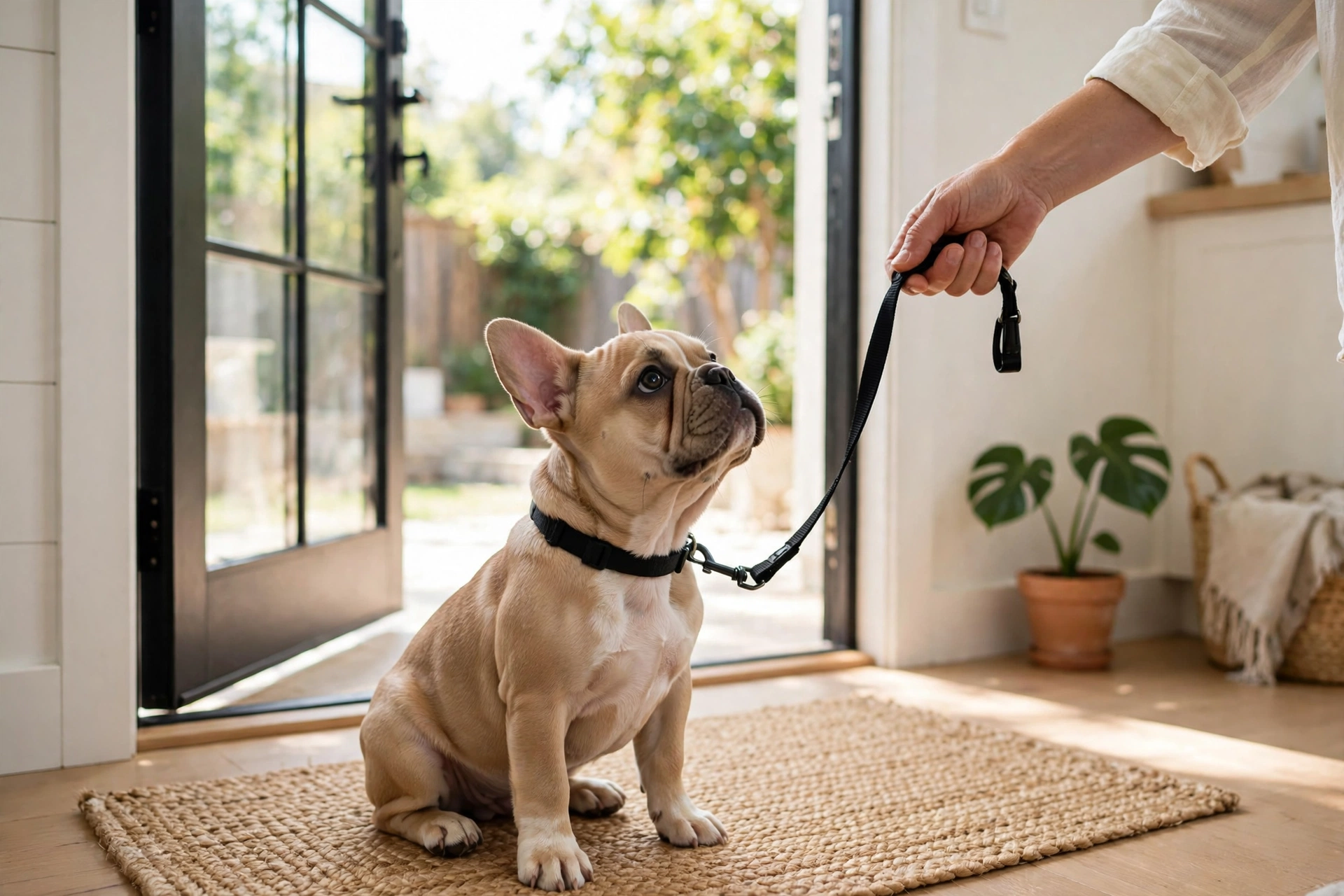
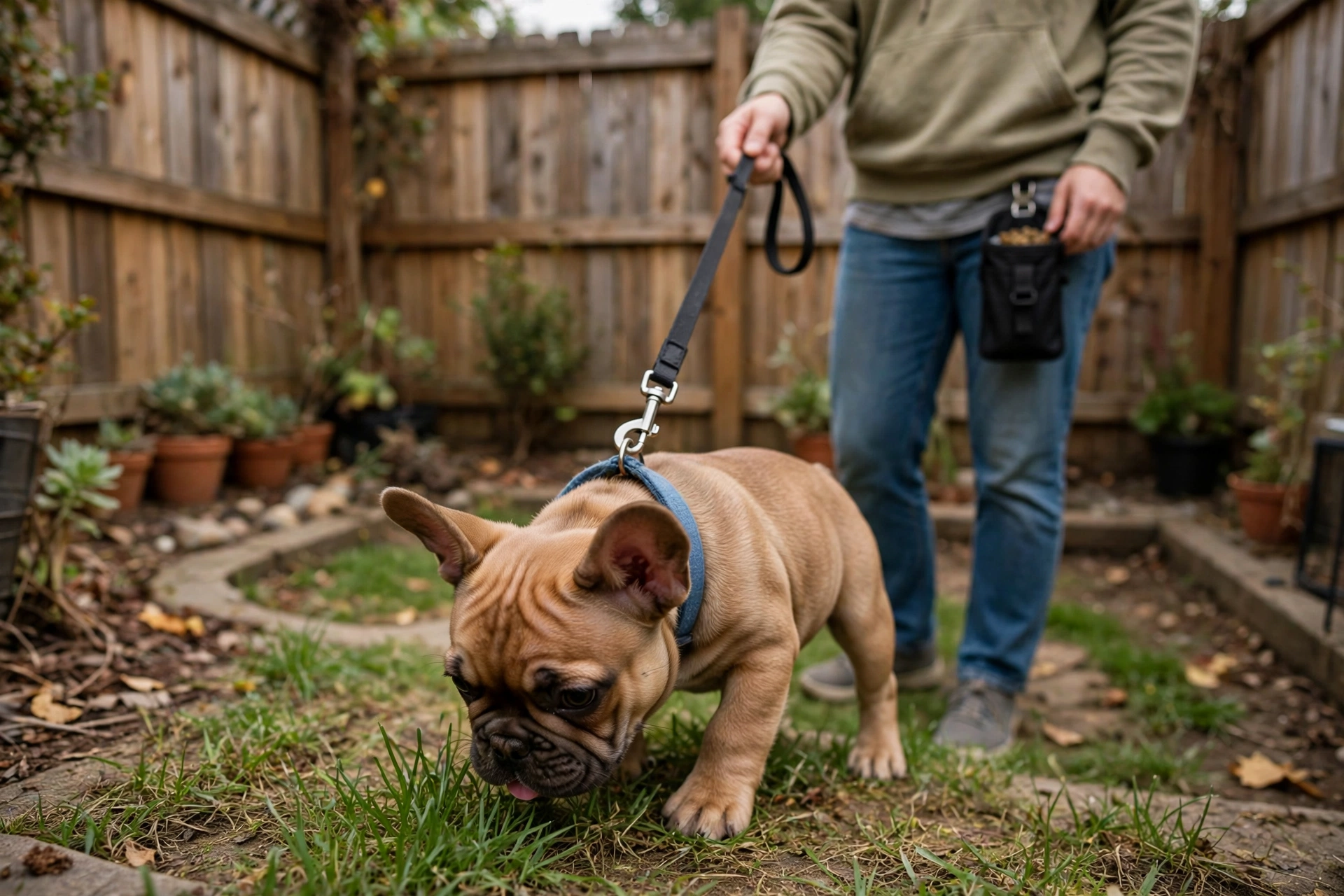
– Go on leash, even in a fenced yard, and walk directly to the same designated spot
– Use one consistent cue, such as “go potty”, and stay boring until he eliminates
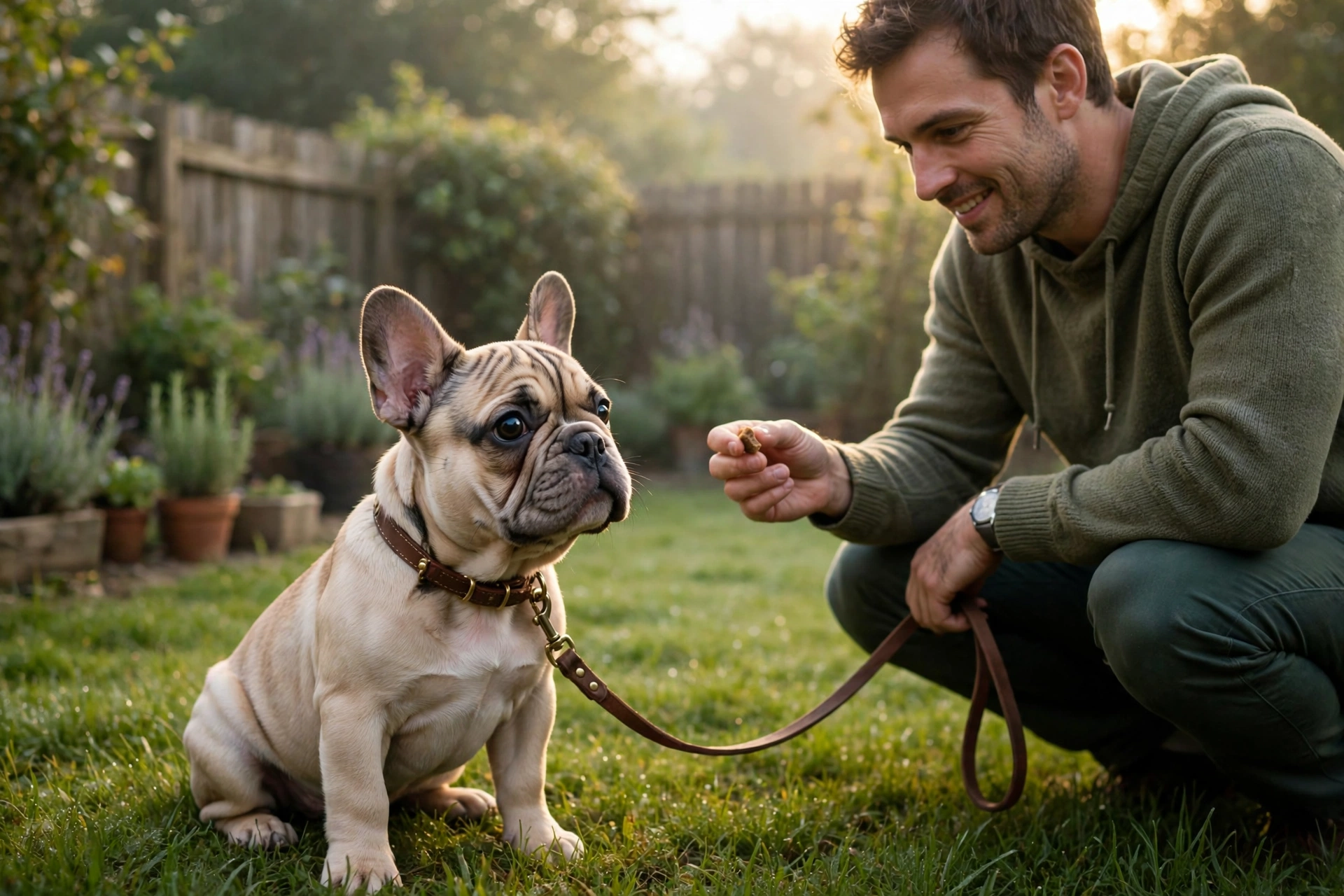
– Give at least five minutes, then reward immediately with a treat and enthusiastic praise when he finishes
– Do not rush straight back inside and end the fun, or he may learn to hold it to prolong the walk
The lingering scent of previous visits helps cue the spot, which is why the same patch of grass beats a new patch every time. Play comes after elimination, not before it. If he does not go within five minutes, the ASPCA advises confining him for 15 minutes and trying again, rather than giving him free roam.
Your French Bulldog Potty Training Schedule by Age
The clock times below are an illustrative template assembled from the verified trigger list, not vet-prescribed clock times. Shift these times to fit your day. Keep the order and the triggers, not the exact hours.
A young puppy day, 8 to 12 weeks
| Time | What happens |
|---|---|
| 7:00 a.m. | Wake up, then straight outside to the potty spot, on leash, same spot, cue word. Reward immediately. |
| 7:15 a.m. | Breakfast at a set meal time. Remove food between meals. |
| About 7:30 a.m. | Outside again after the meal. Supervised free play only after elimination. |
| Morning, hourly | Cycle: supervised play or training, then outside, then a nap in the crate or pen, then straight outside on waking. Any sniffing, circling, or restlessness means outside at once. |
| About 12:00 p.m. | Lunch, then outside after the meal. |
| Afternoon | The same play, outside, nap, outside cycle. If nobody can supervise, use a crate for a short spell or a pen. Never allow unsupervised free roam. |
| About 5:00 p.m. | Dinner, the last main meal, then outside after the meal. |
| Evening | Calm play, then outside. Avoid a big drink and play surge right before bed. |
| About 10:00 p.m. | Last potty trip before bed. Crate in the bedroom so crying is heard. |
| Overnight | One or two scheduled or cried-for breaks. Keep them boring. |
That hourly cycle surprises new owners, and it should not. UC Davis puts the youngest band at 8 to 10 trips a day, and that total includes overnight trips. The AKC says to offer a break every hour when possible for very young puppies.
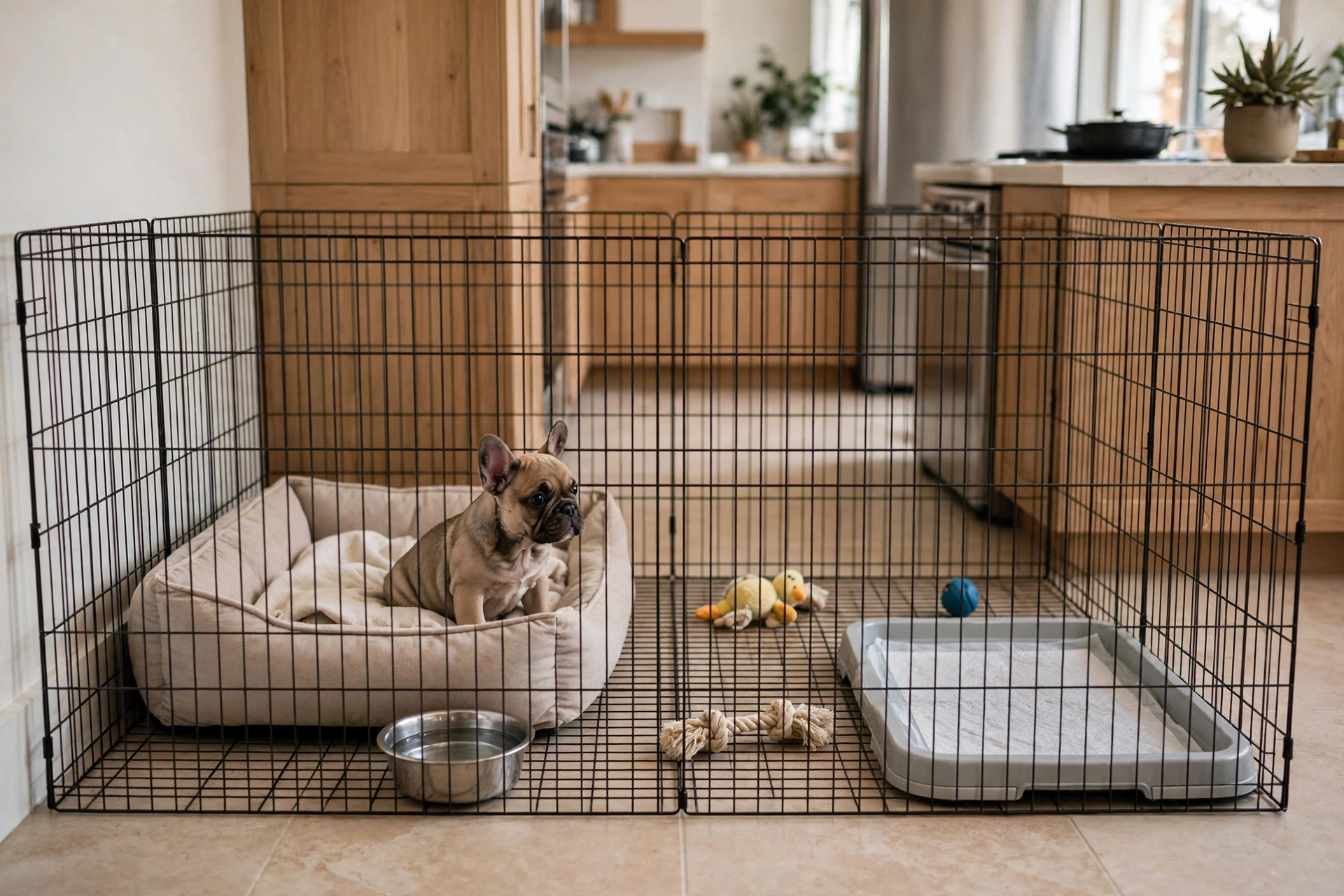
A workday needs its own version, because a schedule that assumes someone is home all day will fail many readers. The AKC explicitly suggests arranging a trusted friend, neighbour, or dog walker if your schedule makes a dozen trips difficult. For an 8 to 12 week puppy left alone, the honest options are midday walker or sitter visits, or a pen setup with a bed, water, and a potty area kept apart. Do not crate an 8 week puppy for a full working day. A pen with a potty area is management, not housetraining, so plan the transition later.
Quick tip: Set your phone alarm for the next trip, not for the last accident. A schedule that runs ahead of the puppy prevents far more mess than a schedule that reacts to it.
An older puppy day, 4 to 6 months
By 4 to 6 months, the day stretches. UC Davis drops the count to 6 to 8 trips a day at 14 to 20 weeks, then 4 to 6 trips a day at 20 to 30 weeks. The AKC ceiling stretches too. A 4-month-old may manage up to five hours on the months-plus-one version, or about four hours on the months-only version. A 5 to 6 month puppy sits around six to seven hours on the longer version, or five to six hours on the shorter one. Use the shorter figure when you plan, and remember that gaps lengthen between triggers, not instead of them.
| Time | What happens |
|---|---|
| 7:00 a.m. | Wake up, then outside immediately. |
| 7:15 a.m. | Breakfast, then outside after the meal. |
| Morning | Supervised play or training, then outside after play. Crate or pen for naps and unsupervised spells, then outside on waking. Gaps of 2 to 3 hours between scheduled trips are now realistic between triggers. |
| About 12:00 p.m. | Lunch, if still on 3 meals, then outside after the meal. |
| Afternoon | The same cycle, with longer gaps. Begin testing short supervised freedom in one room after a successful potty trip. |
| About 5:00 p.m. | Dinner, then outside after the meal. |
| Evening | A calm period, then a last potty trip before bed. |
| Overnight | Usually no scheduled break by this stage for many puppies. Respond if the puppy cries or grows restless, and log it. |
What changes is worth stating plainly. Meals drop from 3 or 4 a day toward 2 or 3. Gaps between scheduled trips lengthen. Overnight breaks fade out. Supervised freedom expands. What does not change is the trigger list. Waking, meals, play, crate exit, and bedtime still mean a trip, at 5 months just as they did at 9 weeks.
Keep outdoor trips short and purposeful in heat. Frenchies are heat-sensitive, and a potty trip in summer is not the time for a long, panting wander around the block. Go to the spot, let him eliminate, reward him, and head back to shade and water. Our French Bulldog heat stroke guide covers warning signs in full, and our BOAS guide explains the breathing anatomy behind that caution.
Do this, not that:
– Do stretch the gap between scheduled trips as the puppy grows. Do not stretch past a trigger, such as a meal or a play session, to protect a tidy timetable.
– Do celebrate a dry crate in the morning. Do not read one dry night as proof that daytime trips can now be skipped.
Crate, Pen, or Tether: Choose by Your Day
No single setup wins for every household. The right choice depends on how long you are away, whether you have a yard, and how old your puppy is. What ties all three options together is one rule. At every transition, the next event is a potty trip. Crate to out, pen to out, nap to out, play to out. Missed transitions are where most accidents happen, because the puppy was ready and nobody moved.
| Setup | Schedule role | When it fits | Warning |
|---|---|---|---|
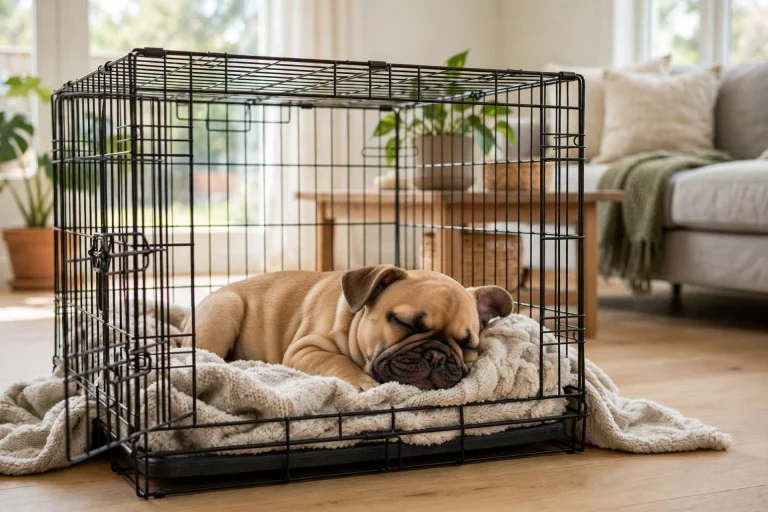
| Crate, correctly sized, with a divider as the puppy grows | Default confinement when unsupervised. Dogs prefer not to soil their sleeping area, so every crate exit becomes an immediate outside trip. | Nights, short unsupervised spells, naps. | Never longer than the puppy can comfortably hold it. Crate soiling usually means the interval was too long or the crate is too large. Never use the crate as punishment. |
| Exercise pen or puppy-proofed room | Confinement with a separate potty area away from bed, food, and water. | Workdays, absences, apartment owners, pad-transition plans. | This is management, not housetraining. It prevents accidents but does not teach holding. Plan the transition to outdoor-only elimination. |
| Tether, leash to your waist | Supervision method when the puppy is out of confinement but not yet trustworthy. | Active supervision hours, especially the first weeks. | This is a supervision tool, not confinement. You must still watch for signals and go out immediately. |
Size the crate by the AKC principle, not by a blog inch figure. It should be large enough for the puppy to stand, turn around, and lie down comfortably, but not so large that he can go potty in one corner and rest in another. Many crates include adjustable partitions, so one crate can grow with the puppy. UC Davis advises making the confined area appealing, with toys, food, and bedding, so it becomes a den the puppy prefers not to soil. Expand that den area gradually.
The ASPCA gives a useful rule for longer absences, with a distinction that matters. Use a crate for short periods, up to four hours for an adult dog. When you must leave a dog for more than four hours, set up a small area instead, such as an exercise pen for a smaller dog, including a crate with a bed, food-dispensing toys and water, plus a place to eliminate, ideally in an easy-to-clean room such as a kitchen or bathroom. That four-hour figure is for an adult dog, not a puppy.
Apartment owners face a real fork in the road. One path is outdoor-first, with a pen used only for short absences and a walker for longer ones. The other path starts with pads or fake grass in the pen, then transitions outside. The AKC warns that pads can sometimes slow the transition to outdoor elimination, and its Dr. Burch puts the problem plainly. You are reinforcing two different options for the puppy. The second path needs a transition plan. Move the pad toward the door, then just outside the door, then to the outdoor spot.
Checklist: setting up for day one
– One designated outdoor spot, used every time, with the scent of previous visits to cue it
– One cue word, used by everyone in the household, with treats kept by the door
– A correctly sized crate or pen, with bedding, water, and a chew, ready before the puppy arrives
– An enzymatic cleaner in the house before the first accident, not after it
– A walker, neighbour, or sitter booked for any workday gap longer than your puppy can hold
Overnight Training Without the Guesswork
The AKC daily-habits guide says its months-plus-one guideline applies day and night. Until your puppy can sleep through the night without needing a bathroom break, expect some early-morning or overnight trips outside. That sentence is the planning rule, and it stays in force even when nights start to feel easier.
No verified single age exists for sleeping through the night, and this article will not invent one. The AKC pages checked for this guide do not state a sleep-through age. What owners typically report, from secondary guides rather than veterinary primary sources, is a range. Puppies at 8 to 10 weeks typically need 1 to 2 night trips. By 3 to 4 months, many manage most of the night. By 5 to 6 months, most sleep through. Treat that range as typical and variable, not as a milestone your puppy has missed if he wakes at 5 months. Small breeds tend to need the longer end of the range.
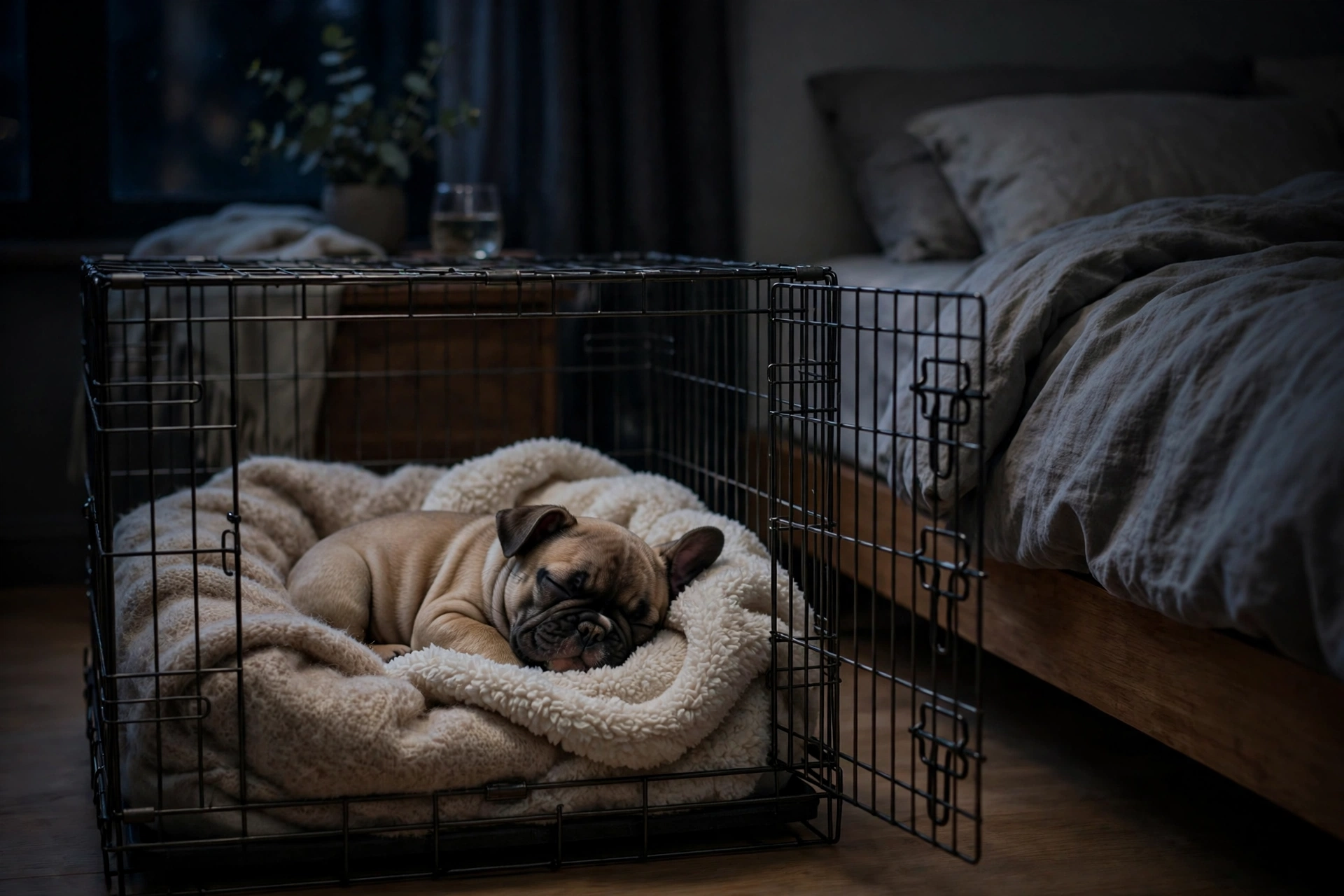
A practical test, framed as owner experience rather than a veterinary rule, helps decide when to try an uninterrupted night. Try it when daytime gaps of 6 or more hours are comfortable, crate accidents have stopped, and the puppy is not waking restless. Even then, keep the crate in the bedroom and respond to crying for the first nights. The ASPCA advises crating in the bedroom at night because dogs are social, isolation can cause stress and anxiety, and proximity lets you hear crying if the puppy needs the bathroom.
Run the overnight routine the same way every night.
- Last meal and last big drink well before bed, with a last potty trip as late as feasible before bed. Avoid a big drink and play surge right before bed. Do not restrict water for a puppy, and do not pick a water-removal hour as a rule.
- Crate in the bedroom, correctly sized, with bedding he already likes.
- Night waking means a boring potty trip only. Leash, same spot, cue, calm praise or a small treat, straight back to the crate. No play, no feeding, no extended cuddling. The AKC advises a small high-value reward or calm praise overnight, and warns against energetic play that leaves the puppy fully awake.
- If the puppy cries, assume a potty need first, especially under about 4 months. Respond promptly to crate signals such as whining, scratching, and restlessness, because responding strengthens the hold-it, then go-outside connection.
- If night accidents persist or restart after a dry stretch, check the routine before blaming the puppy. Was the last trip late enough, and did he actually eliminate on it? Is the crate the right size? If the pattern comes with straining, a frequency change, or blood, see the vet section first.
Many owners find nights stretch sooner than daytime gaps. The honest framing for that observation is owner experience, not a verified fact. Overnight, the puppy is not eating, drinking, or playing, so the bladder fills more slowly than during a busy afternoon. Night success does not equal day success. A puppy who sleeps through at 4 months may still need a daytime trip every 2 to 3 hours.
Quick tip: Keep night trips dark, quiet, and dull. Lights low, voice low, leash on, spot, praise, crate. A night trip that feels like a party teaches the puppy to wake up for the party.
Accidents: The Two-Branch Flow
Accidents will happen and should be expected. UC Davis says so directly, and that sentence deserves to be believed. An accident is information about the schedule, not a verdict on the puppy. Follow two branches, depending on when you find the mess.
Branch A, you catch the puppy in the act. Interrupt calmly with a hand clap or a calm “uh oh”, as the ASPCA advises, or calmly pick the puppy up and move him outside immediately, as the AKC advises. Do not yell, chase, or scold. Take him outside immediately to the designated spot. If he finishes outside, reward generously. If he does not finish, confine him briefly, 15 minutes on the ASPCA advice, then try again, rather than giving him free roam.
Branch B, you find it after the fact. Do nothing to the puppy. No scolding, no nose-rubbing, no showing him the mess. UC Davis is explicit. Do not punish your puppy after you find it, and do not punish verbally or physically, for example by hitting with a rolled-up newspaper or rubbing his nose in his mess. That approach is ineffective and may lead to further and more serious behavioural problems. The AKC warns that punishing can create confusion, damage trust, and make some dogs reluctant to eliminate in front of people, or teach them to hide when they need to go. The ASPCA makes the same point. A dog punished for eliminating in an undesired location may become afraid to eliminate in front of you.
Then clean, and clean properly. Use an enzymatic or odour-neutralising cleaner. All three authority sources agree on this point. The AKC notes that lingering scents can attract the puppy back to the same spot, because dogs return to areas that still smell like previous accidents. Regular soap or scented spray is not enough, because a nose far better than yours can still find the old spot.
Finally, diagnose the schedule gap, not the puppy. Was the interval too long? Was a trigger missed, such as a post-meal, post-nap, or post-play trip? Was the puppy unsupervised in a new room? Was the last outdoor trip too rushed for the puppy to fully empty? Tighten that one thing next time. A one-week log, with time, trigger, location, and last meal, drink, or play, is the fastest way to find a puppy’s personal pattern.

Do this, not that:
– Do interrupt calmly, redirect outside, and reward a finish in the right spot. Do not scold, chase, or punish after the fact.
– Do clean with an enzymatic cleaner and fix the schedule gap. Do not leave the puppy outside unsupervised as a solution, because you miss the praise moment.
– Do keep the diet steady. Do not make abrupt diet changes unless your vet instructs it, because loose stools undo a good schedule fast.
Regression and Readiness for Freedom
Regression feels personal. A puppy who was dry for weeks suddenly wets the rug, and the owner wonders what went wrong. Often, the answer is freedom, not character. The AKC asks why puppies start having accidents after getting more freedom. Many owners expand access to the home too quickly. Even when a puppy appears to understand expectations, continue following the routine and supervision plan until the behaviour is firmly established.
Trainer sources report common regression windows, and they disagree on the edges, so treat them as ranges, not veterinary milestones. One window sits around 4 to 6 months, often when freedom expands and distraction increases. A second window sits in adolescence, roughly 6 to 18 months in one source, 7 to 14 months in another, and up to 24 months for some dogs in a third. Common non-medical triggers include a routine change, a house move, a new pet or person, a diet change, a schedule slip, too much freedom too soon, missed signals, and fear periods. Excitement or submissive urination, where a puppy leaks on greeting, is a separate issue from housetraining. A puppy leaking on greeting is not a schedule failure.
Run this reset plan in order when regression hits.
- Rule out medical causes first if the change was sudden, or comes with a frequency or urgency change, straining, blood, diarrhoea, a thirst change, or lethargy. Dogs who remain difficult to housetrain despite consistent training should receive a veterinary evaluation.
- Return to the young-puppy schedule. Trigger-based trips, crate or pen when unsupervised, same spot, immediate reward. Secondary guides describe this reset lasting 1 to 3 weeks. Present that as a practical reset plan, not a guaranteed timeline.
- Shrink freedom back to the last level that was accident-free, then re-expand one room at a time.
- Re-clean all accident spots with enzymatic cleaner, because odour is a repeat trigger.
- Check the boring causes before assuming adolescence. Interval too long, missed post-play trip, diet change, new schedule, walker or sitter inconsistency.
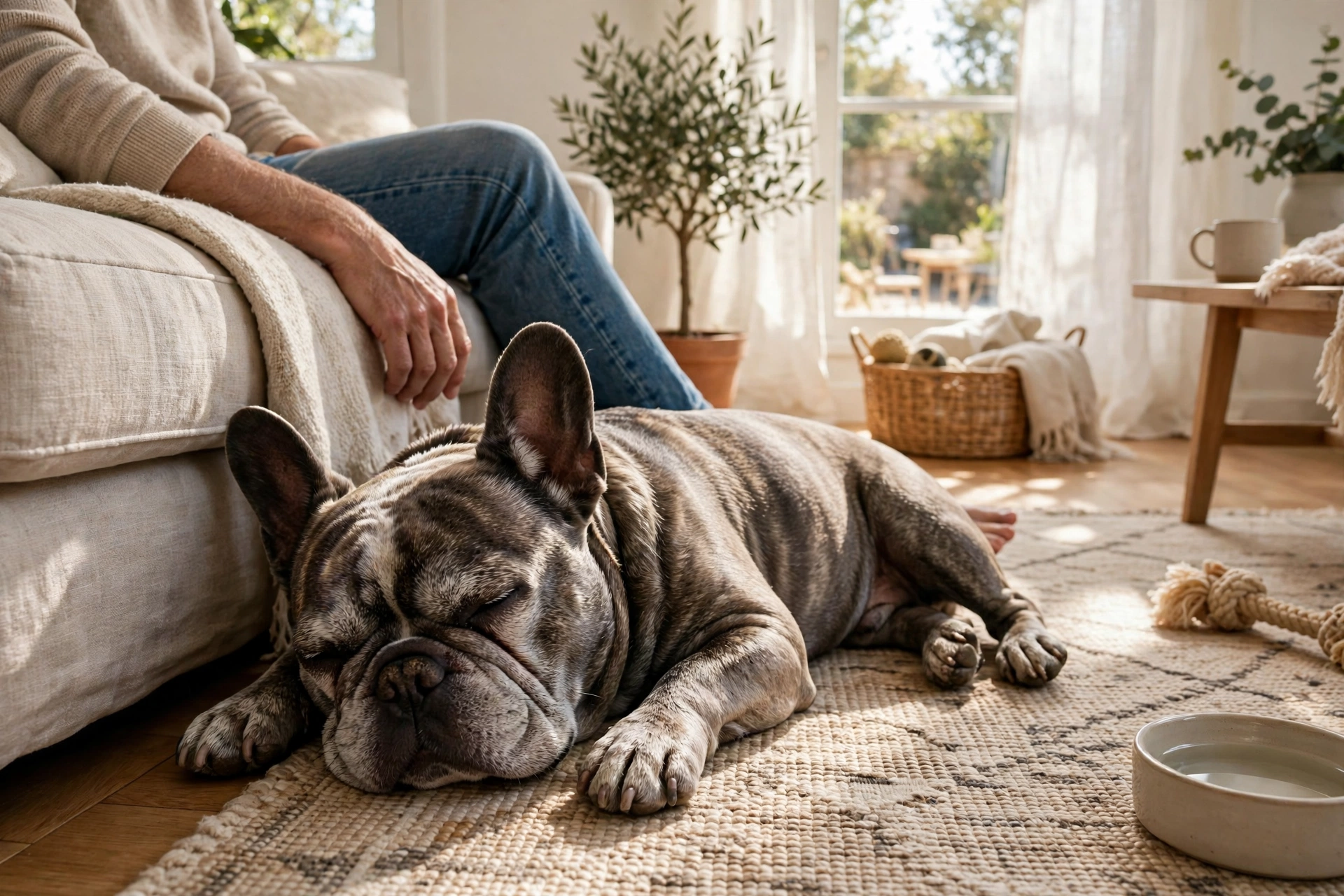
Freedom is earned in steps, and the signs of readiness are observable. The puppy consistently signals, by going to the door, barking, whining, or sitting by the door. The AKC notes reliable signalling as the point where close supervision becomes less essential. He reliably eliminates in the designated spot and can be trusted through a full routine cycle, from wake to meal to play to nap, without accidents. The crate and pen stay dry, including overnight. He has been reliable while following the routine, which is different from appearing to understand it.
Expand one small area at a time, as UC Davis advises. Start with short supervised free time after a successful outdoor elimination, then lengthen it. Older ASPCA guidance, via secondary summary, describes starting with about 15 to 20 minutes of supervised free time after a successful trip. Label that minute figure as a practical starting point, not an ASPCA rule. Freedom follows a successful potty trip, never precedes it. A new room means supervised, short, and ending back in the crate or pen, or with another potty trip. Any accident in the new area means stepping back one level, not punishment. Many owners use a stretch of accident-free weeks as their own test for the next step. That is an editorial rule of thumb, not an AKC, ASPCA, or UC Davis rule.
Checklist: ready for the next room?
– The puppy signals at the door, rather than wandering off to a quiet corner
– He eliminates in the designated spot, promptly, without a long search
– The crate and pen have stayed dry, including overnight
– He has handled a full wake, meal, play, and nap cycle without an accident
– You can supervise the new room, and you have a potty trip booked straight after it
Troubleshooting the Usual Accidents
Most accidents fit a pattern, and patterns have fixes. Use this table as a quick check before you change the whole schedule. One fix at a time works better than five changes at once, because you need to know which change helped.
| Accident pattern | Likely cause | Fix |
|---|---|---|
| After meals | No post-meal trip, or the trip was too rushed | Go out after every meal, give at least five minutes, and reward a finish |
| After play | Excitement and movement filled the bladder fast | Treat play as a trigger, and go out the moment play ends |
| In the crate | Interval too long, crate too large, or a rescue history of long confinement without a chance to go | Shorten the interval, check the divider, and never use the crate as punishment |
| In the same spot | Residual odour is drawing the puppy back | Clean thoroughly with an enzymatic cleaner and block the spot until it is dry |
| At night | Last trip too early, or the puppy did not fully eliminate on it | Move the last trip later, keep it boring, and respond to crying as a potty need first |
| After a dry stretch | Freedom expanded too fast, a routine change, or a medical cause | Step back one freedom level, check the boring causes, and see a vet if the change was sudden |
Crate soiling is usually a schedule or sizing problem, not defiance. For rescue dogs, the AKC notes a separate history. Prior long confinement without a chance to go can leave a dog who soils a crate because that was once his only option. That dog needs patience and shorter intervals, not a longer crate stay.
Quick tip: Change one variable, watch for three days, then judge. Changing meals, freedom, and trip timing on the same day tells you nothing about which change worked.
When to Call the Vet
Most housetraining problems are schedule problems, and this article has treated them that way. Some are not, and knowing the difference protects your puppy. The AKC advises that dogs who remain difficult to housetrain despite consistent training should receive a veterinary evaluation. If the vet rules out health concerns, an experienced trainer or behaviourist is the next step. UC Davis adds a warning that gives that advice weight. Incomplete housetraining is a primary cause of housesoiling as an adult dog. Finishing the schedule properly matters, not just starting it.
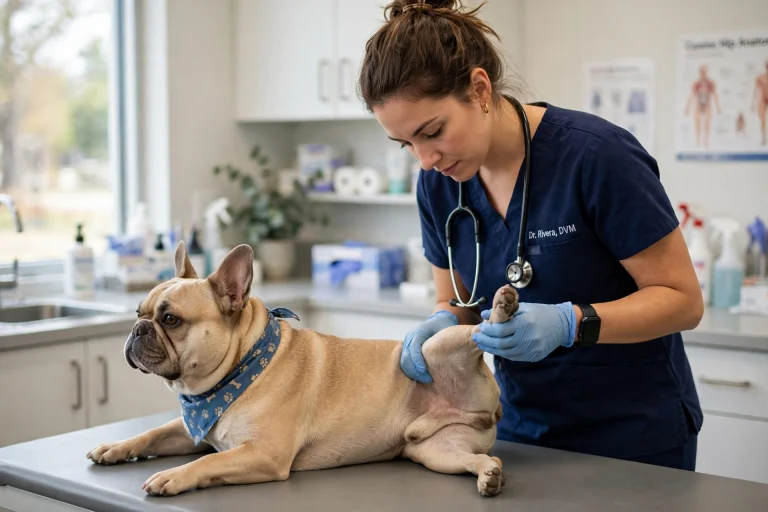
See a vet promptly for a sudden increase in frequency or urgency, straining, blood in urine, diarrhoea, unusual thirst, lethargy, or a previously reliable puppy suddenly regressing with any of those signs. This article offers no diagnoses. Frame the visit as ruling out a medical cause first, then returning to the schedule with a clean bill of health. Bring your one-week log if you kept one. For the wider picture of Frenchie health, see our French Bulldog health problems guide. If you are still choosing a puppy, our complete French Bulldog owner’s guide covers the first weeks at home in broader terms.
Do this, not that:
– Do book a vet visit for a sudden change plus urinary signs. Do not wait out blood, straining, or lethargy to see if the schedule fixes itself.
– Do return to the young-puppy schedule after a clean vet check. Do not punish a puppy who may have been unable to hold it.
Frequently Asked Questions
How often should a Frenchie puppy go out? Use the UC Davis counts as your anchor. At 6 to 14 weeks, expect 8 to 10 breaks a day, including overnight trips. At 14 to 20 weeks, expect 6 to 8. At 20 to 30 weeks, expect 4 to 6. At 30 weeks and older, expect 3 to 4. On top of those totals, go out after every trigger, and every hour while awake for a very young puppy when possible.
How long can a 3-month-old hold it? Use the shorter AKC figure for planning. On the months-plus-one version, a 3-month-old may manage up to about four hours as a ceiling. On the months-only version, the figure is about three hours. Meals, naps, and play still trigger immediate trips at 3 months.
When do Frenchies sleep through the night? There is no verified single age. What owners typically report is 1 to 2 night trips at 8 to 10 weeks, most of the night managed by 3 to 4 months, and sleeping through by 5 to 6 months for most puppies. Treat that as a typical range with wide individual variation, not a milestone. Small breeds tend to need the longer end.
Is a pen better than a crate if I work? For gaps longer than your puppy can hold, yes, a pen is the honest choice. A crate teaches holding, but it cannot stretch a young bladder across a full workday. A pen with a bed, water, and a separate potty area prevents accidents while you are out, but it is management, not housetraining.
How do I transition off pee pads? Move the pad toward the door, then just outside the door, then to the outdoor spot, rewarding outdoor success heavily at each step. The AKC warns that pads can slow the transition, because the puppy is being reinforced for two different options.
What if my adult rescue Frenchie has never been housetrained? Start from scratch with the young-puppy schedule, trigger-based trips, a correctly sized crate or pen, and the same reward timing. UC Davis notes that the same housetraining principles apply even though breeds vary in responsiveness. See a vet first if accidents come with urinary signs.
A Schedule You Can Actually Keep
A good french bulldog potty training schedule is not a test of willpower. It is a rhythm you can keep on a tired Tuesday, with a walker booked for the workday gap, a crate that fits, and a treat pouch by the door. Start with triggers, not the clock. Keep nights boring, clean accidents properly, and expand freedom one room at a time. When the plan slips, return to the young-puppy version for a week and let the routine do the work again. For the rest of his training, return to the broader French Bulldog training guide.