Are French Bulldogs Hard to Potty Train? Honest Answer & Fixes
You came home to a puddle on the rug, again, and the question writes itself: are french bulldogs hard to potty train, or are you doing something wrong? Here is the short answer. Yes, Frenchies are somewhat harder to potty train than many easy-to-train breeds, but they are very trainable, and the breed is rarely the whole story. Small bladders, an independent streak, and a dislike of bad weather raise the difficulty. Method and consistency decide the result far more often than the breed label does.
Before any timeline makes sense, define the goal. A puppy that goes outside most of the time is not the same as a puppy that has gone weeks without a mistake, and neither is the same as a puppy that stays reliable when visitors arrive or a rainy week keeps everyone indoors. Keep those three levels separate: dependable most of the time, accident-free for weeks, and reliable when life gets messy. Most confusion about Frenchies comes from using one word, trained, for all three.
Are French Bulldogs Hard to Potty Train? What the Evidence Actually Says
No Frenchie-specific housetraining study was found for this article. Anyone who gives you a precise Frenchie statistic is dressing up trainer experience as research. What exists is veterinary guidance for puppies in general, small-dog research that applies to Frenchies only with care, and consistent trainer reports.
Start with size. The American Kennel Club lists French Bulldogs at under 28 pounds and 11 to 13 inches tall, near the small-dog end of the scale. A survey of 735 dog owners, published in the Journal of Veterinary Behavior, compared 235 small dogs weighing 20 pounds or less with 500 large dogs weighing 40 pounds or more. Large dogs were significantly more likely to be completely house-trained, defined as eliminating outside for at least the last two months. The authors suggested smaller bladders and higher metabolisms as part of the explanation, and owner-side reasons that deserve just as much attention. A small puddle is easier to miss, easier to shrug off, and easier to clean without changing anything. Apartment living can make outdoor access slower. Small dogs, the authors noted, sometimes simply receive less training, and part of the Frenchie reputation may come from how people respond to a small dog.
Temperament is the second piece, and the AKC describes it in two directions at once. Frenchies can be stubborn, the AKC says, and may need more training than other breeds. The same AKC writing calls them people pleasers at heart who cooperate well when food is the motivator, and relatively easy to train because they are eager to please and enjoy attention. Both can be true. A Frenchie may understand the rule and still test whether it applies today, especially when the reward is dull or the session feels like a drill. Read stubbornness as selective cooperation, not low intelligence and not spite.
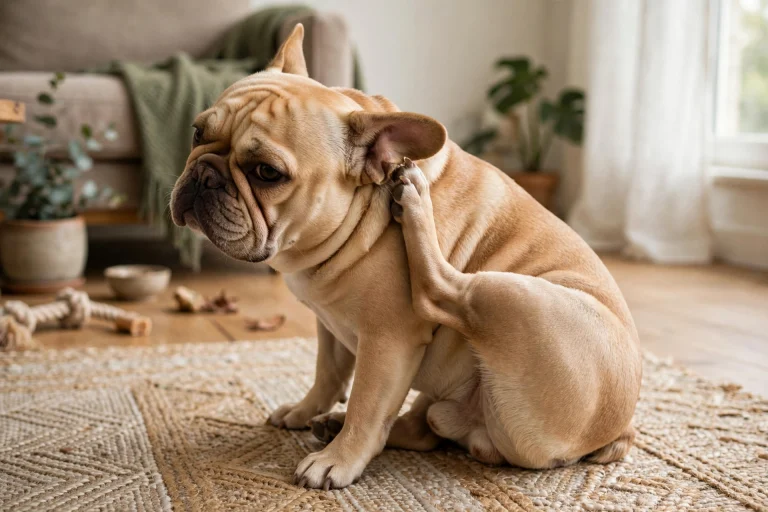
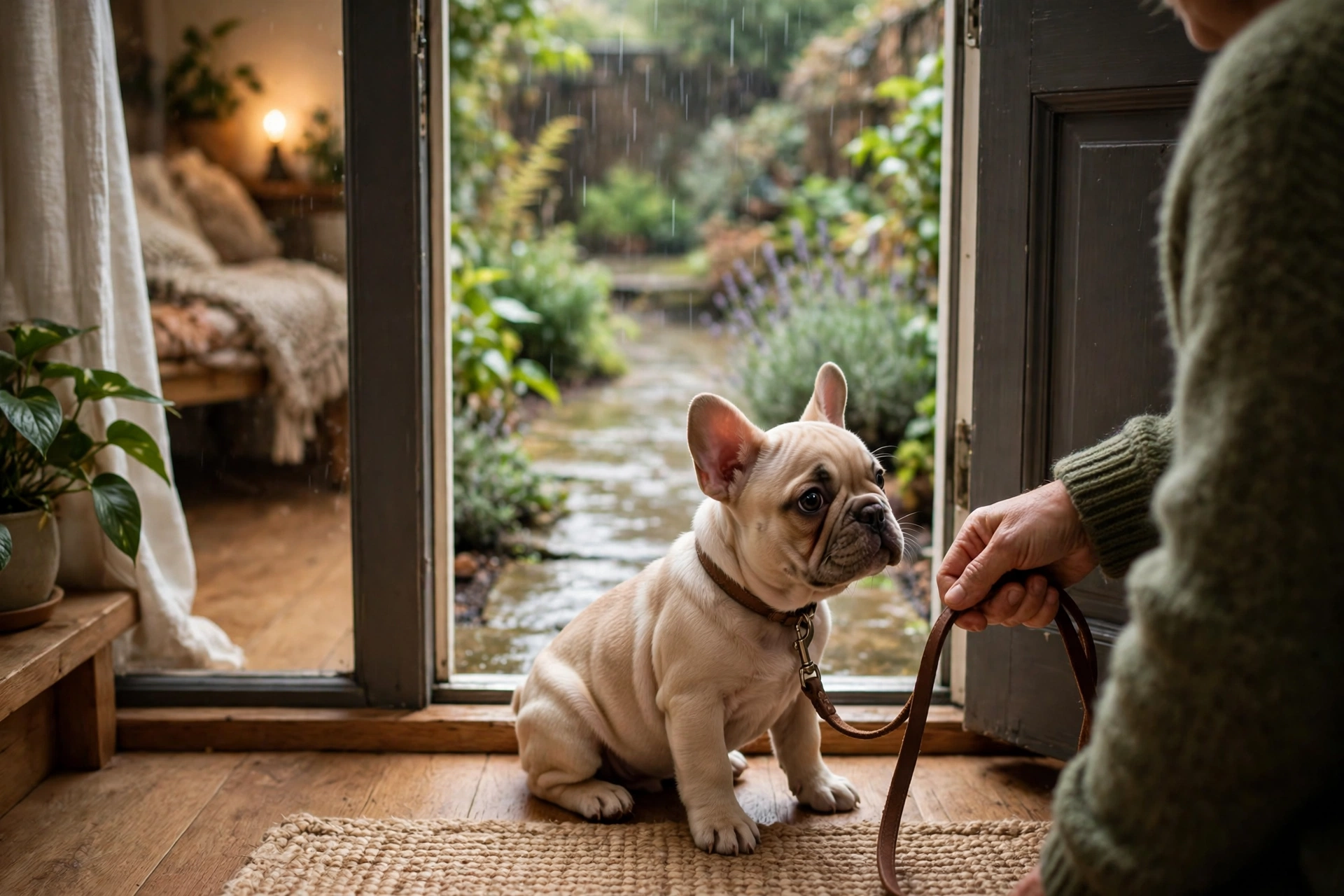
The third piece is the one that is genuinely Frenchie-shaped: weather. Frenchies have short faces, and the AKC notes this makes their breathing less efficient than that of long-nosed breeds, leaving them less tolerant of heat and strenuous exercise. A veterinary emergency source explains the mechanism: shortened skulls and normal-sized soft tissues obstruct airflow, so brachycephalic dogs struggle to cool themselves by panting, and even mild activity, stress, or warm weather can trigger heat stroke. Trainers commonly report the housetraining side of this: Frenchies often refuse wet, cold, or windy outings, hold it until they come back inside, and then go on the floor. That pattern is trainer-reported, not measured in a study, while the heat physiology is veterinary fact. If heat is part of your picture, our guide to French Bulldog heat stroke risks and prevention explains why short, shaded, well-timed outings matter so much for this breed.
Quick tip: Treat every accident as information. Ask what happened just before it, and you will usually find a missed trip, a changed routine, or a weather refusal.
How Long It Really Takes
Timelines sound precise until you compare them. The AKC, quoting chief veterinarian Dr. Jerry Klein, says that if training begins early, a 6-month-old puppy is usually able to be depended on most of the time to eliminate outside. A general veterinary-health source puts full housetraining typically at 4 to 6 months, with some puppies taking up to a year. Trainer and vet-reviewed Frenchie sources describe 4 to 6 months as typical for Frenchies, with some taking up to a year. These are not contradictions. They are different finish lines. Use milestones instead of a single date. The first is a falling accident count, not a zero. The second is the puppy signalling and you responding in time, more often than not. The third is VCA’s freedom threshold: 8 to 12 weeks without mistakes before more unsupervised freedom, given gradually. The fourth is reliability surviving a change, a visitor, a move, or a rainy week.
| Stage | What to expect |
|---|---|
| 8 to 12 weeks, just home | No real bladder control yet, accidents most days, breaks every 1 to 2 hours awake plus after every meal, nap, and play session. Overnight trips are likely until about 5 months, VCA notes. |
| Around 4 months | The month-plus-one ceiling reaches about 5 hours, but daytime reality is far more frequent. Triggers beat the clock. Accidents should be falling if the routine is consistent. |
| Around 6 months | Usually dependable most of the time to eliminate outside if training began early, in Dr. Klein’s words. Occasional slip-ups with excitement or routine change are still normal. |
| 4 to 6 months, typical window | The commonly quoted window for full housetraining, for puppies in general and for Frenchies in trainer and vet-reviewed sources. Treat it as typical, not a promise. |
| Up to about 12 months | The honest tail. Some puppies, including small breeds and some Frenchies, take up to a year. The 8 to 12 accident-free weeks matter more than any date. |
| Adolescence, timing varies | Regression, covered below. A previously reliable puppy starts having accidents again. It is a phase, not a verdict. |
The month-plus-one rule, from the AKC, says a puppy can comfortably hold it for roughly its age in months plus one hour, so a 3-month-old puppy reaches about 4 hours. The AKC presents that as a maximum, not a target, and notes puppies usually hold it longer asleep than awake. A second AKC guide adds that for very young puppies or toy breeds, a break every hour whenever possible is safer. VCA fills in the daytime pattern: after meals or a big drink, immediately after naps, every half hour during high-energy play, every 1 to 2 hours when awake, and every 4 hours even if resting. If accidents persist, check daytime frequency first. Most struggling owners are simply offering too few trips.
Quick tip: Count accident-free weeks in your phone notes. At 8 to 12 of them, you can loosen up slowly, one room at a time.
Breed or Method? Run the Cluster Test
Breed sets the difficulty setting while method sets the result. A small bladder raises the number of trips a puppy needs. An independent streak raises the cost of a dull reward and a boring session. Weather sensitivity raises the cost of a skipped outing. None of those makes housetraining impossible, and none excuses a missing routine. VCA Animal Hospitals defines housetraining as conditioning built on consistency, supervision, and positive reinforcement, not on breed destiny. Dr. Klein’s version is blunter: timing depends on the puppy and the schedule you keep.
Here is a test you can run this week. Look at where the accidents cluster. If they pile up after play, after naps, when the puppy is left alone, in rain, or after a schedule change, that is a routine gap with a specific fix. If accidents are sudden, involve frequent tiny urinations, or come with straining, blood, or a big change in thirst, that is a vet visit, not a training debate. The cluster tells you which problem you have. Guessing usually ends with blaming the dog or blaming yourself, and neither helps the puppy.
- After play or excitement: The puppy was overstimulated and the trip came too late. Build a trip into the end of play, every time.
- In one room, out of sight: Freedom arrived before reliability did. Shrink the area the puppy can roam unsupervised until accident-free weeks stack up.
- Only in rain, cold, or heat: The outing itself is the problem. Go with the dog, keep the trip short and rewarding, and use a covered spot.
- After a move, a visitor, or a new schedule: Routine change scrambles a habit that was still fragile. Tighten supervision for a few weeks and treat it as maintenance.
- Sudden, frequent, or with symptoms: Stop adjusting methods and call the vet. A urinary tract infection or another health issue can look exactly like a setback.
The small-dog study also suggested owner-side explanations: owners tolerating small accidents more, reaching the outdoors more slowly, and training less. If a large dog’s accident would have triggered an immediate change in routine, and your Frenchie’s smaller puddle got a sigh and a paper towel, the method gap is real even though nobody meant to create it. Treat a small accident as seriously as a large one, and change the trip pattern that allowed it.
Quick tip: Write down the last five accidents with the time and trigger. A pattern usually appears by the third entry, and the pattern names the fix.
The Mistakes That Slow Potty Training Down
Most slow progress traces back to a short list of mistakes, each with a fix that costs patience rather than money. Read this section as an audit. Pick the two mistakes that sound most familiar, fix those first, and give the change two weeks before judging it.
- Expecting the puppy to hold it beyond its age. A young puppy physically cannot control elimination for long stretches, and month-plus-one is a ceiling, not a goal. Plan breaks around triggers, waking, eating, playing, and coming out of confinement, not around the clock alone, and keep overnight trips in the plan until about 5 months.
- Waiting for the puppy to signal. VCA warns it can take even longer for a puppy to learn to communicate that it needs to go. Young puppies often do not ask at all. Take proactive trips, and learn the pre-signals: sniffing, circling, restlessness, and a sudden stop during play. Waiting for a bark at the door from a 10-week-old puppy means waiting through a lot of puddles.
- Too much unsupervised freedom, too soon. Accidents out of sight rehearse the wrong habit, and the puppy learns the spare room rug is an acceptable toilet. VCA’s threshold is 8 to 12 accident-free weeks before more freedom, given gradually. Supervise or confine, and expand freedom room by room only after that threshold.
- Punishing, scolding, or rubbing the puppy’s nose in it. VCA is direct: punishment can make a puppy think it should never toilet near a person. American Humane agrees, noting punishment teaches fear and the dog learns to hide when it needs to go. If you catch the puppy in the act, interrupt calmly with a noise or an uh-oh, take it outside gently, and praise if it finishes there. If you find the accident later, clean it silently and tighten supervision. The puppy cannot connect a scolding now with an act from an hour ago.
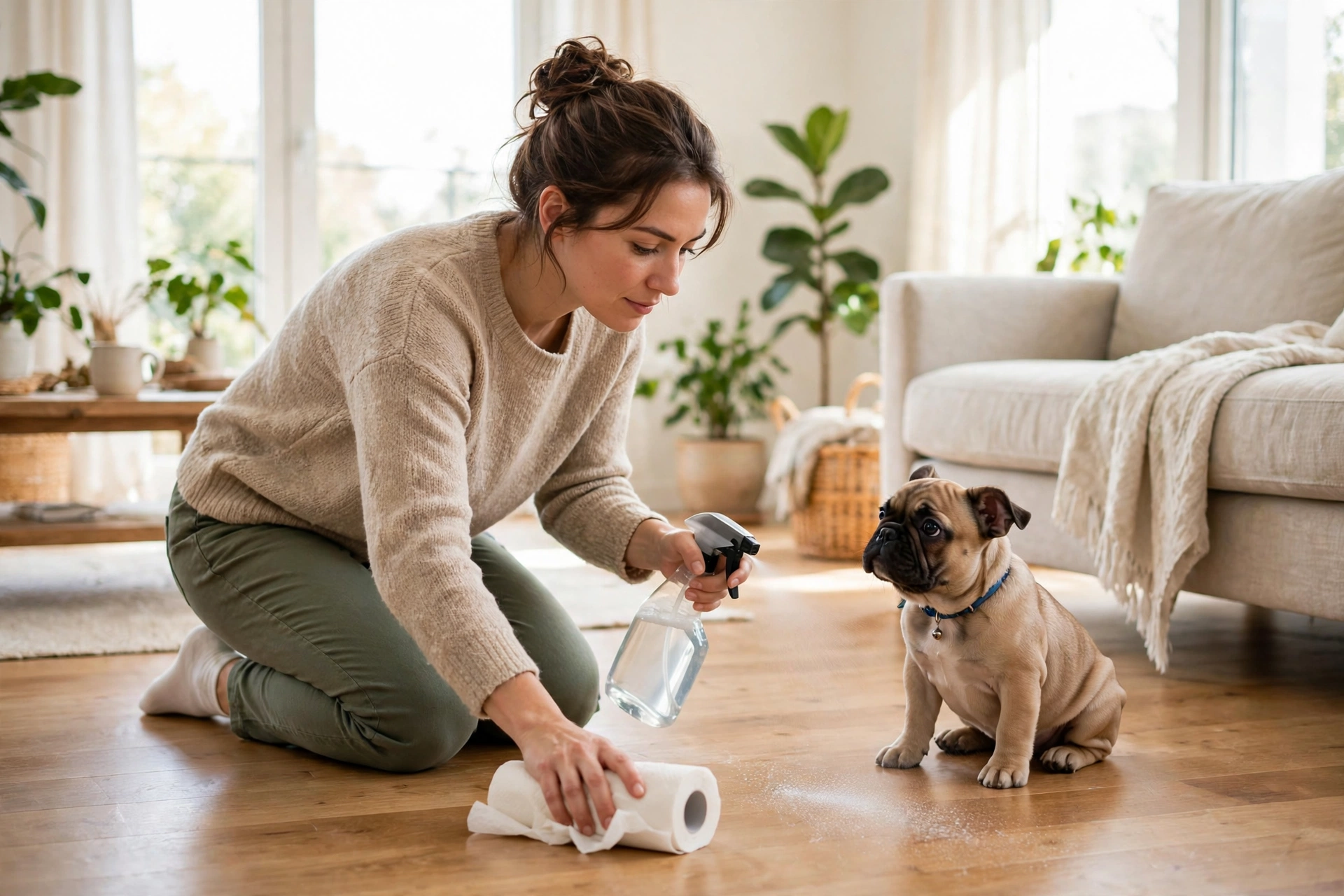
- Cleaning with an ordinary cleaner. Urine and faeces odour cues draw a dog back to the same spot, and VCA, the AKC, and American Humane all specify an enzymatic cleaner. Use it on every accident, every time, even when you are tired of the smell of it.
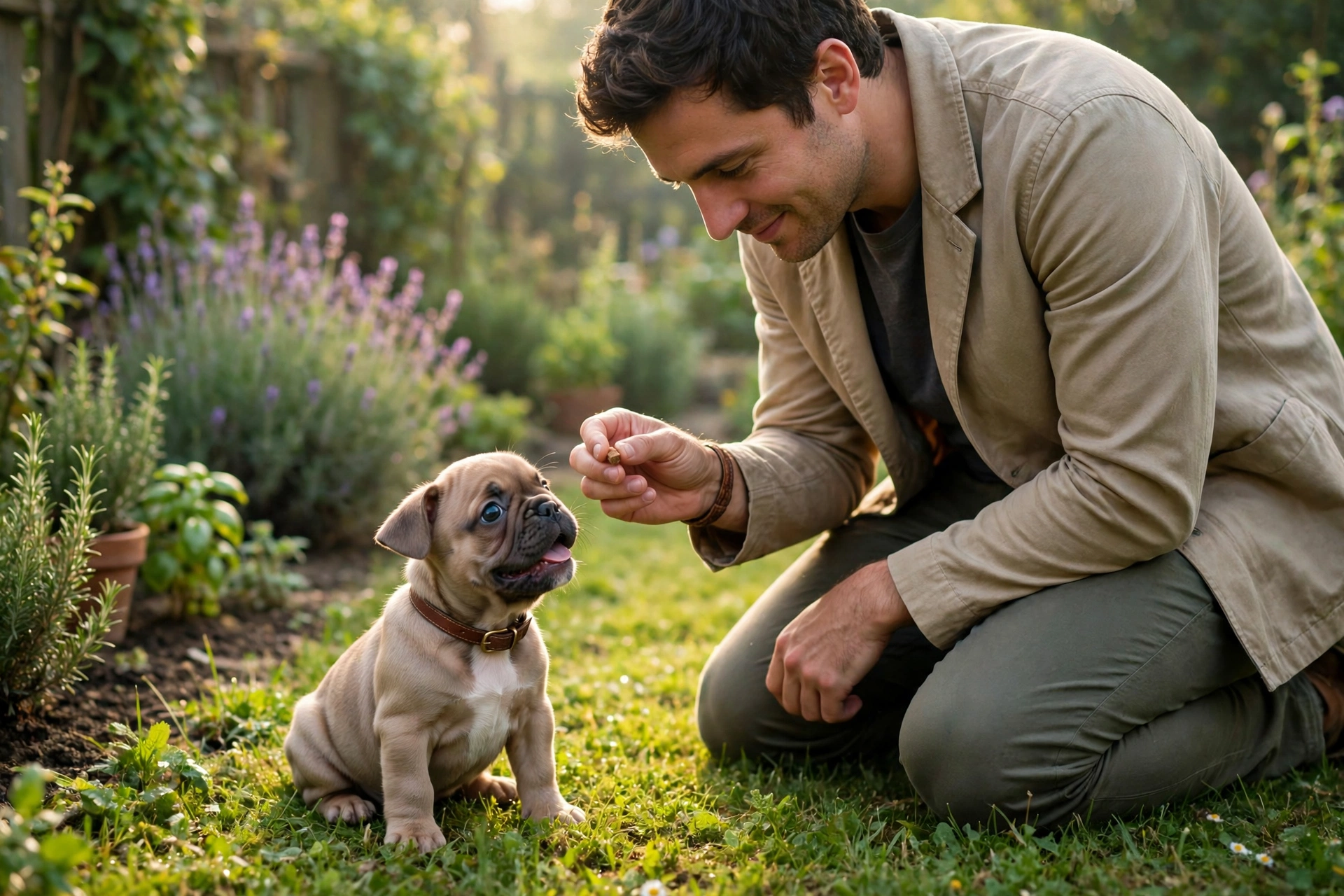
- Rewarding late. VCA advises rewarding while still outside, near the elimination area, so the puppy connects the act with the reward. A treat handed over in the kitchen teaches the puppy that coming inside earns treats. Treat and praise immediately, outdoors, at the spot.
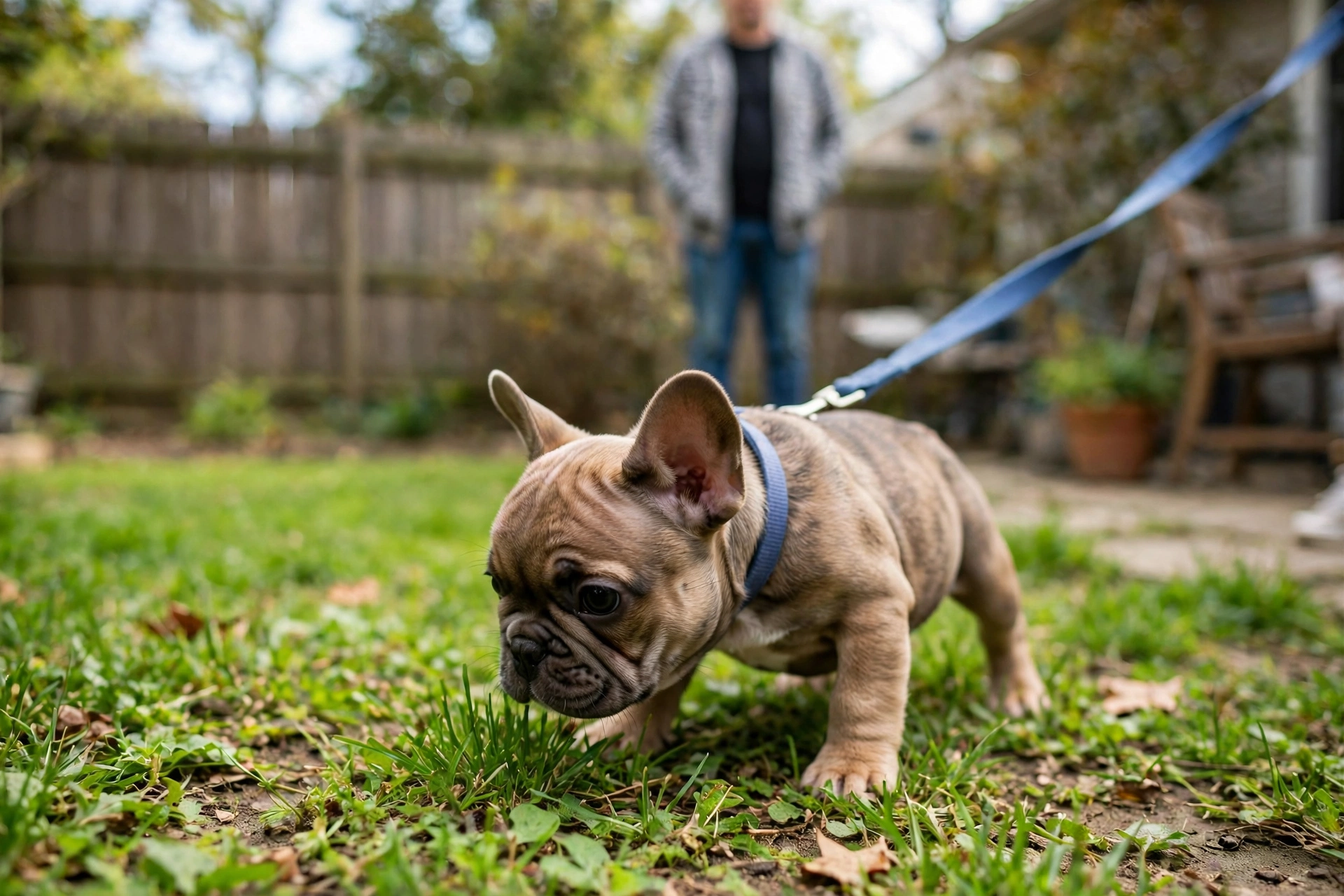
- Sending the puppy out alone. VCA notes puppies left outside alone get distracted and often do not eliminate until they are back indoors. Go out with the puppy, on leash, to the same spot, even with a fenced yard. That change alone explains many cases where the dog pees inside right after going out: it went out, got distracted, and came back in with a full bladder.
- Inconsistent rules across the household. Conditioning depends on consistency, and irregular feeding produces irregular elimination. Use the same door, spot, cue, and feeding times, with every household member on the same rules. If one person lets the puppy out after meals and another does not, the puppy is confused about the house, not the breed.
- Changing the rules in bad weather. This is the Frenchie trap. A skipped rainy trip becomes an indoor accident, and then a habit if it repeats. The fix is in the next section: short, rewarding, covered trips, with you present, and no exercise in peak heat.
- Declaring victory too early. Early reliability is fragile, which is why the 8 to 12 week threshold exists. Relaxing everything the week accidents stop turns a good month into a relapse. Keep the routine after accidents stop, and treat later regression as a short tightening, not a restart.
- Ignoring a medical cause. Dr. Klein advises a vet check when progress stalls, because a urinary tract infection or another health issue may be causing the delay. VCA says the same for a previously trained dog that starts soiling. Vet first, then training adjustments.
Frenchie-Specific Fixes That Actually Help
None of these fixes requires a new product or a new philosophy. They are small adjustments to the standard method, shaped around what Frenchies struggle with.
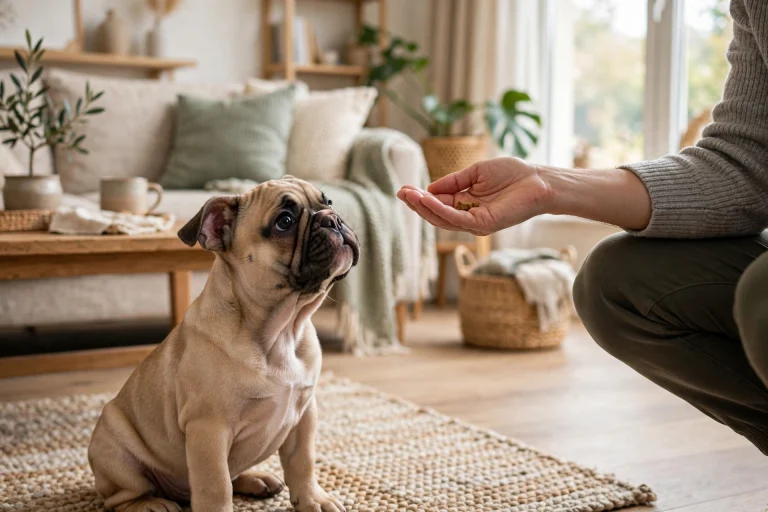
First, go out with the dog, every time, in the early months. A puppy left alone outside gets distracted and comes back in still needing to go. Stand at the same spot, stay boring, and wait. When the puppy goes, reward at the spot, right away. The smell of wet grass, the clicking of nails on the patio, and a pocket of small treats are the whole toolkit. Keep sessions short and upbeat. A Frenchie that shuts down under harsh correction will still work for a good treat and a warm voice, and the AKC says turning training into a game is what gets this breed on board.
Second, solve weather instead of fighting it. Pick a covered spot close to the door, so a rainy trip is twenty steps, not a trek across a soaked lawn. Keep heat trips short, shaded, and in the cooler parts of the day, and never push a Frenchie through exercise in peak heat. In rain or cold, go with the dog, stay relaxed, and reward the moment it goes. If the puppy plants its feet at the door, do not drag it out and do not give up and wait for the inevitable puddle. Wait, try again, and make the trip worth it. Trainers commonly report this refusal pattern, though it is not study-proven.
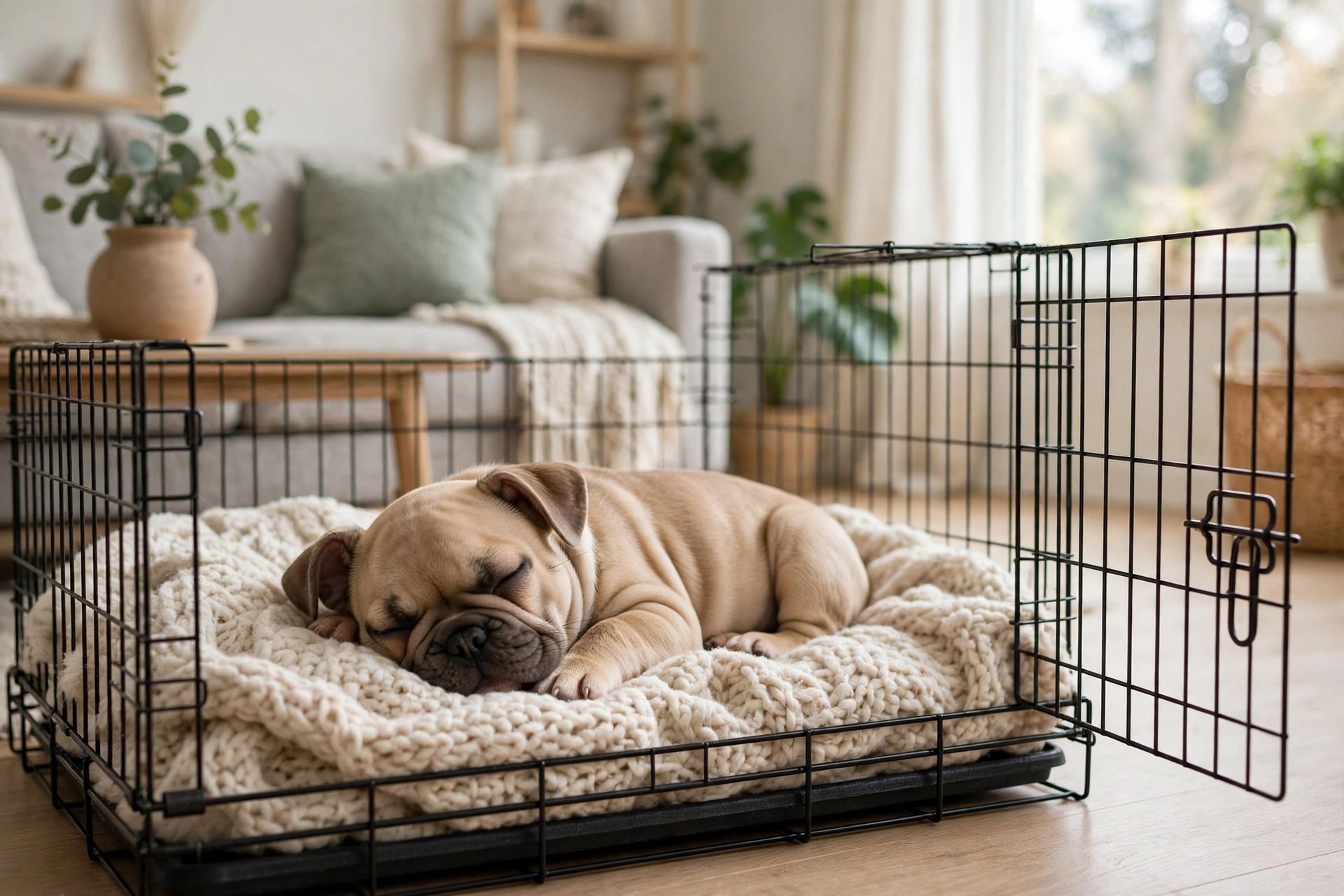
Third, use confinement as a teaching tool, not as a punishment. VCA describes three acceptable states for a puppy: directly supervised, safely confined, or in an area with an appropriate toileting substrate. Puppies left alone for up to 3 hours can usually be crated, while longer absences need a break or a pen with a toileting area. A crate with a soft blanket gives a young puppy a den it does not want to soil. A puppy roaming unwatched is not learning freedom. It is learning that the hallway rug is available.
Fourth, keep pads in perspective. The AKC presents pads as a legitimate tool, defensible for apartments, bad weather, and long absences. Some trainers warn pads teach two acceptable surfaces and add a later transition step. Treat that as a trade-off, not a verdict. If outdoor-only is the goal, direct outdoor training avoids teaching two locations. If pads are the practical choice right now, use them deliberately. Pads should never become a reason to stop taking the puppy outside.
Quick tip: Keep treats by the back door. The reward has to happen at the grass, or the puppy learns the wrong lesson.
Regression Is Normal, Not Failure
A puppy that was doing well and then starts having accidents again has not forgotten everything. Regression is a normal developmental phase. Chewy places puppy regression typically at 6 to 18 months, with potty setbacks among the signs, and notes hormonal changes, inconsistent training, and lack of exercise as possible contributors. Trainer sources cluster potty regression earlier, around 4 to 8 months. Sources disagree on the months: adolescence brings setbacks, the exact age varies, and the remedy is the same.
The fix is a tightening, not a restart. Go back to closer supervision, more frequent trips, and the same spot and cue, for two to three weeks. Re-clean old accident spots with enzymatic cleaner, because a faded smell can still invite a repeat. Keep the routine steady, and do not introduce a harsher method in frustration. Regression often arrives just when the hard work feels done. Tighten the routine, wait it out, and watch the accident count fall again. If the regression is sudden, or comes with symptoms, read the next section first.
When to Call the Vet
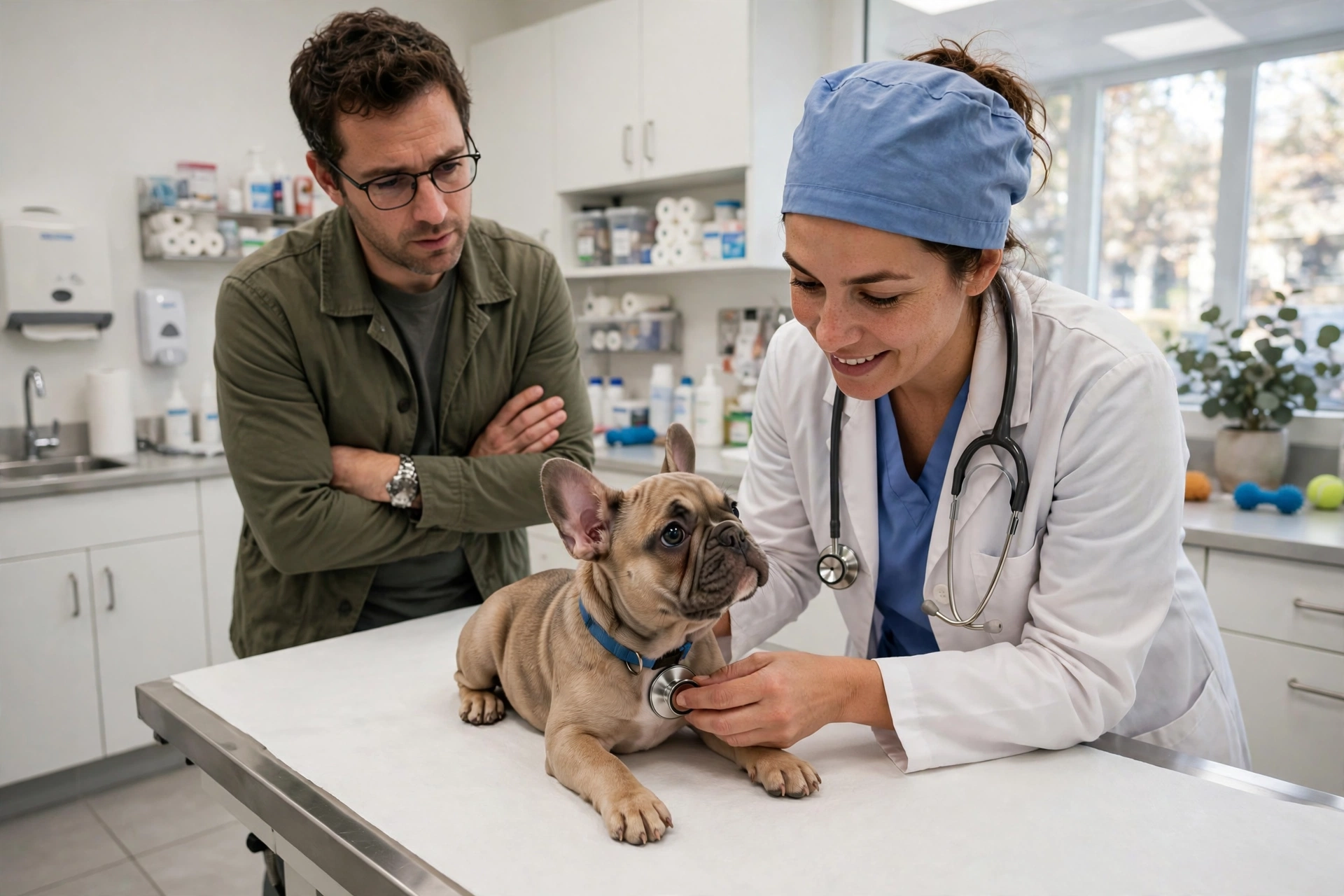
Call your vet if housetraining makes no progress despite a consistent routine, if a previously reliable dog suddenly starts soiling, or if accidents come with frequent tiny urinations, straining, blood, excessive thirst, or loss of bladder control while sleeping. Those signs can point to a urinary tract infection or another medical issue, and no method change fixes a medical problem. Dr. Klein makes the same point about stalled progress, and VCA makes it about previously trained dogs that start soiling: vet first, then training changes. Excitement or worry urination is separate, and VCA notes it is not a housetraining lapse.
Quick tip: Before the appointment, note when accidents happen, how much urine is passed, and whether drinking, appetite, or energy have changed.
Where to Go From Here
This article is the honest assessment, not the routine. For the day-by-day pattern, including wake-up, meal, nap, play, and bedtime trips, crate and pen setup, and week-by-week progression, read the companion guide French Bulldog Potty Training Schedule: Step-by-Step Daily Routine. That guide owns the routine, and this article deliberately does not repeat it. For the wider training picture, see our French Bulldog training guide. If your puppy is new to your home, the Complete French Bulldog Owner’s Guide covers the first weeks, and our French Bulldog health problems guide explains conditions that can shape daily care. For breathing specifically, read the BOAS guide before summer arrives.
Frequently Asked Questions
- Are French Bulldogs hard to potty train? Somewhat harder than many easy-to-train breeds, yes, but very trainable. The difficulty comes from small bladders, an independent streak, and weather reluctance, combined with how much consistency the routine gets.
- How long does it take to potty train a Frenchie? Most puppies reach full housetraining in 4 to 6 months, with dependable outdoor toileting most of the time by about 6 months if training began early. Some take up to a year. Count 8 to 12 accident-free weeks as the milestone that matters, not a single date.
- Are Frenchies stubborn about potty training? They can be, in the sense the AKC describes: they may need more training than other breeds, and they may test whether a rule still applies today. The same sources describe them as eager to please and strongly food-motivated.
- Can an adult Frenchie be potty trained? Yes. Trainer and vet-reviewed sources agree adults can be housetrained with patience and consistency. A dog that learned to eliminate in its living space must unlearn that habit first, so expect it to take longer than with a young puppy.
- Why does my Frenchie pee inside after going out? Very often, the puppy never actually went while outside. Puppies left alone outdoors get distracted and hold it until they are back indoors. Go out with the puppy, on leash, to the same spot, and reward there.
- Why does my Frenchie refuse to go out in rain or heat? Trainers commonly report Frenchies dislike rain, cold, and wind, and their short faces make them less heat-tolerant, which the AKC confirms. Use a covered spot close to the door, keep trips short and rewarding, and keep heat trips shaded and in cooler parts of the day.
- Is it normal to still have accidents at 6 months? Yes. A 6-month-old puppy that began training early is usually dependable most of the time, in the AKC’s words, and occasional slip-ups with excitement or routine change are still normal. If accidents are sudden, frequent and tiny, or come with straining or blood, see the vet.
A Final Word for Tired Owners
If you are reading this with a paper towel in one hand, here is the part that matters most. The question of are french bulldogs hard to potty train has a kinder answer than the reputation suggests. They ask for more trips, better rewards, and a steadier routine than some breeds, and they punish inconsistency faster. That is a harder setting, not a hopeless one. Keep trips frequent, rewards at the grass, and rules the same across the house. Count the accident-free weeks as they stack up. Most Frenchies get there, and a bad week in month four is not failure. Fix the one mistake that sounded most familiar, and give the change two weeks.