Can French Bulldogs Swim? Water Safety Guide (2026)
TL;DR
- Can French Bulldogs swim? Not safely on their own. The breed is front-heavy, flat-faced and short-legged. The French Bull Dog Club of America says Frenchies are poor swimmers who can easily drown and must never be left unattended around water.
- Some Frenchies paddle briefly in calm, shallow water in a well-fitted life jacket. Paddling is not the same as swimming safely.
- In water, a Frenchie needs a life jacket with a sturdy rescue handle and flotation under the chin, plus an adult within arm’s reach.
- The safest water play is standing, not swimming: a kiddie pool with a few inches of water, a gentle sprinkler, or a shoreline splash.
- After water time, rinse him, dry his ears and folds, and watch his breathing. If he was submerged at any point, he needs an emergency vet visit even if he seems fine.
Can French Bulldogs Swim? The Short Answer
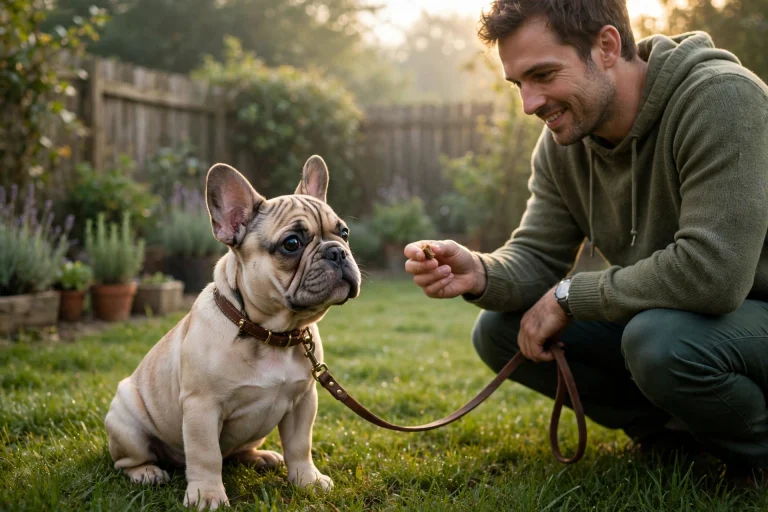
Your Frenchie just followed you to the pool deck, and you need to know before he goes closer whether can french bulldogs swim well enough to be safe in there. The honest answer is no, not on their own.
The American Kennel Club puts it plainly: “because they’re front heavy, French Bulldogs can’t swim. Never leave them unattended near water.” The French Bull Dog Club of America, the US breed club, agrees: French Bulldogs “must never be left unattended around water, as they are poor swimmers and can easily drown due to their front-heavy structure.”
Read that as a working rule, not a dare. A Frenchie in a life jacket, in calm shallow water, with you right beside him, can paddle briefly. A Frenchie alone near a pool, pond or boat dock is in real danger: one slip, one wave over the face, one panicked gulp, and a dog built this way cannot recover the way a Labrador can.
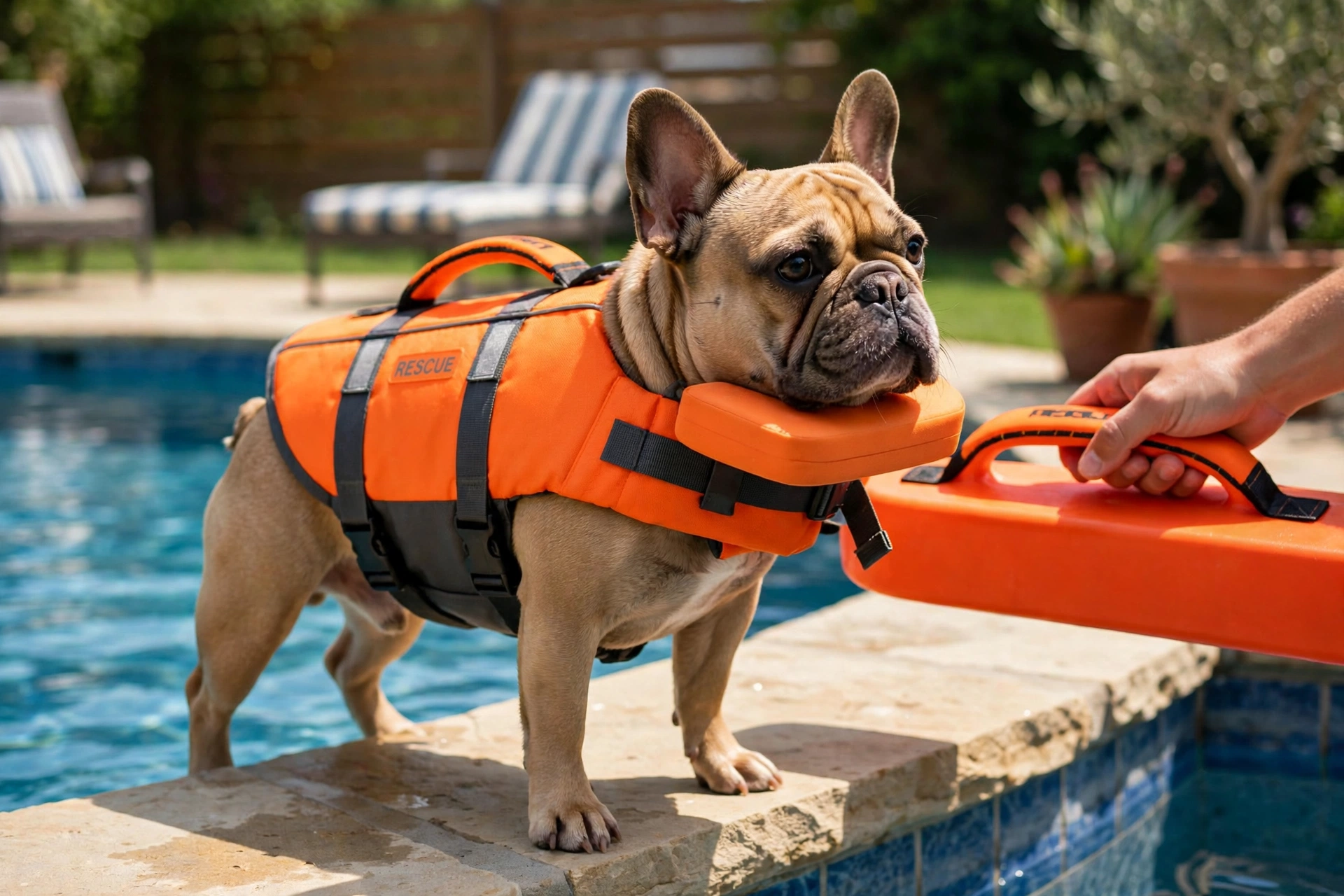
Quick tip: Treat water near your Frenchie like an open staircase near a toddler: gate it, fence it, or keep him leashed and vested near it.
Why French Bulldogs Are Built Badly for Water
Hill’s Pet, summarising AKC guidance, calls it a triple problem: flat faces, barrel-shaped bodies and short legs. A French Bulldog has all three, plus a heavy head and dense muscle.
Start at the front. Most of a Frenchie’s weight sits ahead of his midpoint: a large head, a wide, deep chest, and heavy bone. The AKC puts Frenchies at under 28 pounds and 11 to 13 inches at the shoulder, with heavier bone and a pear-shaped body. Dense muscle and heavy bone do not float well, so the front end pulls down and the lighter rear cannot balance it.
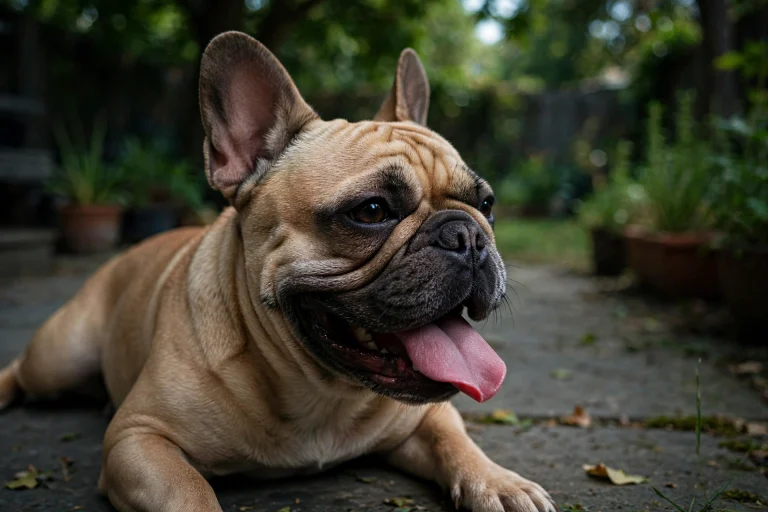
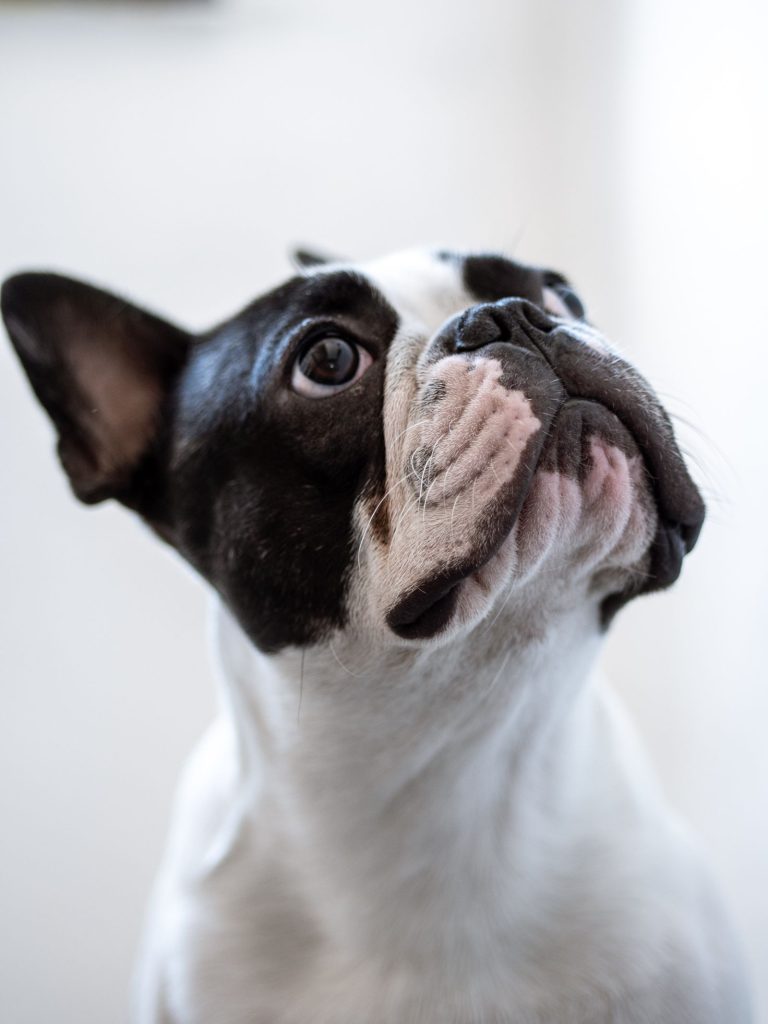
Then look at the face. A Frenchie is brachycephalic, so his muzzle is extremely short and his airway is already less efficient on dry land, with less tolerance of heat, exercise and stress. Swimming stacks all three at once. To keep a nose that sits that low out of the water, he must tip his head far back, and tipping the head back pushes the rear end down: head up, back end sinking, mouth closer to the surface with every stroke.
The legs finish the problem: short legs give weak strokes, so he churns hard, tires fast, and cannot tread water.
The five anatomy problems, in one list:
- Front-heavy build: a large head and deep chest pull the front of the dog down.
- Heavy bone and dense muscle: a lot of weight for his size, with little natural buoyancy.
- Flat face and short muzzle: the nose sits low, so splashes go straight up it.
- Compromised airway: breathing is already less efficient on land, before exercise and stress.
- Short legs: weak propulsion and fast fatigue, with no easy way to rest afloat.
Breathing is one of several breed patterns in our guide to French Bulldog health problems.
But I Have Seen a Frenchie Swim on Video
MedVet, an emergency and specialty veterinary group, draws the line carefully. Breeds with shorter snouts and larger bodies on short legs “don’t do as well in the water. While they might swim to survive, they probably won’t do it for fun.” Surviving a short paddle and being a swimmer are different claims.
A vest explains most of the rest. The AKC’s guide to teaching a dog to swim describes what novice dogs do without one: they paddle with their front feet only while their rear legs dangle, searching for the bottom. AKC trainer Michele Godlevski calls it front-wheel drive. With a vest on, the dog’s back stays level, and once the back is level all four paws can paddle.
What the clip never shows is the margin. A vested Frenchie in flat water has almost nothing left for a wave in the face, a current pulling sideways, a moment of panic, or a pool wall with no step. VCA warns that even a regular swimmer can get into trouble with strong currents or when he cannot work out how to exit a pool.
Do this, not that:
- Do treat a short, vested, supervised paddle in calm water as the top end of what a Frenchie can do. Do not treat it as proof he can swim.
- Do end the session while he is still paddling calmly. Do not wait for visible struggling.
The French Bulldog Life Jacket: How to Choose and Fit One
VCA’s rule for this breed leaves no debate: “Certain stocky breeds with short legs, like bulldogs and pugs, will always need a life jacket anytime they go in the water.” For a Frenchie, the jacket is the equipment that makes any time in water reasonable at all.
Shop by measurement, not by the size label. The AKC advises measuring neck girth, rib-cage girth, hip circumference and body length, and weighing the dog. Chewy’s fitting guidance makes the key point: girth, the widest part around the rib cage, is the most important number. Between sizes, choose the next size up.
Fit it with the two-finger rule, which both the AKC and MedVet use. The jacket should sit snug without restricting movement or breathing, with two fingers sliding under the straps, and the dog should be able to sit, lie down and walk comfortably in it. Too loose is its own hazard, because an oversized jacket can slip off in the water. Too tight constricts movement and breathing.
Two features matter more for a Frenchie. The first is a sturdy rescue handle on top, strong enough to actually lift the dog out of the water, as the AKC advises. Test the handle on dry land with a full lift. If the jacket twists or slips toward his head, it fails. The second is extra flotation under the chin, which the AKC suggests for keeping a dog’s head above water. On a front-heavy dog, chin flotation buys breathing room.
Frenchie shape creates three fit traps. The barrel chest means chest girth, not the weight on the box, decides the size. The thick neck means no strap should press on the throat, because a brachycephalic dog must never have his breathing constricted. And belly straps can ride over the widest part of the barrel and work loose, so recheck the fit after the jacket gets wet.
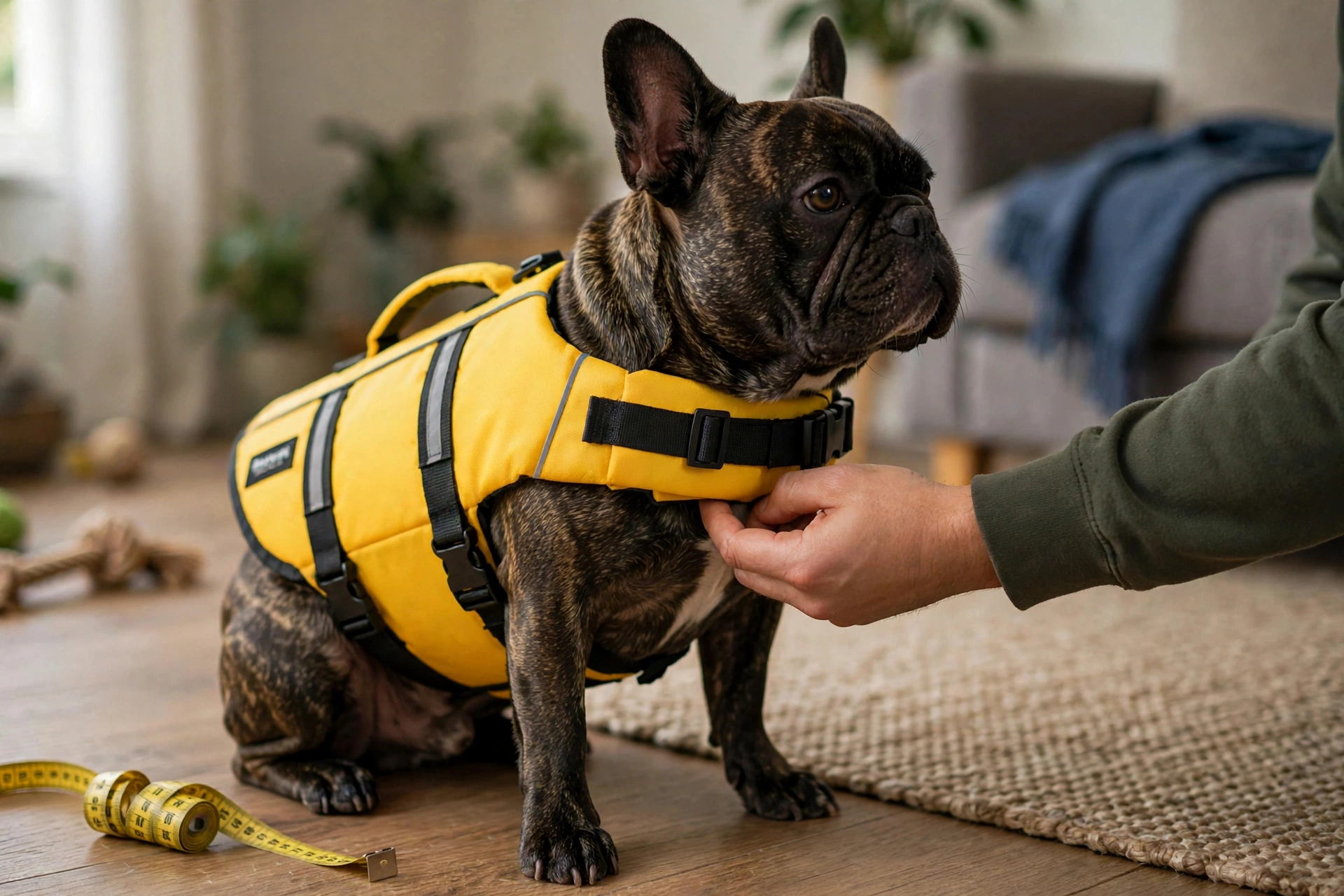
Life jacket fit checklist:
- Chest girth measured at the widest point and matched to that brand’s chart
- Two fingers under every strap, with no strap pressing on the throat
- Rescue handle passes a full dry-land lift test without twisting
- Chin or front flotation present to support the heavy front end
- Bright colour or reflective trim so you can spot him fast
- Dog can sit, lie down, walk and breathe normally in it on land
- Short float test done in shallow water, with you beside him, before real use
On price, expect roughly $20 to $30 for a solid budget jacket with a chin float and rescue handle, and $70 to $100 for a premium jacket like Ruffwear’s Float Coat, at retailer prices in October 2026. Fit matters more than price: a $25 jacket that fits beats a $100 jacket that slips. The AKC also notes that life jackets give more buoyancy and visibility than lighter swim vests, so for this breed choose the jacket.
Water Activities That Are Actually Safer for Frenchies
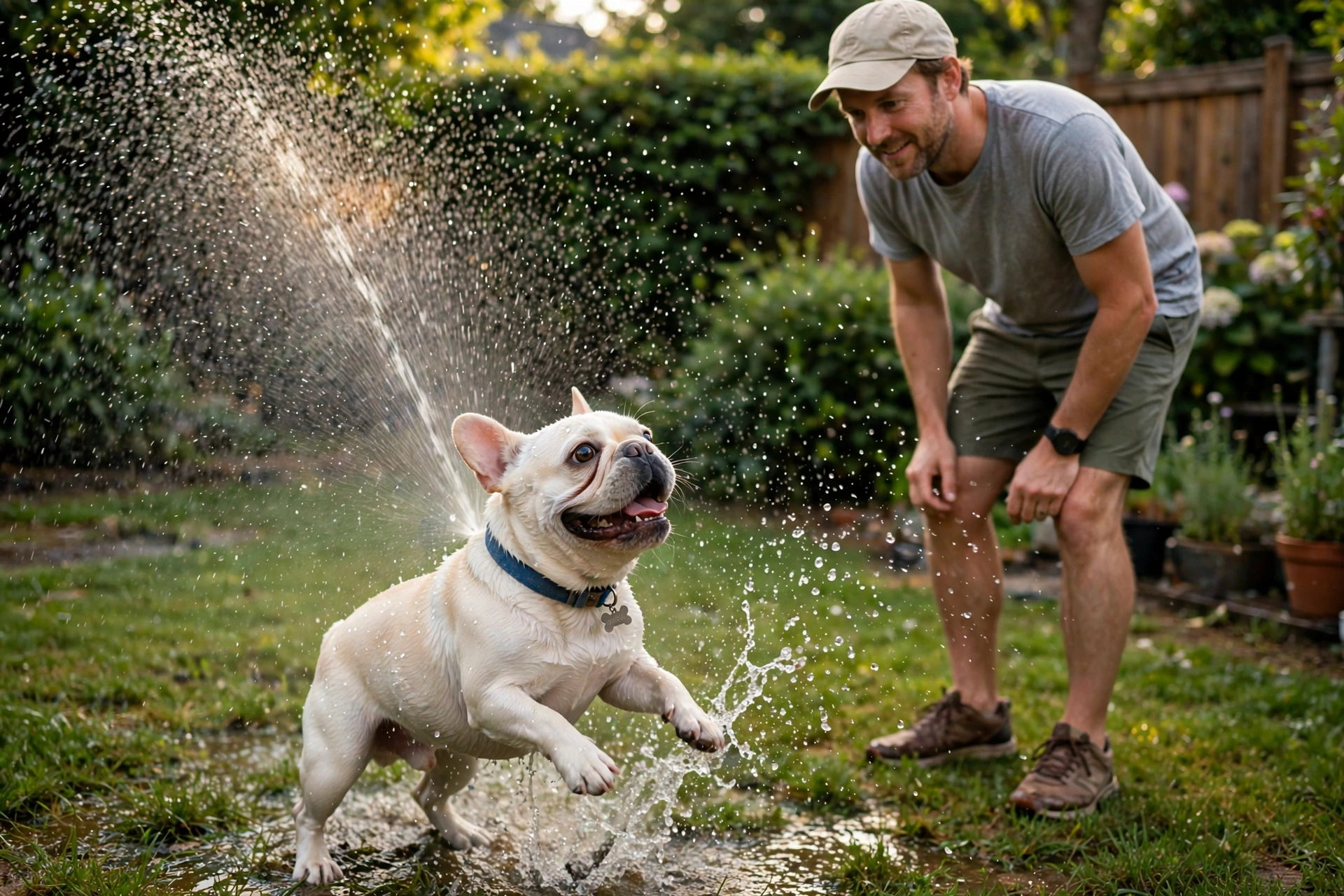
The kiddie pool is the default recommendation. The AKC suggests a plastic kiddie pool for dogs that never take to swimming, and Hill’s describes a small plastic pool as shallow enough for a dog to stand in the water while still getting the fun of splashing. Fill it with a few inches, enough to wet his belly while he stands, never up over his chest. Put a rubber drainage mat on the bottom, because the AKC warns that many dogs fear the slippery surface. Then stay there. PetMD warns that even shallow pools and buckets can drown an animal that becomes unwell or cannot right itself, so a kiddie pool is supervised play, never a place to leave him while you answer the door.

| Activity | The safer version | The main caution |
|---|---|---|
| Kiddie pool | A few inches of water, mat on the bottom, you beside it | Never leave him in it alone |
| Sprinkler or hose | Low, gentle spray, short sessions | Stop obsessive biting of the stream |
| Beach | Jacket on, leashed, calm shallow edge only | Waves, rip currents, drinking salt water |
| Lake or pond | Jacket on, clear water only, fresh water offered often | Blue-green algae can poison him |
| Boat or paddleboard | Jacket on the whole time, practise the lift back aboard first | Falling in away from shore, heat on deck |
| Hydrotherapy | Vet-referred rehab centre, certified hydrotherapist | Never DIY, case-by-case for flat faces |
At the beach, VCA advises avoiding big waves, riptides, strong currents and dangerously cold water. Do not let him drink sea water: the ASPCA warns that a few mouthfuls can cause diarrhoea and large amounts risk salt poisoning, so carry fresh water.
Lakes carry the risk owners miss most often. The ASPCA’s blue-green algae alert describes algae that thrives in warm, sunny fresh water, looks like pea-green paint or slime, and can cause severe liver and neurological damage. Dogs are poisoned by drinking it or by licking the cells off their fur afterwards. If the surface looks green or scummy, keep him out.
On a boat, the jacket stays on at all times. Bring fresh water, practise the lift beforehand: haul him back aboard by the jacket handle in shallow water near shore.
Hydrotherapy is the one place deeper water belongs in a Frenchie’s life, because it is a clinic, not a pastime. PetMD describes it as exercise in water at a rehabilitation centre under a certified hydrotherapist, usually after a vet referral: do not attempt it on your own. Buoyancy takes more than half the dog’s weight off his joints. PetMD also flags that brachycephalic breeds can have more trouble because of their breathing, so a Frenchie may start on an underwater treadmill.
The Water Safety Protocol: Before, During and After
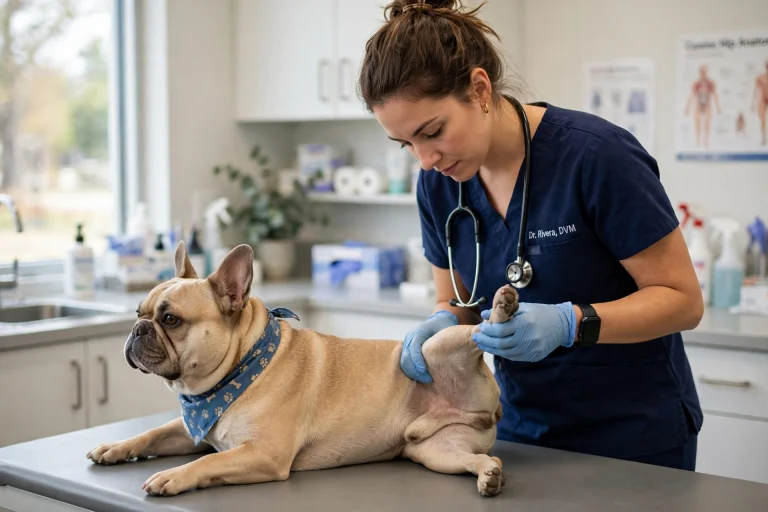
Before: check with your vet first. VCA advises asking your veterinarian before taking a dog swimming, because conditions like arthritis, heart disease or epilepsy can make swimming risky. Pool owners, fence the water off when it is not in use: PetMD and VCA both point to a fence or pet gate as core prevention. Do not count a standard pool cover as protection. A cover is a hazard: a dog can walk onto one, go through it and become trapped underneath.
During: never force him in. The AKC is direct: never toss a dog into water to figure it out. A dog without a vest can panic, gulp water and drown in the few seconds before the paddling reflex starts. Let him enter on his own feet. Teach the exit before you need it. VCA advises teaching your dog to climb out of the pool, into the boat or onto the dock, using ramps or broad, slip-free steps. PetMD describes a drowning dog tipping his head back, nose just above the water, body fully submerged, paddling fast and failing to keep his head up. It is quiet.
Keep sessions short, with breaks on dry land, in shade, with fresh water offered. VCA’s guidance is simple: swimming is hard work, so give your dog breaks. MedVet adds that dogs will keep going until they are too tired, so the stopping decision is yours. One AKC trainer rule of thumb, from Michele Godlevski, caps swim sessions at 10 minutes for water-intoxication prevention. For a Frenchie, go shorter, and end at the first sign of heavy panting.
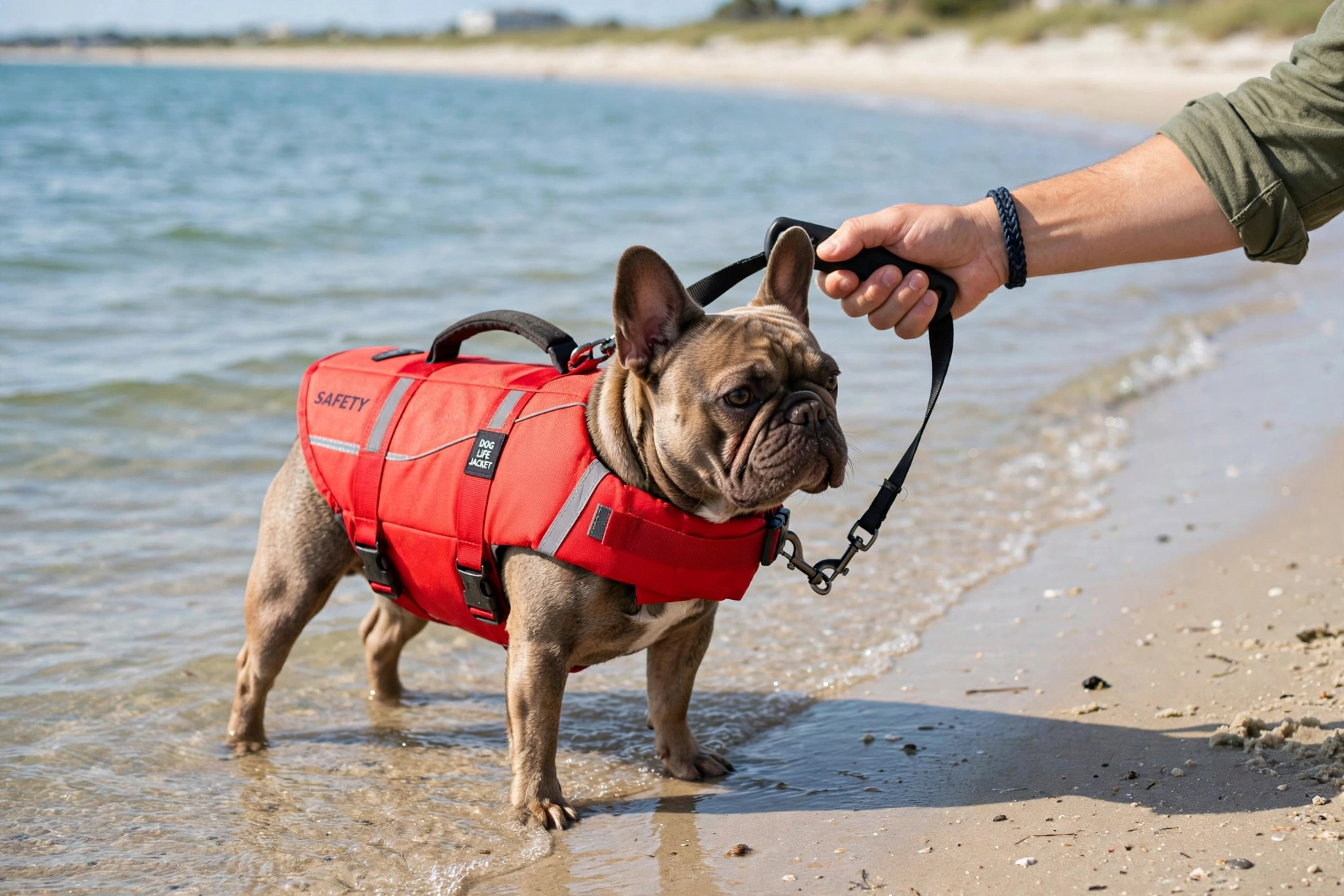
After: rinse him with fresh water, head to tail. The ASPCA, VCA and MedVet all put the rinse on the list, because chlorine, sea salt and debris irritate skin. Dry his ears properly. VCA notes that an ear cleaner with a drying agent removes moisture that can lead to ear infections, and MedVet calls water left in the ears a perfect breeding ground for bacteria. Dry his facial folds too, then take the wet jacket off, towel him down, offer fresh water, and watch his breathing for the rest of the day.
The protocol, as a checklist:
- Vet check done, jacket fitted at home, fresh drinking water packed
- Pool fenced or gated when not in use, cover fully off during use
- Jacket on before he reaches the water, handle lift tested
- Voluntary entry only, exit route practised in the shallows
- Short bouts, shade breaks, session ends at heavy panting
- Rinse, ear drying, fold drying, wet gear off, breathing watched afterwards
New owners will find the same approach across our complete French Bulldog owner’s guide.
The Risks Most Owners Miss
Water intoxication is the strangest one. The AKC explains that swallowing too much water depletes the sodium outside a dog’s cells, the cells swell, and brain cells swelling inside a rigid skull is what makes the condition dangerous. It happens while swimming, diving for toys, and biting at hose and sprinkler streams. Early signs include lethargy, bloating, vomiting, drooling, pale gums, a stumbling gait, restlessness and glazed eyes. Difficulty breathing, seizures or collapse mean the brain is under pressure and it is a race to an emergency vet. Prevention is plain: frequent land breaks, flat toys instead of round balls so his mouth closes better, no diving games, and no biting at a high-pressure stream.
Delayed breathing problems after a rescue are the second trap. You may see the terms dry drowning and secondary drowning used for this. Vets tend to describe it more precisely as delayed complications after a nonfatal drowning. MedVet warns that water in the lungs can cause inflammation, infection and death hours or even days later. Watch for coughing, lethargy and difficulty breathing after a scare in the water, and treat breathing trouble as an emergency.
Heat is the third trap, because wet feels safe. It should not. Embark Veterinary’s vets confirm that dogs can overheat while swimming, especially in brachycephalic breeds. Warm pool water and shallow sunlit water can trap heat rather than remove it. Your Frenchie’s only real cooling system is panting, and his version was compromised before he got wet. Our guide to French Bulldog heat stroke covers the signs and first response in full.
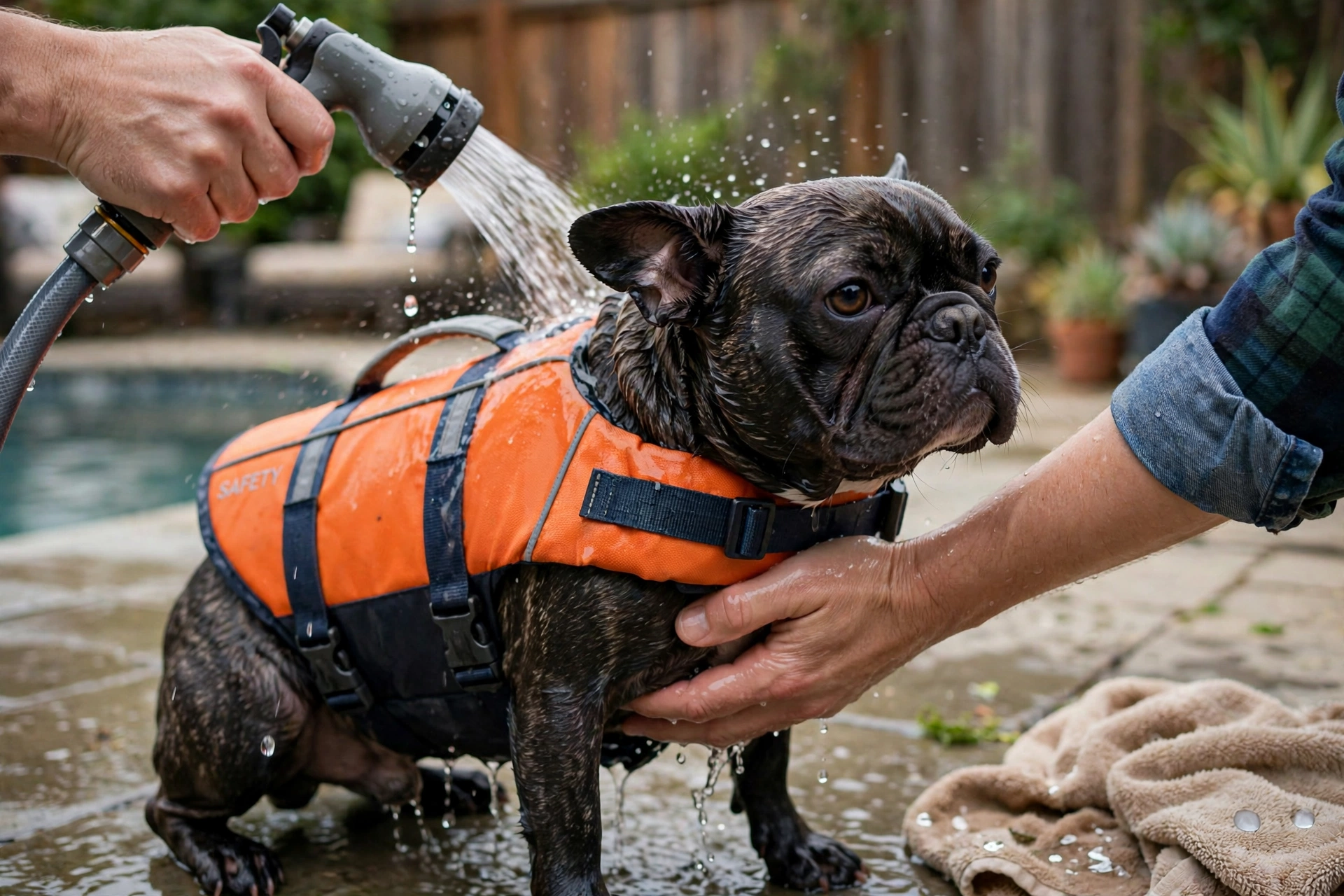
Do this, not that:
- Do offer fresh water every few minutes during water play. Do not let him lap pool, lake or sea water.
- Do use flat floating toys and take land breaks. Do not play diving or hose-biting games.
If Your Frenchie Falls In: What to Do
First, get him out without becoming a second emergency. MedVet warns that a panicking dog can interfere with your swimming, especially if you are not a strong swimmer, so keep yourself safe before you go in. Use the jacket handle, a ramp, a pole or a rescue ring before entering deep water yourself.
Second, once he is out, check responsiveness and breathing. If he is unresponsive and not breathing normally, PetMD advises starting mouth-to-muzzle resuscitation or CPR if you are trained, clearing only visible obstructions from the airway, then drying and warming him with towels. Never hang a dog upside down or lift him by the hind legs to drain his lungs. That old advice is outdated, it does not clear the lungs, and it wastes minutes that belong to breathing support and transport.
If you know dog CPR, Frenchies need the barrel-chested position. The American Red Cross names French Bulldogs explicitly: place the dog on his back, stack your hands with the heel on the highest part of the sternum, and compress one third to one half the width of the chest at 100 to 120 compressions a minute, in cycles of 30 compressions to 2 rescue breaths. For rescue breaths, close his mouth, extend the neck, cover his nose with your mouth and exhale for about a second until the chest rises.
Third, the vet visit is not optional, even when he seems fine. PetMD states it in bold for a reason: if a dog is submerged for any length of time, seek emergency veterinary care immediately, because clinical signs can be delayed. At the hospital, expect oxygen support, IV fluids, bloodwork, chest X-rays and heart monitoring. Dogs who arrive conscious and get fast care have a good prognosis when no complications develop.
For the days after, watch for a worsening cough, harder breathing, unusual tiredness, pale or blue gums, repeated vomiting, and any collapse. Difficulty breathing at any point is an emergency.
Quick tip: Save your nearest emergency vet’s number in your phone today. A pool accident is the wrong moment to search for an address with wet hands.
Frequently Asked Questions
Can I teach my Frenchie to swim? You can teach him to paddle calmly in a life jacket, in shallow water, with you beside him. The AKC says that with a vest and lessons from you, every breed should be able to get around safely in the water.
Can French Bulldogs swim in a pool if they wear a vest? Briefly, in calm water, with you within reach and the exit practised, yes. VCA classifies bulldogs as breeds that always need a life jacket in the water, and the vest holds his back level so all four paws can work.
How deep should a kiddie pool be for a Frenchie? A few inches, enough to wet his belly while he stands with his head clear, never up over his chest. No veterinary source sets an exact inch figure as a safety line, and PetMD warns that even shallow water can drown a dog who becomes unwell in it.
Can a French Bulldog go on a boat? Yes, with the jacket on for the whole trip, fresh water available, shade to rest in, and a practise lift back aboard done in shallow water beforehand.
My Frenchie fell in but seems fine. Does he still need a vet? Yes. PetMD is explicit that any dog submerged for any length of time needs emergency veterinary care immediately, because signs can be delayed for hours.
Why does my Frenchie sink at the back when he tries to swim? It is the head-tilt problem. To lift a very short muzzle clear of the surface, he tips his head far back, and that angle drives his rear end down.
Final Word
A Frenchie will never be a dock-diving dog, and he does not need to be. So can French Bulldogs swim in a way that is actually safe? Yes, on Frenchie terms: shallow water, a jacket that fits his barrel chest, an exit he knows by heart, and you close enough to touch him. Plenty of dogs love water on exactly those terms. Start with the kiddie pool this weekend, keep it short, and dry those ears afterwards. Thanks for reading, and save this guide so the checklist is in your pocket when you need it.