French Bulldog Weight Guide: Obesity Risks & Weight Loss Plan
TL;DR
- Healthy is a body condition first and a number second. The target is a score of 4 to 5 on the 9-point scale, with ribs you can feel easily and a waist you can see from above.
- The AKC standard caps French Bulldogs at 28 lb, and typical adults run 16 to 28 lb. A dog under 28 lb can still carry too much fat.
- Extra pounds hit this breed harder than most. Fat around the neck tracks with worse breathing, heavier dogs face higher heat risk, and body condition is scored before airway surgery.
- Weight loss runs on math. Feed the resting energy requirement at ideal weight, aim for 1 to 2 percent of body weight lost per week, and keep treats inside 10 percent of calories.
The Problem Is Not the Number. It Is What the Number Does to This Breed
He looks fine. That is what most owners say at the first weigh-in, and on a compact, heavy-boned dog they often believe it, because judging french bulldog weight by the scale alone misses the fat hiding inside a shape that is supposed to look solid. Three extra pounds on a 25 lb dog is about 12 percent of his whole body weight. On a breed that already breathes through a narrowed airway, cools itself poorly, and carries a spine with no slack, that 12 percent does real work against him.
This guide gives you the home check, the honest version of how common overweight is in this breed, and a plan built on calorie math your vet can confirm at one visit. It sits with our French Bulldog health problems hub and our complete French Bulldog owner’s guide.
Quick tip: Take two photos today, one from the side and one from above, with your dog standing on a hard floor. They are your baseline, and they show change months before your eye catches it.

What Healthy French Bulldog Weight Actually Looks Like
Start with the official line. The AKC breed standard says weight should not exceed 28 lb, and over 28 lb is a disqualification in the show ring. The standard sets no minimum. The AKC’s own owner guidance agrees: Frenchies typically weigh under 28 pounds and stand about 11 to 13 inches tall.
In daily practice, adult males commonly run about 20 to 28 lb and females about 16 to 24 lb. Treat those ranges as typical, not as a pass mark. Frame size varies too much for a range to judge an individual dog.
The VetCompass figures show why headroom matters. In the 2016 UK sample studied by O’Neill and colleagues, the median French Bulldog bodyweight was 12.45 kg, about 27.4 lb. That sample was young, so do not read 27.4 lb as an adult ideal. Read it this way: the typical recorded Frenchie already sits close to the 28 lb cap, leaving little room between normal for the breed as kept and over standard.
Two dogs can both weigh 26 lb and be in different shape. One is a large-framed male with ribs you can feel. The other wears the same number as fat over a lighter frame. The scale tracks. Body condition decides, and the next section teaches it.
Do this, not that:
- Do judge by ribs, waist, and tuck first, then use the scale to track change.
- Do not clear a dog as healthy just because the number lands under 28 lb.
The 60-Second Home Check: Ribs, Waist, and Tuck
Vets score body condition on a 9-point scale. The WSAVA Global Nutrition Guidelines state that the goal for most pets is 4 to 5 out of 9, and warn that this can look too thin to owners used to heavier dogs. Risk starts climbing above 6 out of 9. Overweight is commonly defined as 10 to 20 percent above ideal weight. Obesity sits at about 30 percent or more above ideal, lining up with a score of 8 or higher.
Run this check on a standing dog, in good light, once a month:
The home body-condition checklist:
- Ribs: run both hands flat along the ribcage with light pressure. At 4 to 5, you feel each rib easily under minimal fat. If you have to press, the score is climbing.
- Waist from above: look down and find a clear narrowing behind the ribs. A straight line or an outward bulge means excess cover.
- Tuck from the side: the belly should slope up from chest to hind legs. A level or sagging line is fat, not breed shape.
- Neck and tail base: feel for soft fat deposits over the back and around the tail base.
- Score it honestly: 1 to 3 is under ideal, 4 to 5 is the target, 6 to 7 is overweight, and 8 to 9 is obese.
On a Frenchie, hands matter more than eyes. This breed is supposed to look compact and muscular, which is how fat hides in plain sight. The rib and waist checks cut through the line every owner has heard: he is not fat, he is just a Frenchie.
Quick tip: Do the rib check with your dog standing and relaxed. A dog curled on the couch folds fat into places your hands will misread.

How Many Frenchies Are Actually Overweight? The Honest Answer
Here is the figure you will see quoted, with its limits attached. O’Neill and colleagues reported in 2021 that vets recorded obesity in just 1.3 percent of French Bulldogs in UK primary-care records in 2016, 36 of 2,781 dogs, against 7.2 percent in non-French Bulldogs, with adjusted odds of 0.30. On paper, obesity was a disorder Frenchies were protected against, not predisposed to.
Do not read that as proof that Frenchies stay lean. Two caveats change what the number means. First, the 1.3 percent counts obesity recorded as a diagnosis in practice records during one year. It is not a count of dogs whose body condition was measured. Recorded diagnoses run far below reality: the British Veterinary Association and British Veterinary Nursing Association estimate that about 46 percent of dogs seen in UK practice each year are overweight or obese, while VetCompass recorded overweight status in only 7.1 percent of dogs under care in a single year. Vets under-record weight.
Second, the French Bulldog sample was very young, with a median age of 1.51 years, against 4.48 years for the comparison dogs. Obesity is a middle-age condition. In wider VetCompass data, dogs aged 6 to under 9 years carried the highest risk at 2.99 times the risk of dogs under 3, and neutered males carried the highest risk at 1.90 times the risk of entire females. A puppy-heavy population records little obesity no matter how its adults end up.
A sister breed carries the warning. Obesity is the single most common disorder recorded in Pugs, at 3.12 times the overweight risk of crossbred dogs. French Bulldogs were not on that increased-risk list, and the Pug is not a Frenchie statistic. It shows what happens when a flat-faced breed’s weight stops being watched.
The honest summary is narrow: recorded obesity looks low in young Frenchies, recording misses most excess weight, and the risk years arrive at middle age. None of that softens what extra pounds do once they are on the dog.
Quick tip: Ask your vet to record the body condition score at every appointment, not just the weight. A score trend catches fat gain that a stable-looking weight can hide.
Why Extra Weight Hits a Flat-Faced Dog Harder
The Brachycephalic Working Group puts the core point plainly: obesity can harm any dog, but it is of particular concern for brachycephalic dogs, because they face higher risks of breathing problems, and rising bodyweight is associated with worsening breathing in these breeds. The group has made managing obesity a priority for flat-faced welfare. Here is the mechanism, system by system.
Breathing: fat around the airway is not cosmetic
Packer and colleagues found in 2015 that thicker neck girths increased BOAS risk, and that obesity further increased that risk. Liu and colleagues reported in 2017 that in Pugs and Bulldogs, higher body condition scores tracked with higher BOAS risk. In French Bulldogs specifically, the significant predictors were neck girth ratio and neck length ratio. In this breed, the measurable signal was the fat neck, not the score itself. A 2026 Cambridge study by Tomlinson and colleagues, covering 898 dogs across 14 brachycephalic breeds, again found higher body condition among the three key risk factors for BOAS. Management reviews add that weight loss should be considered before surgery in mild cases. Our BOAS in French Bulldogs guide covers the airway condition in full.
Heat: two risk factors, stacked
Frenchies cannot pant efficiently, and weight makes cooling worse. In the VetCompass heat study of 905,543 UK dogs, dogs at or above their breed and sex average weight had 1.42 times the odds of heat-related illness compared with dogs below their breed average. Brachycephalic dogs separately had 2.10 times the odds of medium-muzzled dogs. A heavy Frenchie stacks both factors, and weight is the one an owner can change. In that dataset, 14.18 percent of cases were fatal, roughly 1 in 7.
Joints and spine: load the dog carries every step
The strongest lifetime evidence comes from Labradors, labelled as such. In the Kealy study, 48 Labradors in 24 littermate pairs, one of each pair fed 25 percent less for life, the lean-fed dogs lived a median 13.0 years against 11.2 years. At 8 years old, only 10 percent of lean-fed dogs had osteoarthritis in two to three joints, against 77 percent of control-fed dogs. That is not a Frenchie trial. It shows what lifelong leanness does to joints and lifespan in dogs.
For the spine, frame it as load. French Bulldogs are a chondrodystrophic breed predisposed to IVDD, and excess mass is a continuous load on the spine and discs. In Miniature Dachshunds, another chondrodystrophic breed, overweight status was associated with increased disc herniation risk in the Packer 2013 study. No verified Frenchie-specific figure links overweight to IVDD odds, so none is quoted here. Weight control is part of standard IVDD risk management, and our IVDD guide covers the condition.
Anaesthesia: body condition is scored before surgery
If your Frenchie ever needs airway surgery, a dental, or any anaesthetic, arriving lean removes a risk factor in advance. The Brachycephalic Risk score, called BRisk, predicts major complications in BOAS surgery from six factors. Body condition is one of them. In validation covering 228 BOAS surgery dogs, dogs scoring above 3 were 3.0 times more likely to have major complications than dogs at 3 or below, and 12.7 percent had major complications. Our BOAS surgery decision guide covers that decision.
Do this, not that:
- Do treat weight as the one breathing, heat, and surgery risk factor you control at home.
- Do not wait for a breathing problem to make it a priority. Fat loss gets harder once exercise tolerance drops.
The Calorie Math Behind a French Bulldog Weight Loss Plan
AAHA weight programmes, as summarised in a peer-reviewed review by Haddad in 2024, calculate the daily ration from resting energy requirement, or RER, using ideal weight rather than current weight. The formula is RER equals 70 times ideal weight in kilograms raised to the power of 0.75. For dogs between 2 and 25 kg, the linear version is RER equals 30 times kilograms plus 70. The weight-loss ration is set at that RER figure, then adjusted at rechecks.
These are worked examples. Your vet sets the actual target.
| Ideal weight | Weight-loss target, RER at ideal weight | Typical maintenance, RER times 1.4 to 1.6 |
|---|---|---|
| 20 lb, 9.1 kg | About 366 kcal per day | About 512 to 585 kcal per day |
| 22 lb, 10.0 kg | About 394 kcal per day | About 551 to 630 kcal per day |
| 25 lb, 11.3 kg | About 431 kcal per day | About 604 to 690 kcal per day |
| 28 lb, 12.7 kg | About 471 kcal per day | About 659 to 754 kcal per day |
Need an ideal weight before your vet confirms one? A clinical rule of thumb says each body condition point above 5 is roughly 10 percent excess weight. Treat it as an estimate only. A 32 lb Frenchie scored at 7 out of 9 divides by 1.2, giving an ideal of about 26 to 27 lb. RER at 12.1 kg is about 454 kcal per day as a starting ration. At 1 percent loss per week, that dog loses about 0.3 lb per week and needs roughly 5 to 6 months to reach target. The vet confirms the target at the first visit.
A label check grounds the math: Hill’s Metabolic dry, at 257 kcal per cup, feeds about 342 kcal per day for a 20 lb target on its own table, in the same range as the RER method.
Quick tip: Write your dog’s daily calorie target on the food bin in marker. Every feeder in the house should be working from the same number, not from memory.
The Plan, Step by Step
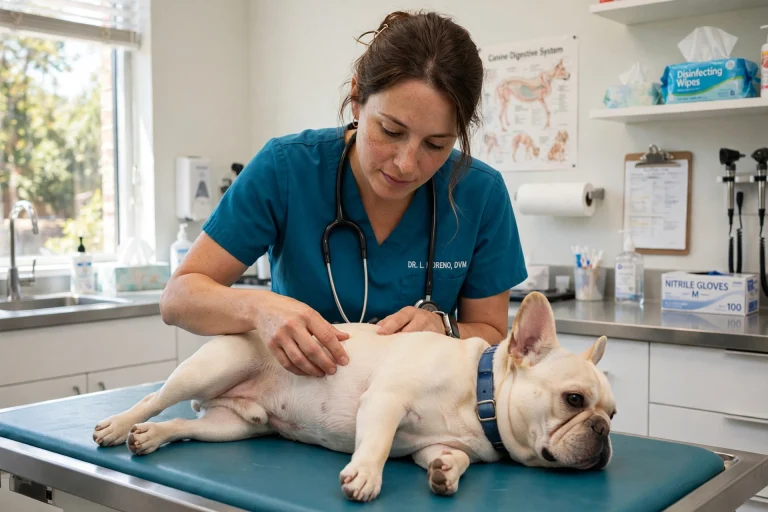
Step 1: Book the vet visit and set the target. The vet confirms ideal weight and body condition, rules out medical drivers of gain, and sets the daily calorie figure. Puppies, pregnant dogs, seniors with other conditions, and dogs on medication belong in this vet-first route, not a home plan. So does any dog with breathing distress or collapse. Casual effort usually fails: in caseload work summarised by Haddad, more dogs gained than lost over follow-up even with veterinary involvement, at 56.5 percent against 43.5 percent.
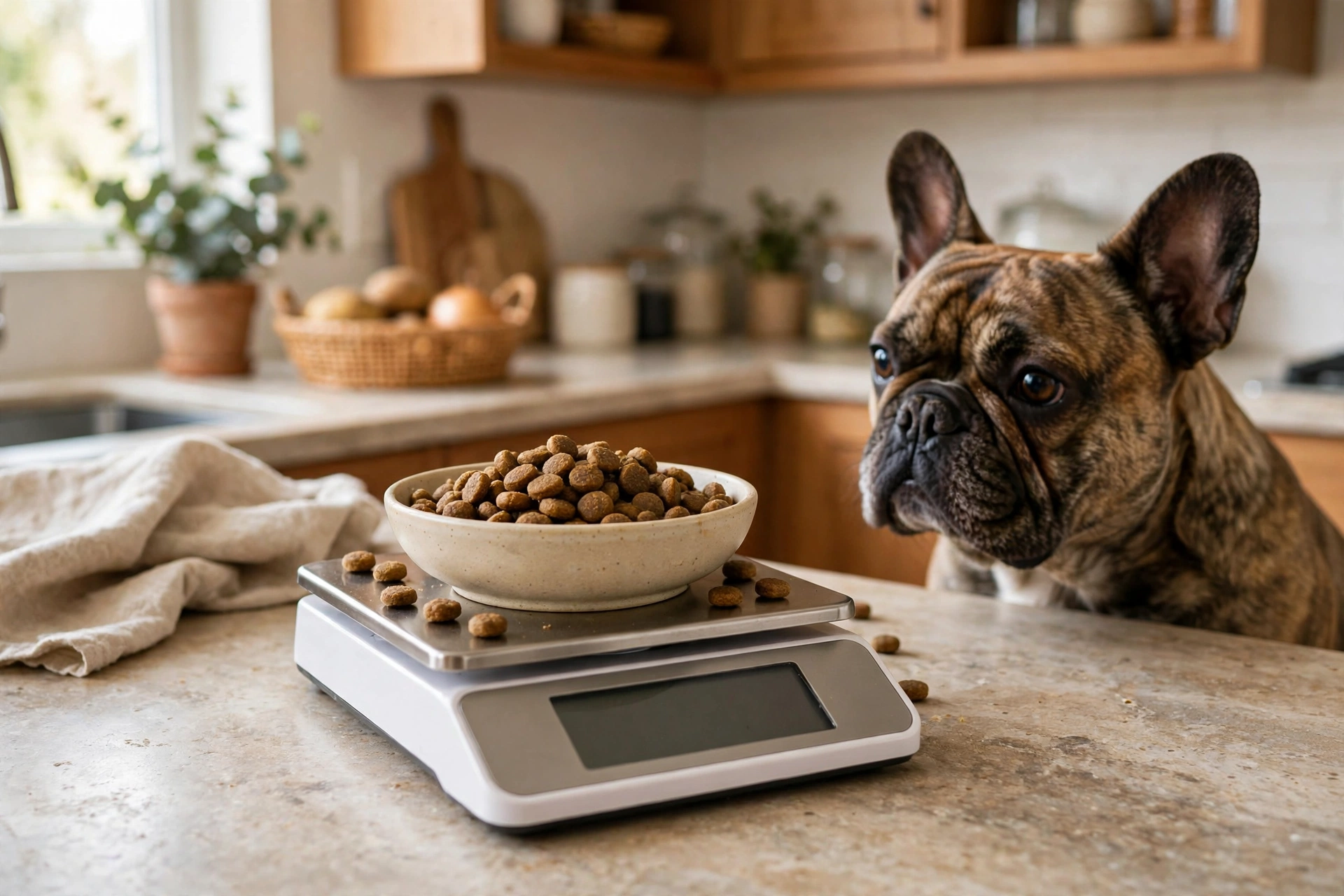
Step 2: Weigh every meal in grams. In the University of Guelph study, 100 owners portioned food with three common measuring devices, and results checked against a gram scale ranged from 48 percent too little to 152 percent too much. The worst errors landed on the smallest portions, exactly what a 25 lb dog eats. The researchers recommended a kitchen gram scale, and VCA Hospitals gives the same advice.
Step 3: Choose the food route honestly. Feeding much less of a regular food also cuts essential nutrients. VCA notes that regular and over-the-counter weight foods do not re-concentrate nutrients for calorie restriction, which can produce deficiencies, naming choline and arginine. Therapeutic weight-loss diets are fortified for restricted calories. At a score of 6 with a little to lose, a measured reduction under vet guidance may be enough. At 7 or above, a therapeutic diet is the safer tool. Prescription diets need veterinary authorisation in the US.
Step 4: Put treats on a budget. VCA’s rule is firm: no more than 10 percent of daily calories from treats, snacks, and people food combined. On a 430 kcal ration, that is about 43 kcal per day for every treat put together. Low-calorie commercial treats run under 15 kcal per piece. Most fresh or plainly cooked vegetables, with no butter, salt, or cheese, can serve in moderation, so ask your vet team which and how much. Pre-measure the day’s allowance into one container each morning. When it is empty, treating switches to petting, play, or a short walk.

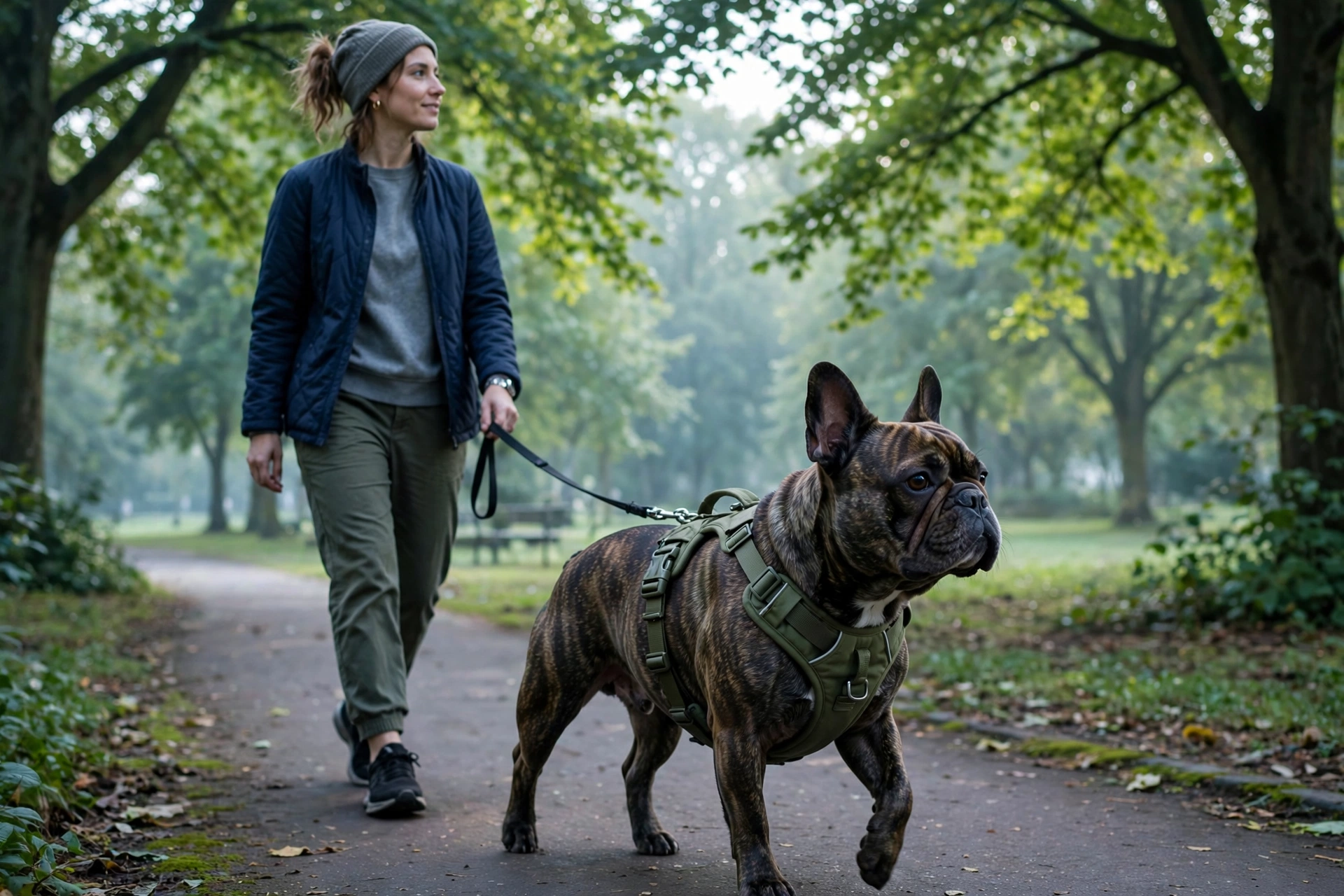
Step 5: Move more, the flat-faced way. Weight loss is driven mainly by calories. Activity protects muscle and joints, and it builds gradually. VCA advises adding a minute or two each day, building toward a few minutes of movement two or three times a day. For a Frenchie, that means short walks at cool times, on a harness so nothing presses on the airway. One firm warning: Frenchies are front-heavy, poor swimmers. Never use swimming without a life jacket and a person within reach. An underwater treadmill at a rehab facility is the supervised version.
Household rules that hold the plan together:
- Pre-measure meals, and keep the day’s treats in one visible container.
- Feed other pets separately, and block access to their bowls.
- Ask neighbours and family not to feed your dog. One kind neighbour can erase a week of math.
- Keep a food and activity diary, and repeat the photos monthly.
Timeline, Plateaus, and Troubleshooting
Set the pace before frustration sets it for you. AAHA programmes target 1 to 2 percent of body weight lost per week. VCA gives a broader range of 0.5 to 2 percent and notes that overweight pets typically need many months. For a 30 lb Frenchie, 1 to 2 percent is 0.3 to 0.6 lb per week. That is the plan working, not failing.
Weigh in at the clinic every two weeks, on the same scale. If weekly loss falls outside the band, the ration adjusts by about 10 percent. Never crash-cut the food. If there is no loss after 4 to 6 weeks, book a vet recheck.
When progress stalls, work the VCA checklist first. Is someone sneaking treats? Does your dog reach another pet’s food? Is a neighbour feeding him? Has the portion crept back to a scoop?
Quick tip: Weigh at the same time of day, before breakfast, on the same scale. A recent meal can swing a small dog’s reading enough to fake a plateau.

What a Weight-Loss Plan Costs in the US in 2026
The starting vet visit typically runs about $60 to $175 depending on region. A national average exam figure sits near $89. Bloodwork, if your vet wants a baseline or thyroid check before the diet, costs extra. Ask your clinic what a weigh-in visit costs between exams. Many clinics handle scale checks cheaply or free.
Therapeutic food is the main ongoing cost, and it needs veterinary authorisation. Hill’s Prescription Diet Metabolic dry costs $52.99 for the 7.7-lb bag and $133.99 for the 27.5-lb bag at Chewy, checked in October 2026. A Frenchie eating about 1 and a third to 1 and two-thirds cups a day uses roughly 7 to 9 lb a month, so budget about $50 to $65 a month at the small-bag price. That is an estimate from bag prices and the feeding table, not a quote. Royal Canin Satiety Support dry is typically about $53 for the starter-size bag at big-box retailers, with larger bags around $100 and up.
A home pet scale is optional, at about $40 to $130. The free method tracks a trend: weigh yourself holding your dog, then subtract your own weight. The kitchen gram scale is a separate, cheaper purchase, and it is the one that matters daily.
Do this, not that:
- Do price the plan as exam plus food per month, so the real cost is clear first.
- Do not skip the starting exam to save money. The target weight and medical rule-outs are the plan.
Frequently Asked Questions
How much should a French Bulldog weigh? The AKC standard caps the breed at 28 lb, with no minimum set. Typical adults run about 16 to 28 lb, males commonly 20 to 28 lb and females 16 to 24 lb. Judge your dog by body condition first: ribs felt easily, a waist from above, and a tuck from the side at 4 to 5 out of 9.
Is my French Bulldog fat if he weighs 30 lb? Probably carrying excess, but the number alone does not decide it. Run the rib, waist, and tuck check. A large-framed dog can be lean slightly over 28 lb, and a small-framed dog can be fat under it. If ribs need pressing and the waist has gone, book a vet visit and get a score on record.
How many calories does a French Bulldog need to lose weight? Programmes feed the resting energy requirement at ideal weight. Worked examples: about 366 kcal per day for a 20 lb ideal, 394 kcal for 22 lb, 431 kcal for 25 lb, and 471 kcal for 28 lb. Treats stay inside 10 percent of that figure. Your vet sets your dog’s number.
How fast should a French Bulldog lose weight? The usual target is 1 to 2 percent of body weight per week. VCA gives a general range of 0.5 to 2 percent. For a 30 lb dog that is 0.3 to 0.6 lb per week, over many months. Faster is not better.
Can I just feed less of his regular food? For a small excess at a score of 6, a measured reduction under vet guidance may be enough. For larger losses, much less of a regular food cuts essential nutrients with the calories, and therapeutic diets are fortified to prevent that.
Final Word
Start with your hands, not the food bin. Run the rib check tonight, take the side and above photos, and book the visit that turns worry into a number and a target. French bulldog weight is the rare health risk in this breed that sits almost entirely in your hands, measured in grams and small weekly losses. Your dog will not miss the extra handful. He will feel the easier breath on every walk. Save this guide for your first weigh-in, and bring the photos. Good luck to you both, and take it steady.