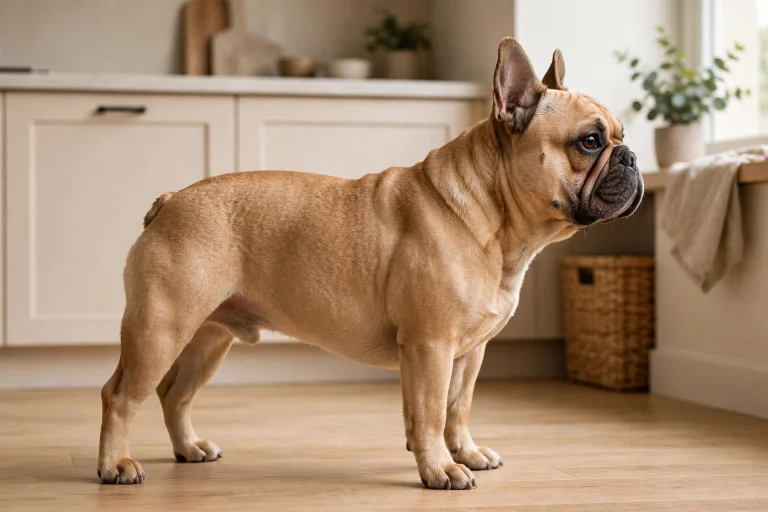
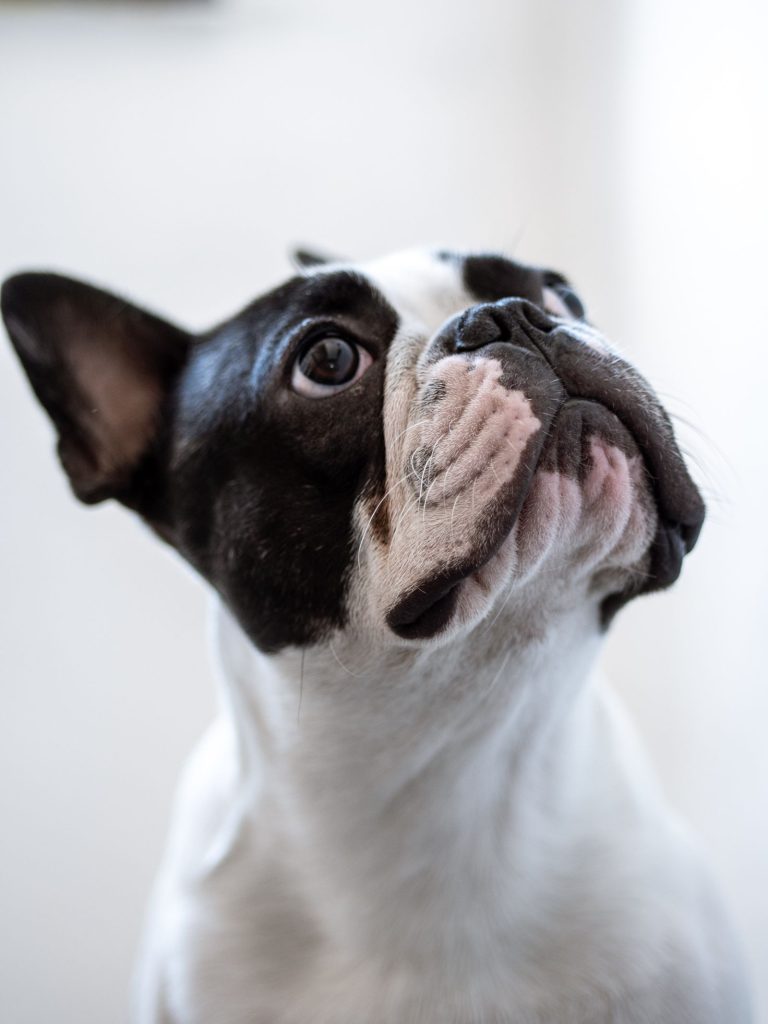
French Bulldog Reverse Sneezing: Causes & What to Do
TL;DR
- French bulldog reverse sneezing is a spasm at the back of the nose and throat. Air rushes in through the nose in loud snorts instead of out, and the dog stands still with his neck stretched out.
- Most episodes last a few seconds to about a minute and end with a swallow. The dog is alert throughout and completely normal straight after.
- Stay calm, stroke his throat gently, and let it pass. A brief hold over the nostrils or a sip of water can trigger the swallow that ends it.
- It is not harmless by default. Frequent episodes, episodes that keep getting longer, discharge from one nostril, or any struggle to breathe between episodes all need a vet.
- Film the next episode. That clip is the most useful thing you can hand a vet.
That Snorting Fit at 2 A.M. Is Usually a Spasm, Not Choking
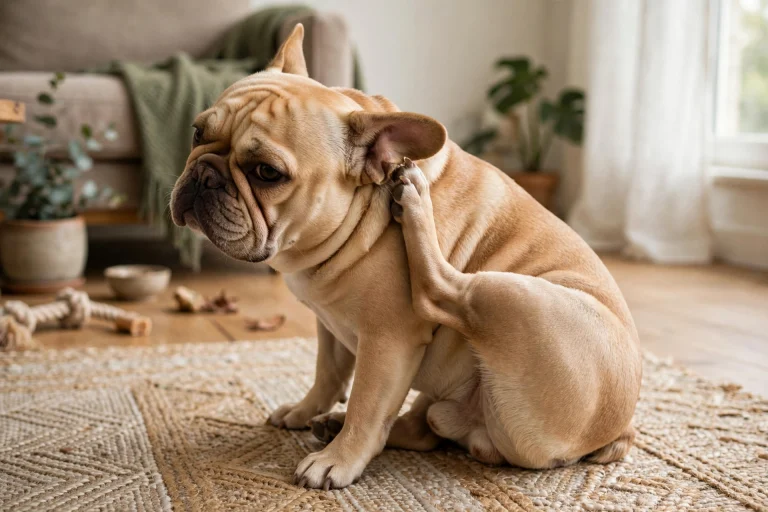
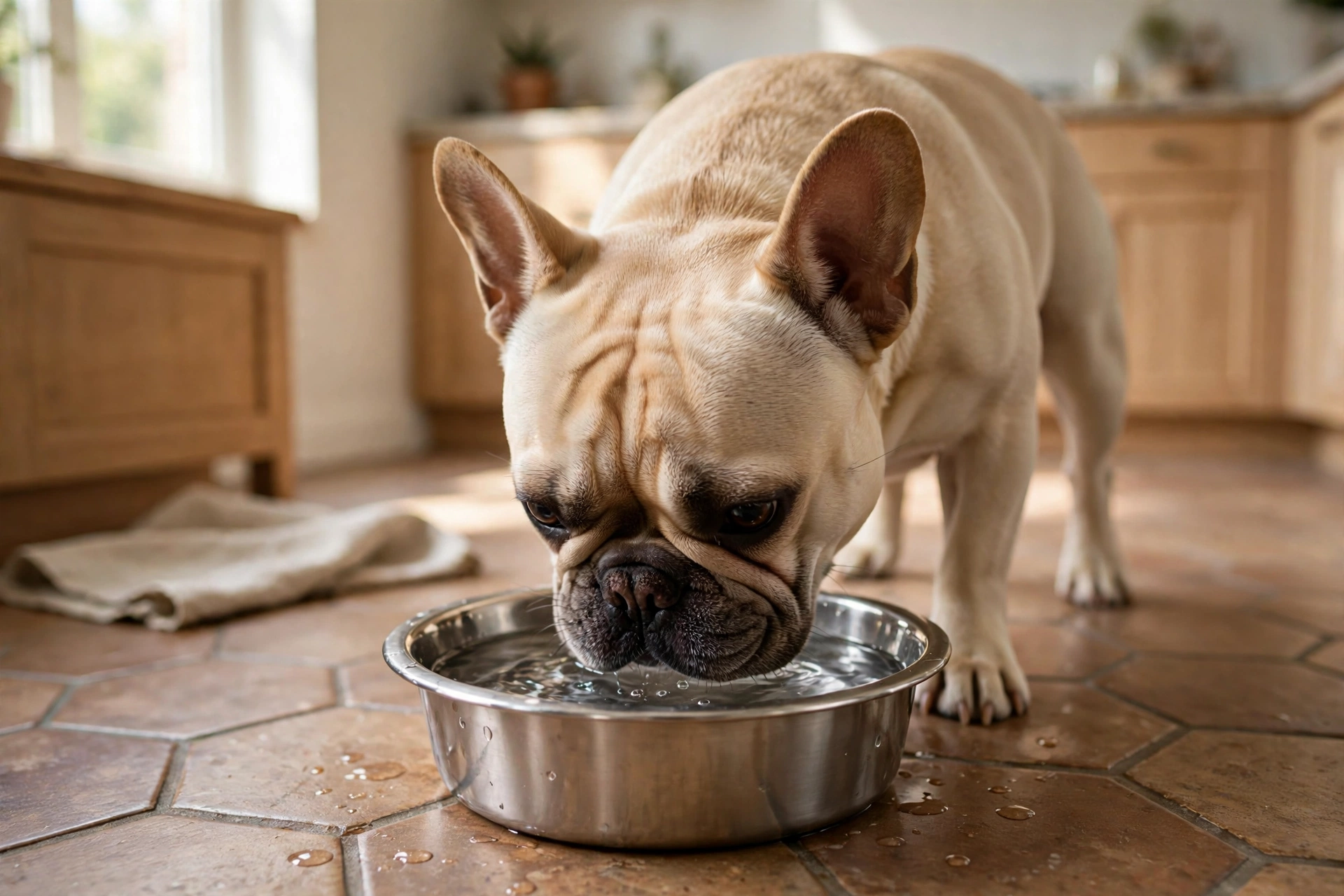
The sound wakes the whole house. Your Frenchie stands frozen in the hallway, neck stretched forward, snorting loudly, as if trying to inhale and choke at once. Then it stops. He shakes himself, trots to his water bowl, and looks at you like nothing happened.
That is the classic picture. Cornell University’s Riney Canine Health Center explains that irritation in the nasopharynx, the area at the back of the nose above the hard and soft palates, sets off a reflex producing loud, sudden, rapid inhalations and what looks like laboured breathing. Vets call it paroxysmal respiration. It is also called the pharyngeal gag reflex.
A normal sneeze pushes air out. A reverse sneeze pulls air in, with the glottis, the opening to the windpipe, closed. At Texas A&M, Dr. Lori Teller describes the trigger as a muscle spasm at the back of the mouth where it meets the throat, briefly narrowing the trachea opening, which is why each inhale sounds like hard work. Cornell and the Merck Veterinary Manual describe the reflex as a way of clearing dust, allergens, or other irritants from the upper airway. The honest limit: VCA Hospitals states that the exact cause is unknown. Any irritation to the nose, sinuses, or back of the throat can set one off.
Quick tip: Air is moving during a reverse sneeze, loudly. A choking dog moves little or no air and paws at his mouth in distress. Treat that picture as an emergency, not a sneeze.
Why French Bulldogs Do This More Than Most Dogs
Any dog can reverse sneeze. Cornell notes it can occur at any age and in both sexes, but it is reported more frequently in dogs under 15 kg and in brachycephalic breeds. The American Kennel Club describes the same pattern in smaller dogs and flat-faced breeds. For balance, VCA also notes that dogs with narrow nasal passages and long noses seem commonly affected. Frenchies are a prone group, not the only group.
The Frenchie reason is anatomy. Cornell lists BOAS, driven by an elongated soft palate, as a named cause, and VCA lists that palate among the triggers. VCA defines it plainly: an elongated soft palate is too long for the mouth, so the excess partially blocks the entrance to the trachea. That tissue sits right where inhaled air passes. Excitement, a hard pull on the lead, or a bit of mucus can draw it into the airstream and flip the spasm on.
Two cautions keep this honest. No study found for this guide puts a percentage on how many French Bulldogs do this, so none appears here. A reverse sneeze alone does not diagnose BOAS either. Many cases have no identifiable cause at all.
The anatomy behind it, in short:
- Short skull and a crowded throat
- A soft palate that runs long for the size of the mouth
- Palate tissue that can be sucked into the airstream during a hard inhale
See the breed rundown in our French Bulldog health problems hub.
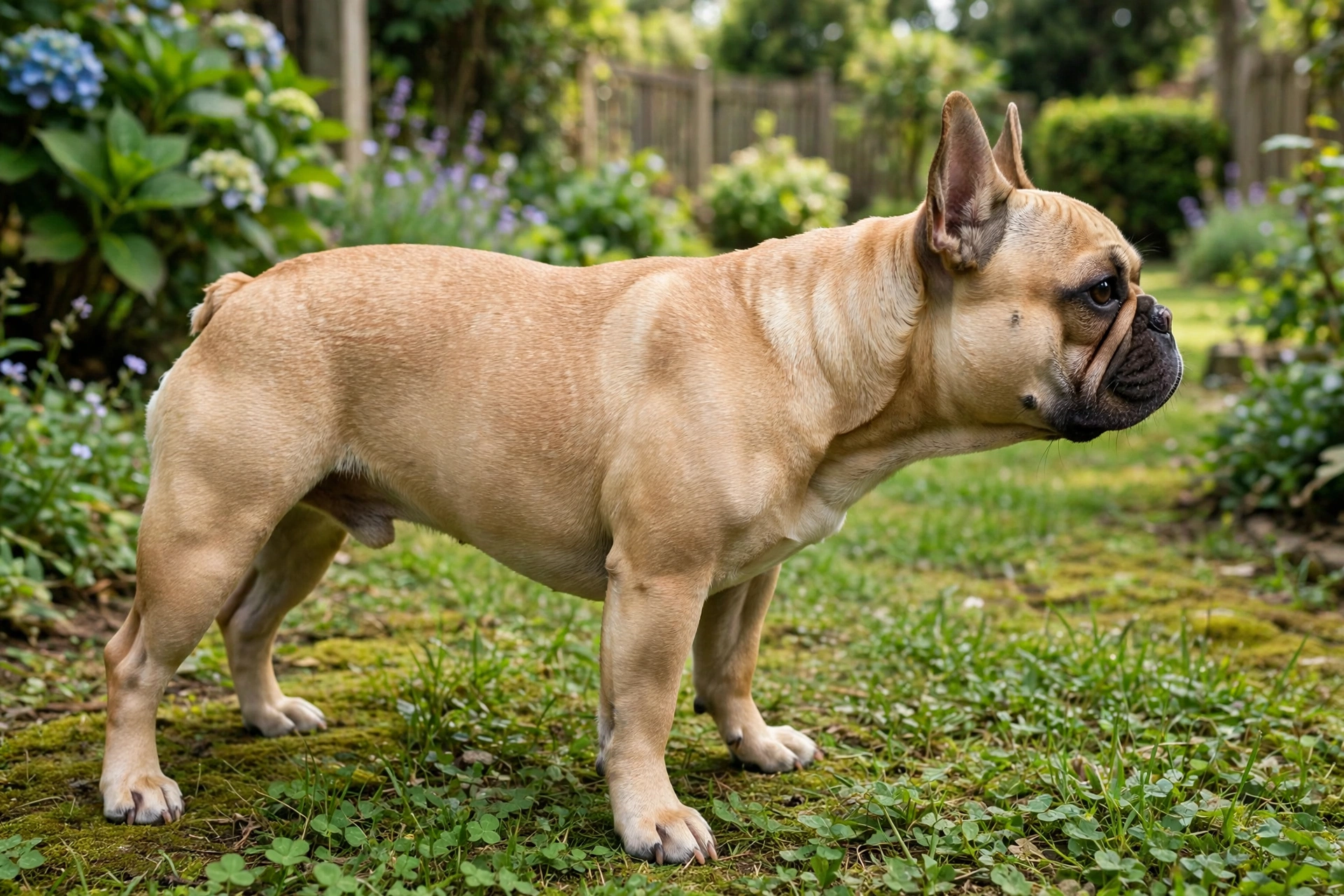
What French Bulldog Reverse Sneezing Looks and Sounds Like
Owners describe it as a snort, a honk, and a choking noise combined, close to Dr. Teller’s own words at Texas A&M. The sound is half the picture. The posture confirms it.
The 30-second posture checklist, from Cornell:
- Standing still on all four feet, not collapsed and not lying down
- Neck extended, head tilted slightly backward
- Elbows pointing outward, away from the chest
- Nostrils flared, mouth closed, lips pulled back
- Chest and abdomen moving rapidly in and out
- Loud, rapid snorting inhalations through the nose
Duration trips owners up because sources give a range, not a number. VCA: several seconds to a minute, longer reported. Cornell: a few seconds to minutes. Texas A&M: around 30 seconds.
The most reassuring fact is what happens either side of the noise. VCA states that the dog is completely normal before and after, with no ill effects, and the AKC agrees. Dr. Teller adds that it is not painful or harmful, and much scarier to the owner than to the dog. Hold on to that pattern: standing, alert, noisy for under a minute, then normal.

What Sets an Episode Off
Most triggers are ordinary. Cornell lists excitement, pulling too hard against a leash, and eating or drinking too quickly.
VCA lists secretions, pollens, grasses and seeds, allergies, smoke, and odours, and the AKC notes that perfumes and carpet cleaners are often cited in these dogs’ histories. Post-nasal secretions belong here too, the extra mucus Merck describes the dog trying to clear. Many owners also notice an episode when a dog steps from warm indoor air into cold outdoor air. That is a commonly reported owner and clinic observation, not a Cornell, VCA, or AKC listing, so log it as a pattern, not a proven cause.
Some triggers are not everyday at all: infections, nasal mites, foreign material such as plant matter, and masses all appear on Cornell’s cause list. A trigger you can remove is a management problem. A trigger inside the nose is a vet problem.
Everyday triggers vs. causes that need a vet:
- Everyday: excitement, leash pull, gulped food or water, pollen, dust, smoke, scented sprays, cleaning products, secretions
- Needs a vet: episodes with sneezing and discharge, suspected mites, plant material after a walk, any mass
What to Do Mid-Episode, and What Is Just Folklore
Start with the hardest instruction: do nothing except stay calm. VCA states most cases require no medical treatment, and Cornell agrees most events are sporadic, mild, and self-limiting. The steps below carry direct veterinary backing. All aim at one thing: a swallow, which resets the spasm.
- Speak to him in a low, soothing voice. The AKC and Cornell both back verbal calming.
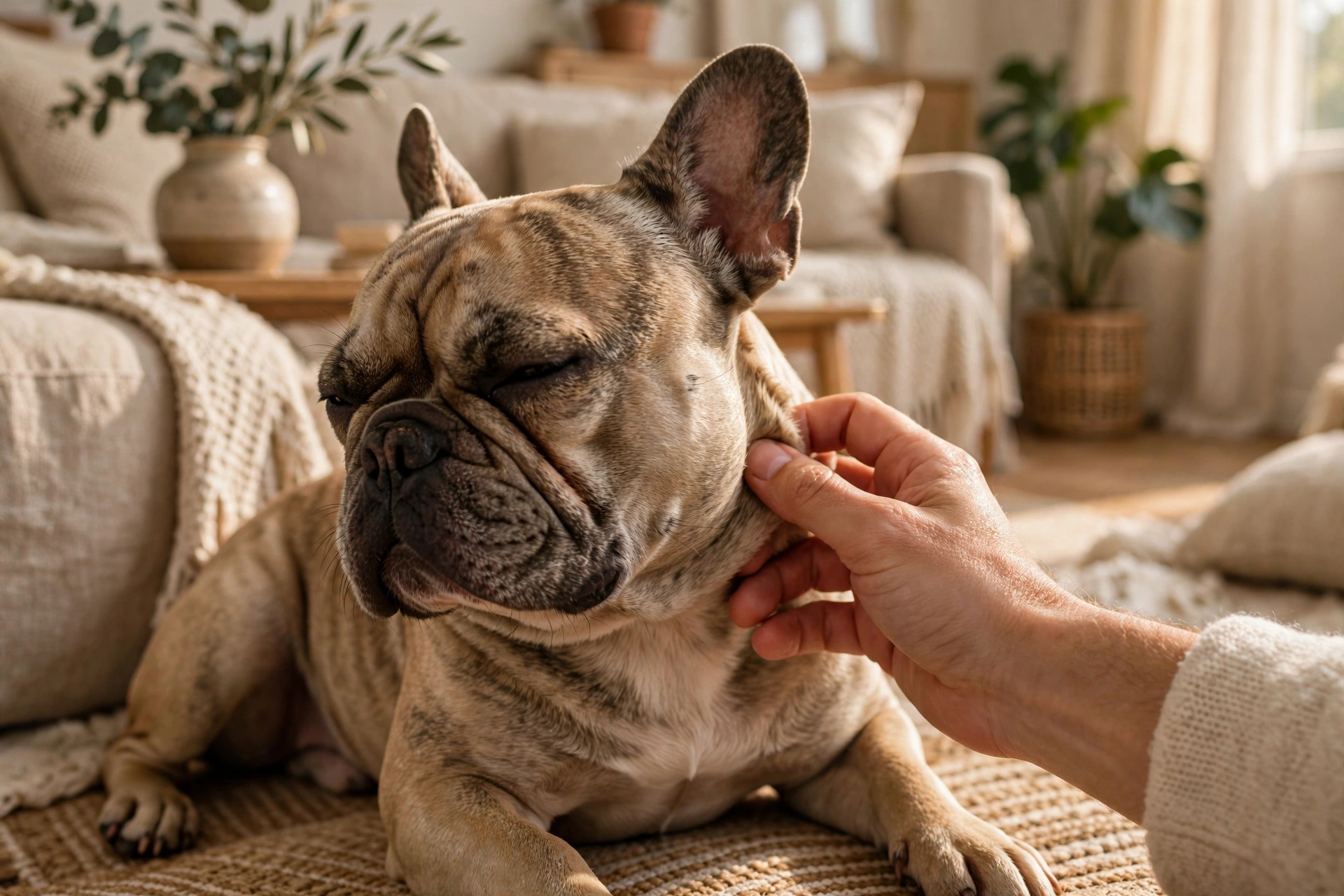
- Stroke or massage his throat gently. The best-supported hands-on step. VCA, Cornell, the AKC, and Texas A&M all describe it.
- Hold his nostrils closed briefly, then release. The AKC describes a one-second hold followed by a light throat massage so the dog swallows, which usually stops the spasm. Cornell gives the same hold at a few seconds. Release at once if he panics, and never keep a flat-faced dog’s nostrils shut.
- Offer something to lick or drink. VCA notes this may stimulate swallowing and clear a possible irritant. Once he exhales through the nose, the attack is usually over.
- Move him to fresh air. The AKC suggests a cool area or outside air, and the AKC’s Chief Veterinary Officer, Dr. Jerry Klein, notes that removing the dog from the irritating environment corrects most cases. A light blow in the face can also trigger a swallow.
Now the folklore. Owners online lift hind legs, lift the dog by the front of the body, tap the chest, and press acupressure points. None has backing in VCA, Cornell, AKC, Texas A&M, or Merck guidance. The steps above also have a limit: they end a simple spasm. They do not treat breathing distress, a foreign body, mites, or a seizure. An episode that resists them and escalates means stop, check the ladder, and act on what you see.
Do this, not that:
- Do: stay close, speak softly, stroke the throat, offer water once he settles
- Do not: force his mouth open, hold his nostrils shut and keep them shut, or repeat tricks while his breathing gets harder
The Red-Flag Ladder: French Bulldog Reverse Sneezing vs. Everything Scarier
Read the ladder first, then the table.
Green: likely a harmless reverse sneeze. Standing, snorting air in, mouth closed, alert, gums pink, stops within about a minute, normal immediately after, no discharge, breathing normal between episodes.
Amber: book a vet. Episodes becoming frequent, daily, or clustered, or lasting longer than usual. A new cough, especially a dry honk. Sneezing with discharge. Face-pawing or nosebleeds. First episodes in a puppy or senior. Bring the video.
Red: emergency now. Breathing effort at rest, or breathing that does not settle. Blue, purple, or grey gums or tongue. Overheating, collapse, or fainting. A fall onto his side with paddling legs, drooling, and no response to you.
Three look-alikes do most of the damage when they get misread.
Collapsing trachea is a cough out, not a snort in. VCA describes a persistent, dry, harsh cough, sometimes called a goose honk cough, and the AKC contrasts the two directly: a reverse-sneezing dog stands still and snorts, while tracheal collapse honks and is more serious. It recurs over days and worsens at night, with excitement, heat, or collar pressure. Diagnosis needs radiographs, fluoroscopy, or endoscopy, and the cartilage keeps deteriorating despite treatment.
BOAS distress does not start and stop cleanly. It is effortful breathing that escalates. Stertor is the low-pitched snoring noise from the pharynx, made by an elongated, thickened soft palate vibrating. Stridor is high-pitched and points to a narrowed or collapsed larynx. The table below lists the emergency signs. Most dogs are diagnosed at 1 to 4 years of age. Keep him cool and calm, use a harness, and transport him. Do not wait it out. Our guide to BOAS in French Bulldogs covers the surgery decision.
A seizure is the opposite posture. VCA describes a seizing dog falling onto his side and losing consciousness. Legs stiffen, then paddle, with jaw chomping and heavy drooling. The giveaway is what follows: confusion, pacing, seeming blind, with recovery up to 24 hours, where a reverse-sneeze dog is normal immediately. Seizures typically last 1 to 2 minutes, overlapping reverse-sneeze length, so posture, responsiveness, and the state after decide it, not the clock. Never put your hands in a seizing dog’s mouth.
| Condition | Sound and posture | Between and after | Key signs | Urgency |
|---|---|---|---|---|
| Reverse sneeze, baseline | Snorting inhalations through the nose. Standing, neck extended, elbows out, mouth closed | Completely normal before and after | Seconds to about a minute. Alert, pink gums, settles with a swallow | Monitor. No treatment if occasional |
| Collapsing trachea | Cough out through the mouth. Persistent, dry, harsh goose honk | Recurs over days. Worse at night, with excitement, heat, or collar pressure | Classic in toy breeds, mostly 4 to 14 years. Progressive | Book a vet promptly. Emergency if blue gums or collapse |
| BOAS respiratory distress | Effortful breathing that escalates. Stertor is low-pitched pharyngeal snorting. Stridor is high-pitched, from the larynx | Does not return to normal. Cannot settle | Open-mouth breathing, elbows out, abdominal effort, blue gums, overheating, collapse | Same-day or emergency. Cool, calm, harness, transport |
| Seizure | Falls onto his side, loses consciousness. Legs stiffen, then paddle. Drooling, often urination or defecation | Confused afterwards, may pace or seem blind. Recovery up to 24 hours | Unresponsive during the event. Typically 1 to 2 minutes | Emergency if first, long, or repeated. Any suspected seizure needs workup |
| Kennel cough | Loud, high-pitched, persistent honking cough out, often ending in retching | Returns over days. Recent boarding, daycare, grooming, or dog park contact | Nasal and eye discharge, mild fever. Incubation about 6 days. Most recover in 7 to 10 days. Puppies can progress to pneumonia | Book a vet, isolate from other dogs. Same-day if laboured breathing or a puppy |
| Nasal mites | Reverse sneezing is a presenting sign. Mites live deep in the nasal cavity | Persistent sneezing, discharge, face-rubbing. Spreads nose-to-nose | Nosebleeds, impaired scenting. Mites over 1 mm, may only show on rhinoscopy | Book a vet promptly |
| Foreign body or polyp | Sudden violent sneezing fits, face-pawing, nose-rubbing. A polyp causes chronic, progressive signs | One-nostril discharge with face-pawing points to a foreign object | Bloody or pus-like one-sided discharge, sudden nosebleed | Book a vet promptly. Same-day if bloody or a grass seed is suspected. No home removal |
Kennel cough stays contagious for up to 8 weeks after signs resolve, and Cornell notes the bacteria survive in the environment for at least 10 days.

When It Is a Vet Visit, Not Wait and See
A trust point: no authoritative source publishes a magic number. None of Cornell, VCA, the AKC, Texas A&M, or Merck sets a count of episodes per day or week that means see a vet. What vets use is a pattern. Cornell’s pathway starts when episodes are frequent or more severe, and Texas A&M advises a vet whenever breathing is affected, episodes recur, or coughing, discharge, or seeming unwell joins them.
So the trigger is change: new, frequent, longer, clustered, different in character, or carrying any added sign. Time is a clue, not the test. An episode that will not stop, episodes restarting back-to-back, or any episode with collapse, disorientation, or a blue tongue is not reverse-sneeze territory. A 90-second standing snort ending in a swallow and a normal dog is very different from 60 seconds of escalating effort.
Discharge has its own rules, stated most strongly by Merck. Discharge from one nostril with face-pawing suggests a foreign object until proven otherwise. Bloody discharge, or discharge that gains blood over time, puts tumour, fungal disease, or chronic rhinitis on the list. Puppies get a lower threshold: Cornell warns kennel cough can progress to pneumonia in puppies. Breathing difficulty between episodes is never a reverse-sneeze sign: the dog is normal between episodes by definition, so effortful breathing at rest points back to BOAS.
Book it if you can tick any of these:
- Episodes on most days, in clusters, or lasting longer than they used to
- A new cough, especially a dry honk out through the mouth
- Discharge from one nostril, or any bloody discharge
- Face-pawing, nosebleeds, or a nose rubbed raw on the ground
- Lower appetite or energy alongside the episodes
- First or frequent episodes in a puppy, or laboured breathing at any age
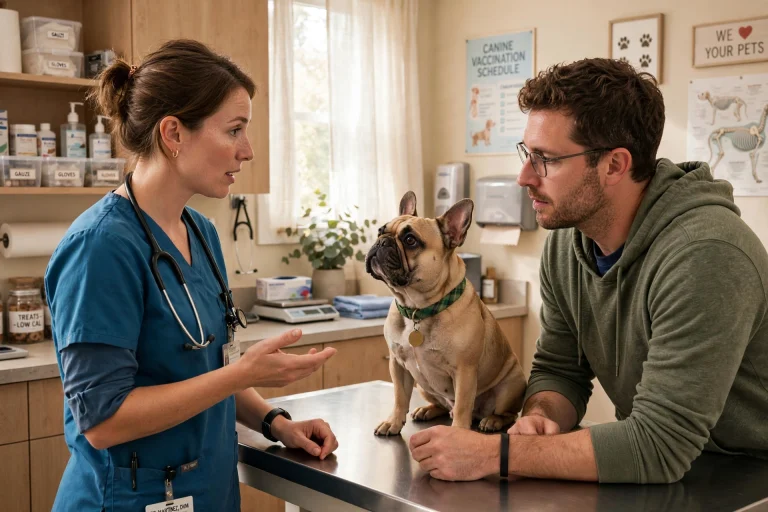
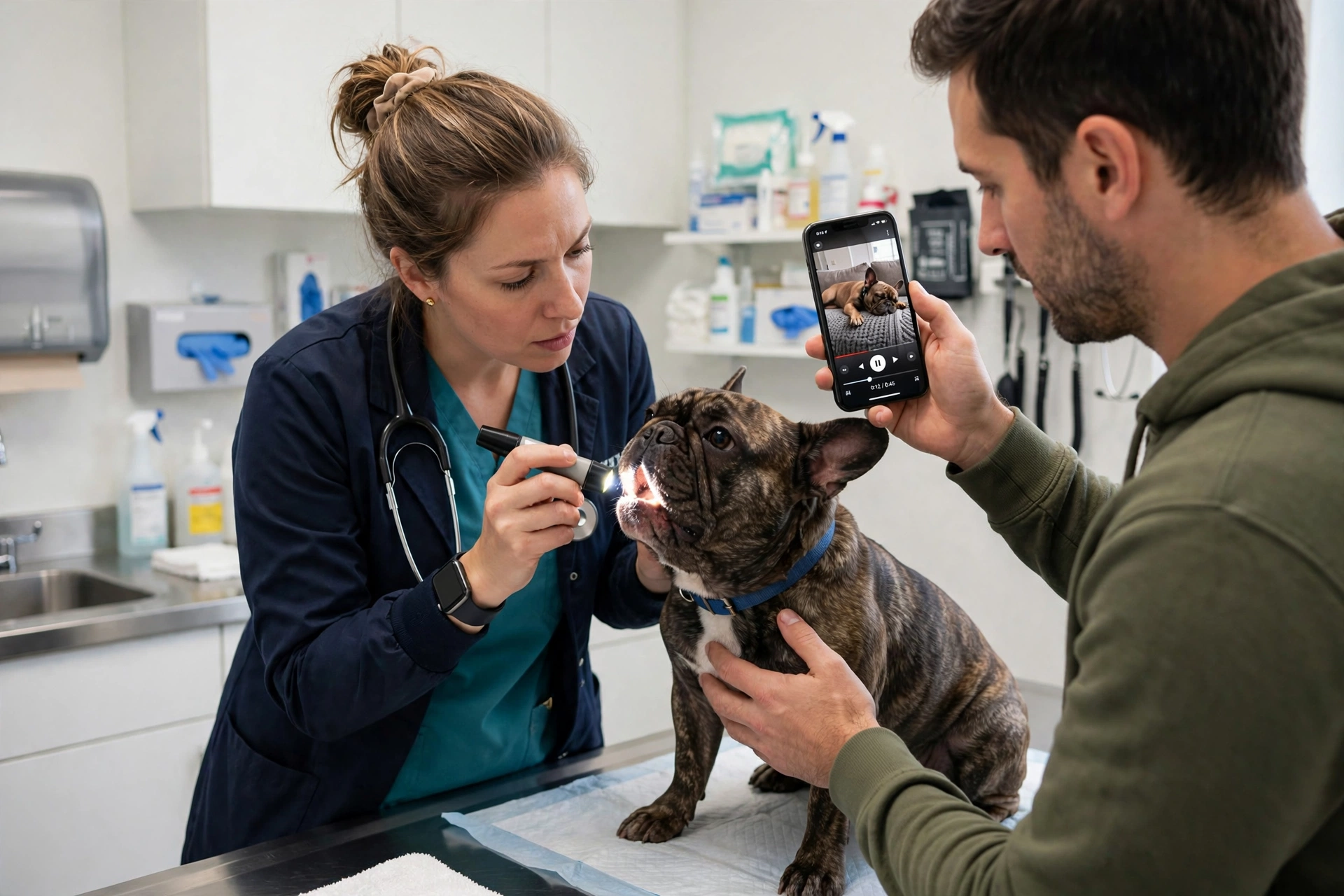
Bring two things: a video of a typical episode and of the worst one, noting the date, time, and what happened just before it, and a log of frequency, duration, triggers, discharge and which nostril, appetite and energy. VCA diagnoses this condition from history and clinical signs while ruling out the mimics, so that clip and log are the diagnosis kit. Our complete French Bulldog owner’s guide shows where a log fits into routine breed care.
What the Vet Does for a Dog Who Will Not Stop
The workup climbs a ladder. Most dogs step off early.
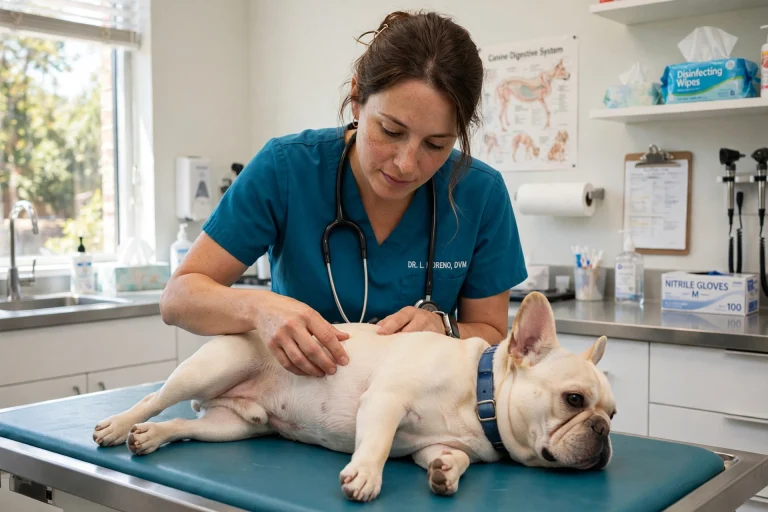
- History and examination. The vet works from your history, video, and clinical signs, ruling out upper respiratory infection, collapsing trachea, nasal tumours or polyps, and foreign bodies in the nose or mouth. Persistent cases may need a sedated oral exam to see the palate and larynx.
- A trial treatment for hidden causes. Cornell describes vets treating for allergies and mites first, to see if there is an improvement.
- Blood tests, allergy tests, and X-rays. VCA lists all three to rule out look-alike conditions. Merck adds nasal cultures for nasal disease.
- CT of the head. The imaging step Merck highlights when a mass, fungal disease, or deep foreign body is suspected.
- Rhinoscopy, with biopsy if needed. If symptoms persist after the trial, Cornell’s path adds head X-rays and rhinoscopy to look for a mass or foreign object.
- Palate and BOAS assessment. Cornell supports palate-shortening surgery for dogs with an elongated palate and other signs of respiratory distress. Reverse sneezing alone is not an indication for surgery in any source used here.
Treatment follows the cause. No cause found means no medication, just trigger management: a harness instead of a collar, a lean weight, less smoke and scented spray, calmer greetings, slower feeding. For allergy-related cases, VCA notes a vet may prescribe anti-inflammatory, antihistamine, or decongestant medication, and the AKC describes antihistamines as a vet option when the problem is serious, chronic, and allergy-related. For nasal mites, no drug is FDA-approved. Treatment is off-label and vet-directed, with macrocyclic lactone options such as selamectin, ivermectin, or milbemycin oxime, and in-contact dogs may need treating too. Foreign bodies and polyps come out under anaesthesia.
Quick tip: Ask for an itemised estimate before any anaesthesia. Biopsy, contrast, and radiologist fees sit on top of headline procedure prices and change the total.
What It Costs in the US in 2026
US vet pricing has no single national list, so read these as ranges with the setting named, never as a quote.
| Step | Typical 2026 US figure |
|---|---|
| Routine vet exam | $89 average in CareCredit and Synchrony data. Spot range $70 to $174 |
| Emergency exam | $135 average in CareCredit data |
| Blood work, emergency setting | CBC $104, chemistry panel $164 on average |
| X-rays, 2 to 3 views | Roughly $170 to $335 depending on general practice vs. emergency setting, in CareCredit and Synchrony data |
| Sedation | $146 average in emergency-setting data. Relevant because rhinoscopy, CT, and sedated oral exams bundle it |
| Allergy testing | About $296 on average in Synchrony data, excluding exam fees. Specialty intradermal testing $600 to $800, serum testing $200 to $300, at one hospital example |
| CT scan | $1,200 to $3,000 at specialty imaging centres, per Sage Veterinary Imaging. CareCredit 2024 average $1,113 for dogs. One Florida clinic lists head CT at $600 as a floor |
| Rhinoscopy | Roughly $500 to $2,000 or more by setting and bundling. Combined CT, rhinoscopy, biopsy, and bloodwork workups run $1,800 to $2,500 |
| Nasal mite treatment itself | Usually under $300 for drugs plus the visit, per Petco’s veterinary guidance. Finding the mites costs more than treating them |
Budget this way: exam, bloods, X-rays, and an allergy or mite trial typically stay in the low hundreds. Add CT, rhinoscopy, and biopsy under anaesthesia at a referral centre and expect a low-thousands estimate.
Frequently Asked Questions
Can a reverse sneeze hurt my Frenchie? For the classic episode, no. Texas A&M states it is not painful or harmful, and VCA calls complications very rare during these attacks. That covers the classic episode in an otherwise normal dog. Frequent, worsening, or changed episodes, and any with discharge, bleeding, or breathing difficulty between episodes, sit outside it and need a workup.
How long is too long? There is no single cutoff. VCA puts most episodes under a minute, noting longer durations are reported, and Cornell allows up to a few minutes. Judge the dog, not the stopwatch. An episode that will not stop, restarts back-to-back, or comes with collapse, disorientation, or a blue tongue is an emergency at any length.
How do I tell a reverse sneeze from a collapsing trachea? Follow the air. A reverse sneeze snorts air in through the nose with the mouth closed, lasts under a minute or so, and leaves the dog normal. Tracheal collapse is a dry, harsh goose honk cough out through the mouth that recurs over days and worsens with excitement, heat, or collar pressure.
Can I give an antihistamine at home and skip the vet? No. In the sources for this guide, antihistamines appear only as a vet-prescribed option for serious, chronic, allergy-related cases. No authoritative source supports owner-dosed medication as a substitute for working up frequent episodes, and this guide publishes no home doses.
Will he outgrow it? Probably not, and he does not need to. The AKC notes that repeat episodes throughout a dog’s life are not uncommon. What deserves a visit is change: more often, longer, harder effort, or new signs alongside it.
Final Word
A french bulldog reverse sneezing episode sounds like an emergency and, in the classic standing, snorting, under-a-minute form, it is a spasm that asks for a calm voice and a throat stroke, nothing more. Your real skill is not stopping the noise. It is spotting the episode that breaks the pattern, the cough out, the breathing that never settles, the dog who is not himself afterwards. Save the ladder in this guide, film the next episode, and share it with the Frenchie owner who will get that 2 a.m. fright next. Stay steady. He takes his cue from you.