French Bulldog Training Guide: The Complete Beginner’s Manual
TL;DR
- French bulldog training works best with rewards only. AVSAB says reward-based methods should be used for all dog training, with no exceptions.
- Stubborn is usually a motivation problem. Frenchies are food-motivated and people-focused, so pay well and keep sessions short.
- Socialize early and safely. The most sensitive period runs from about 3 weeks to about 3 to 4 months, before a puppy is fully vaccinated.
- Housetrain on a schedule. Use age in months plus one as an AKC guideline for the longest wait.
- Clip the leash to a harness, never to a collar, on a breed with a narrowed airway.
- Keep sessions to 5 to 10 minutes in cool conditions, and teach alone time from week one.
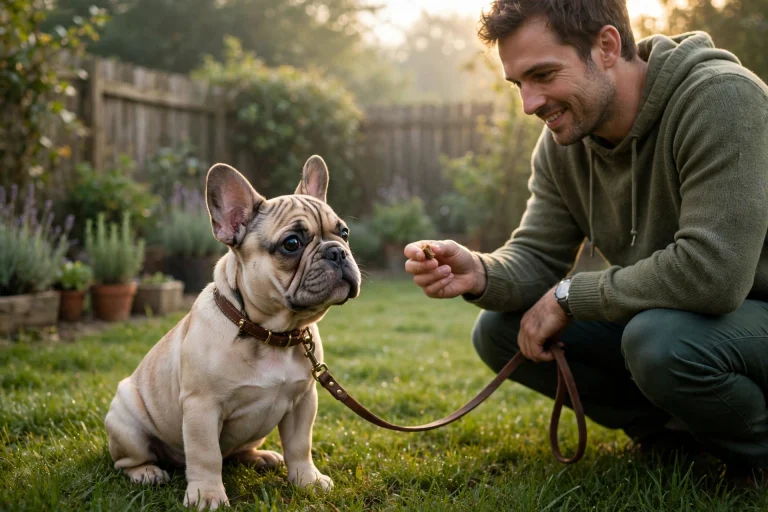
Your puppy ignores the cue he knew perfectly yesterday, in your kitchen, for a piece of chicken. That is not spite. It is information, and learning to read it is most of french bulldog training. This hub covers the philosophy, gear, socialization, housetraining, the crate, the first cues, walking, barking, reactivity, alone time, and 2026 costs. Most methods here are general-dog guidance from the AKC, AVSAB, and the ASPCA, applied to a Frenchie. See also our complete French Bulldog owner’s guide.
Your First Week at a Glance
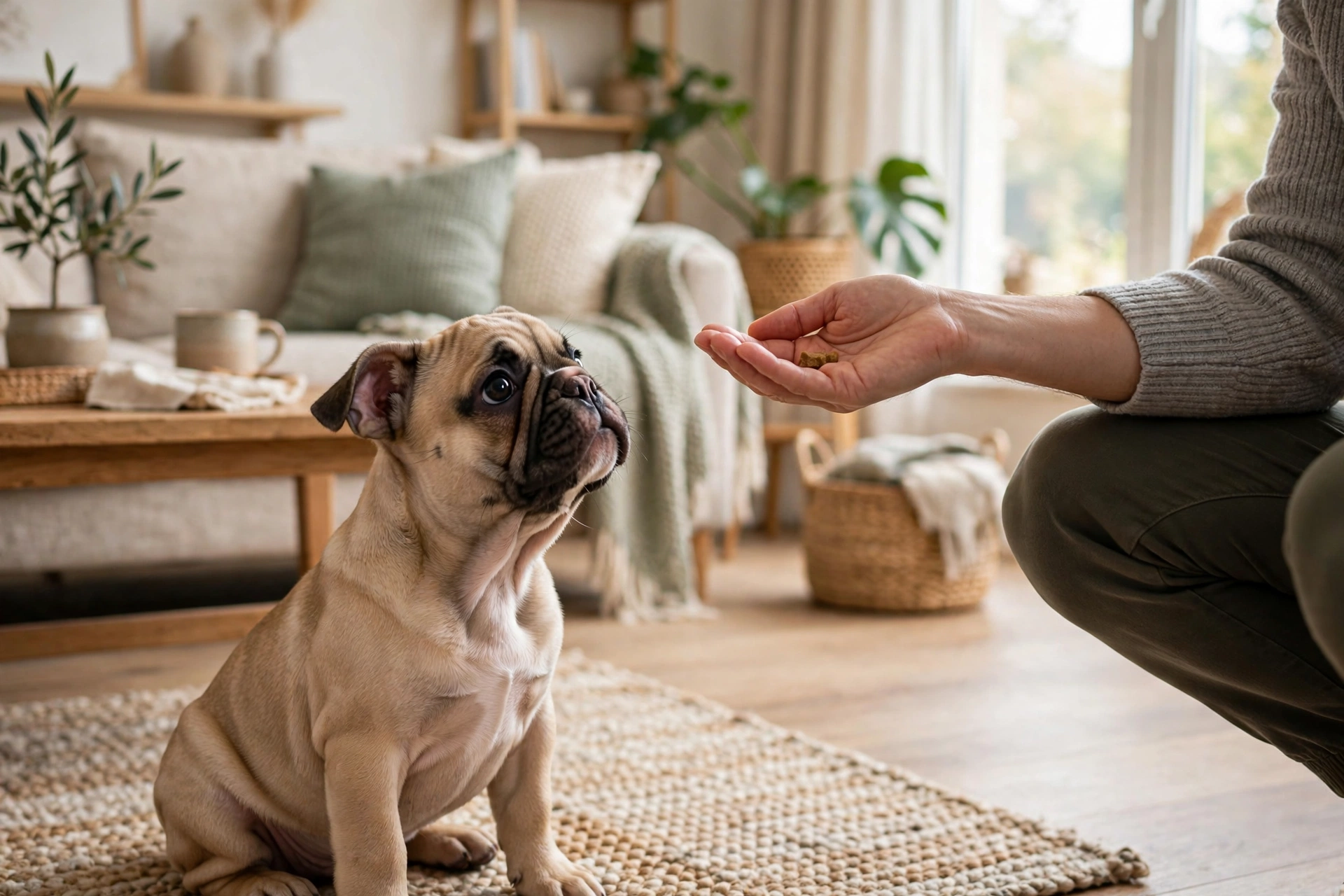
Set the routine before you perfect any cue. Keep treats pea-sized and soft, count them in the day’s food, and use part of the meal ration as pay.
Checklist: your first week
– Fit a harness and let the puppy wear it indoors for short, rewarded periods
– Set the crate up with bedding, door open during the day
– Pick one toilet spot and one cue phrase, and use both every time
– Start name games at feeding times, paying every look toward you
– Practise brief out-of-sight moments behind a closed inside door
How French Bulldogs Actually Learn
The AKC itself calls French Bulldogs stubborn, then reframes the label in the same breath: Frenchies are people pleasers at heart, and food helps them cooperate. A small preliminary C-BARQ pilot of 206 French Bulldogs in Italy found the same pattern, high attachment and attention-seeking with moderate trainability.
Why does a Frenchie stare at you and do nothing? Behavior consultants give four usual reasons. He does not understand the cue in this place, because kitchen skills do not transfer automatically to the park. The reward is worth less than the distraction. He is stressed, tired, in pain, or over-aroused. Or the behavior has not been paid enough times to be reliable. None of that is defiance.
Quick tip: When your Frenchie “ignores” you, check: Does he know this cue here? Is the treat worth it? Is he tired or sore? Has he been paid enough times?
French Bulldog Training Starts With Rewards, Not Force
The AVSAB position statement on humane dog training is blunt. Only reward-based methods should be used for all dog training, including treatment of behavior problems. Aversive methods damage welfare and the dog-owner bond, and there is no evidence they work better in any context. AVSAB counts prong collars, shock collars, shake cans, shouting, and leash jerks as aversive, and rejects the dominance and pack hierarchy ideas that still circulate online.
In practice: pay behaviors you want, remove the reward for behaviors you do not want, and use a marker such as a clicker to pinpoint the moment the dog got it right. Reward-trained dogs in observational work showed increased attentiveness to their owners. Aversive-trained dogs showed more stress signals, including a tense body, lip licking, and yawning.
For a Frenchie there is a physical argument too. The airway is already narrowed, with narrowed nostrils, an elongated soft palate, and a narrower trachea. A tool that tightens around the neck pressures exactly the wrong structure. Our complete BOAS guide covers that anatomy in full.
Do this, not that:
– Do pay within a second or two, every time, while a behavior is new. Do not pay late and hope the dog connects the dots.
– Do end after a success. Do not drill a tired puppy until he quits on you.
– Do use treats, play, and praise. Do not use prong, choke, or shock collars, leash jerks, or shouting.
Socialization: The Window You Cannot Get Back
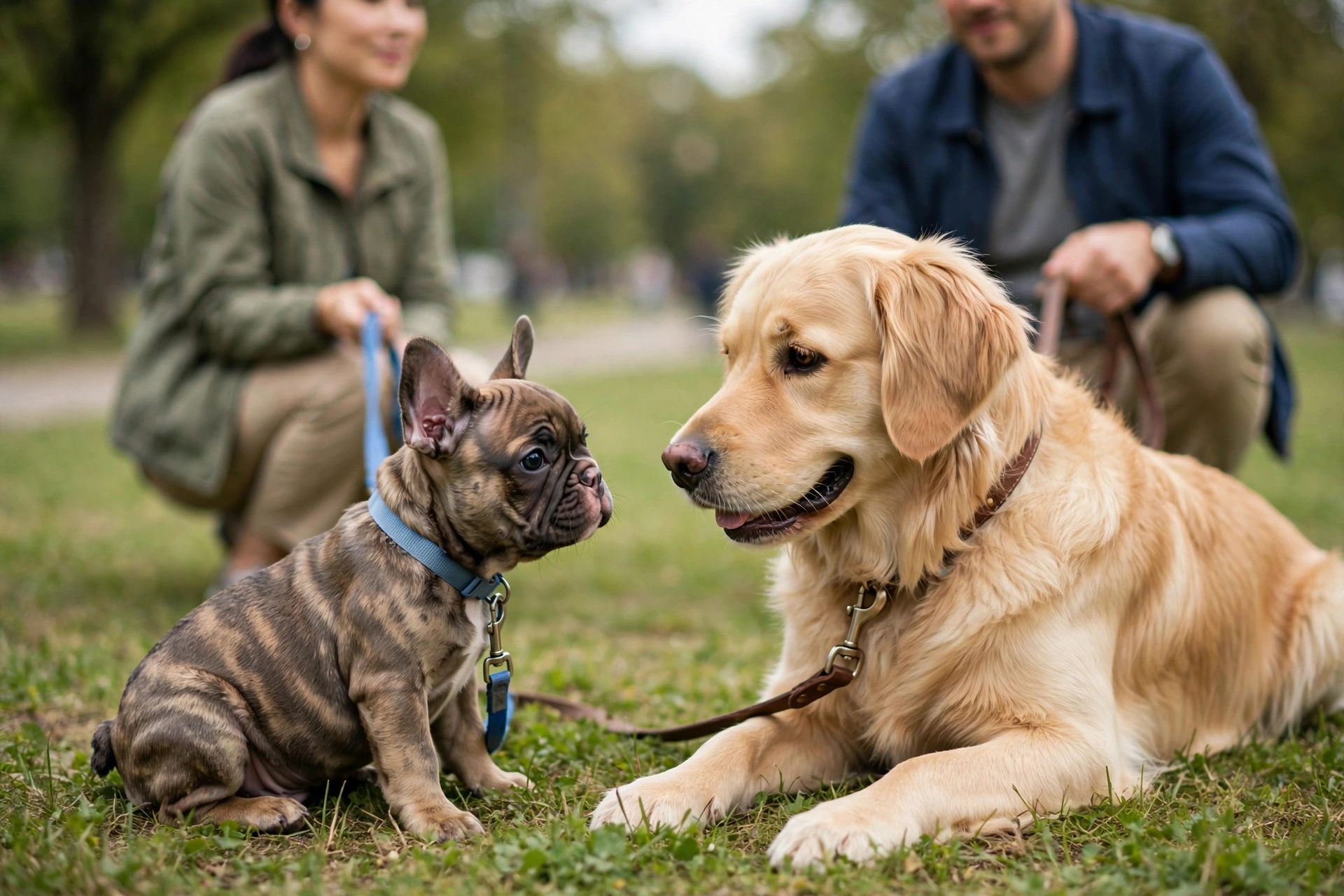
AVSAB calls the first three months of life the primary and most important time for puppy socialization. The wider veterinary literature describes puppies as especially responsive to unfamiliar dogs and environments at roughly 3 to 14 weeks, and the AKC frames exposure work as running to about 16 weeks. Read together: the steepest payoff comes before about 12 to 14 weeks, the sensitive period stretches to about 3 to 4 months, and socialization should not stop at any deadline. AVSAB notes behavioral problems, not infectious disease, are the top cause of death for dogs under three.
Socialize before the vaccine series ends, but safely. AVSAB says classes can start at 7 to 8 weeks, with one set of vaccines at least 7 days before the first class and a first deworming, on clean indoor surfaces. Carry the puppy in busy places, arrange play with known, healthy, vaccinated adult dogs, keep paws off dog parks until your vet clears it, and check local disease risk with your vet.
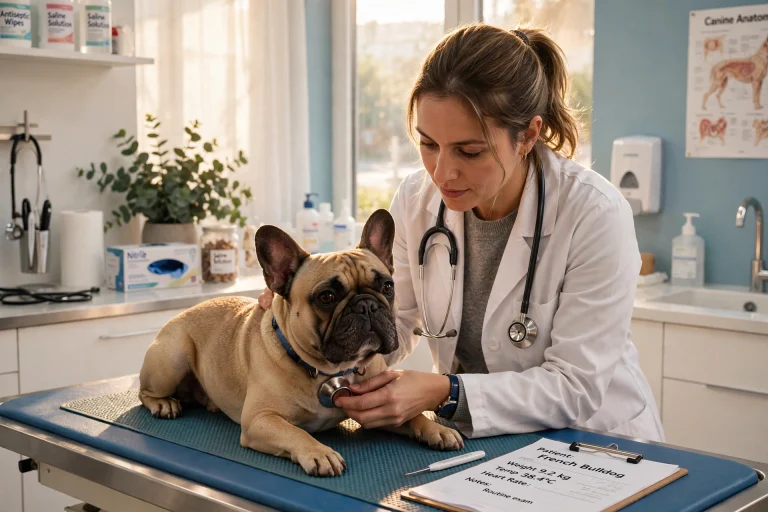
The AKC exposure list for 8 to 16 weeks covers traffic noises, car rides, people of all ages, other dogs, vet visits, and body handling. Handling matters doubly here, because wrinkle cleaning, ear cleaning, and nail trims are weekly life. Our French Bulldog health problems guide explains why.
Checklist: socialization by age
– 7 to 8 weeks: puppy class becomes possible, with the vaccine and deworming rules above
– 8 to 12 weeks: carried outings, new people, household sounds, short car rides, daily handling
– 12 to 16 weeks: wider exposure at the puppy’s pace, known healthy dogs, vet-visit practice
Housetraining on a Schedule, Plus Crate Basics
Housetraining is a scheduling problem, not a character test. The AKC method rests on consistency, close supervision, positive reinforcement, and a predictable routine: same spot, same cue, reward immediately when the puppy eliminates outside. Scheduled meals make timing predictable.
The months plus one rule is an AKC guideline for planning, not a promise and not a target to push. A puppy can generally hold his bladder for about as many hours as his age in months, plus one, so a 4-month-old may manage up to five hours. Young puppies and small breeds do better with a break every hour while awake, overnight too. Complete training often takes several months, with clear progress usually within a few weeks.
Never scold an accident. The AKC is direct that punishment creates confusion, damages trust, and can make puppies reluctant to eliminate in front of people. Clean with an enzymatic cleaner, tighten the schedule, and reward outdoor successes harder.
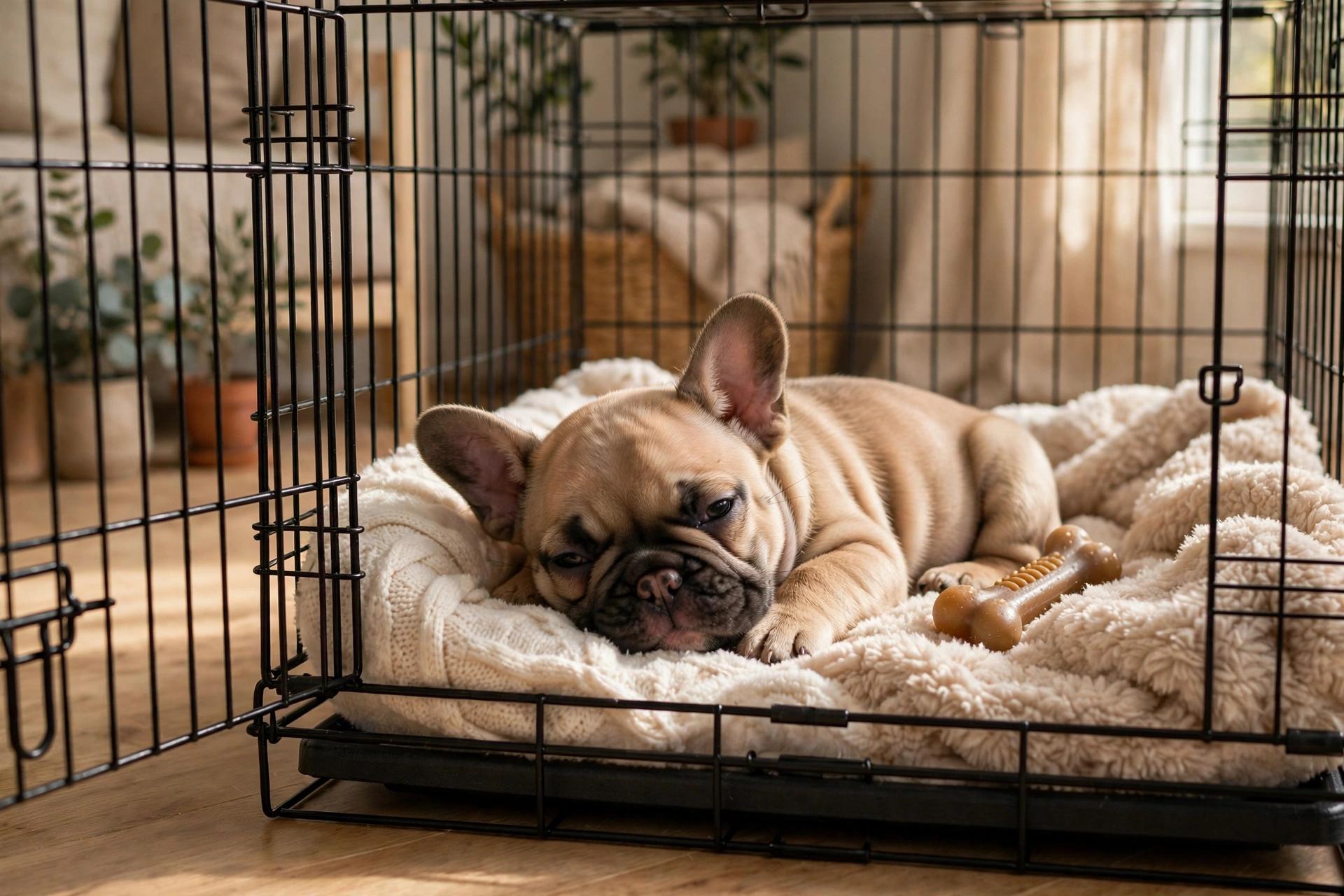
The crate supports the schedule because dogs prefer not to soil their sleeping area. Size it so the puppy can stand, lie down, and turn around, with a divider in a larger crate while he grows. Use it for naps, nighttime sleep, and quiet breaks, and take the puppy straight outside every time he comes out. Never use it as punishment, never leave a puppy in it all day, and treat months plus one as the absolute ceiling between breaks, staying well under it by day.
Checklist: when the puppy goes out
– First thing in the morning, and last thing before bed
– After every nap, meal, and play session
– Every hour while awake for a young puppy
– At the first sniffing, circling, or squatting
The First Cues, in the Order to Teach Them
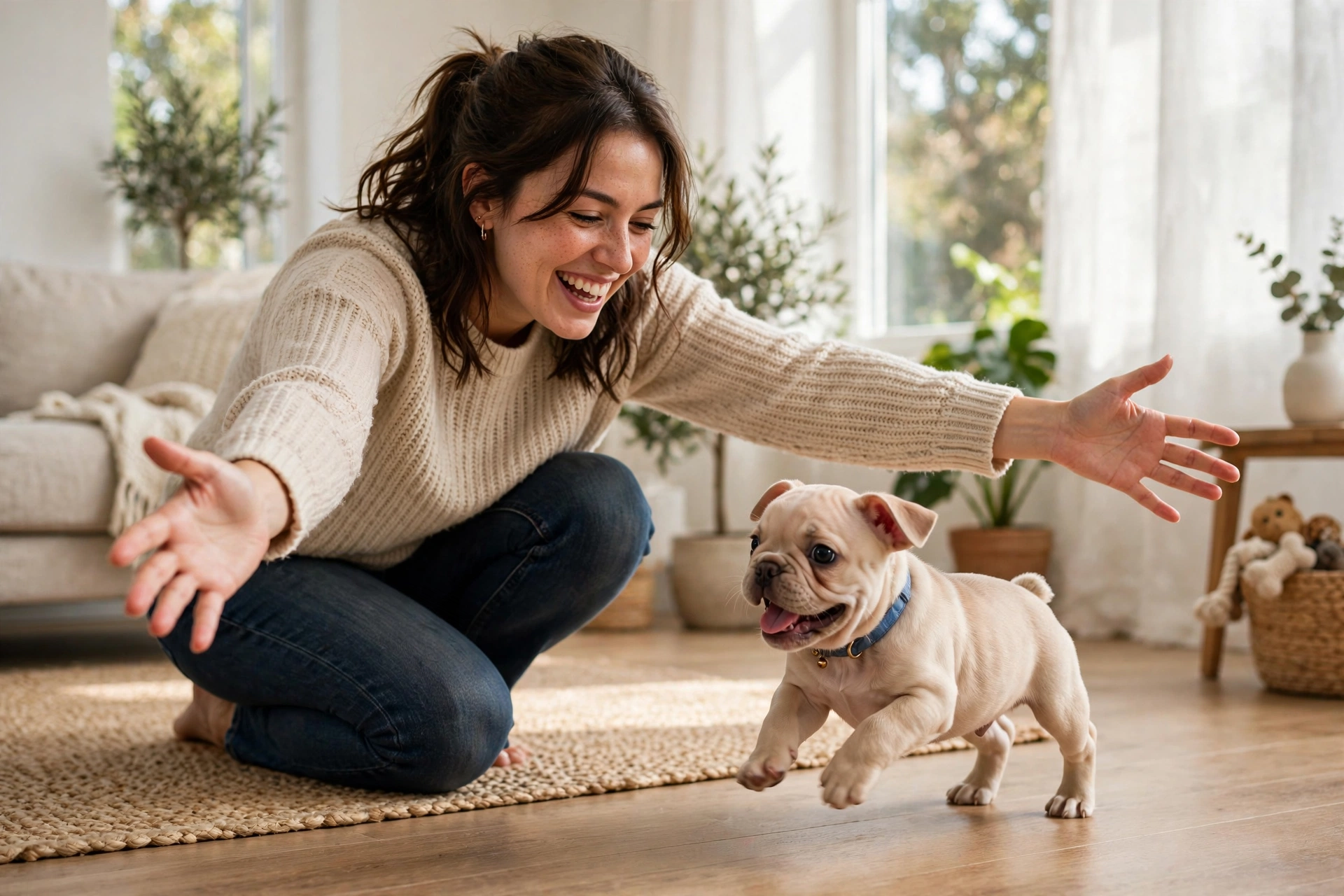
The AKC by-one-year list is a good finish line: sit, down, and stay even with distractions, come when called, loose-leash walking, drop it, and leave it. The AKC puppy training timeline starts with trust and the puppy’s name. Simple training can begin at homecoming, usually around 8 weeks, if it stays reward-based. Keep sessions to five to 10 minutes and end on a positive note, per the AKC.
Name and attention. Say the name once, mark and pay the look toward you, practise at feeding times first. Never use the name to scold.
Sit. Lure the nose up and back so the rear drops, then mark and pay. Build toward sit before meals, play, and attention.
Down. Lure downward from a sit and pay on the mat. Never push the puppy into position.
Stay. Build duration, distance, and distraction one at a time. A three-second stay in a quiet kitchen is a real win.
Come. Call once, brightly, and pay like it matters. Never call a puppy to punish him or end something fun.
Leave it. Treat under your hand, pay for looking away, then add the cue. This guards against dropped food and medication.
Drop it. Trade, do not snatch. Offer something better, and sometimes give the item back so dropping it does not always end the game.
Loose-leash walking. Reward check-ins beside you on a harness. When the leash tightens, stop or change direction and pay for catching up.
| Cue | Why it matters first | Classic beginner mistake |
|---|---|---|
| Name | All cues depend on attention | Repeating it until it is background noise |
| Sit | Polite default for food and doors | Pushing the rear down instead of luring |
| Come | Safety, on and off leash | Calling the puppy to end play or to scold |
| Leave it | Dropped pills and floor food | Starting with items valued too highly |
| Drop it | Safe trades for stolen objects | Chasing and prying the mouth open |
Gear That Keeps a Flat Face Safe
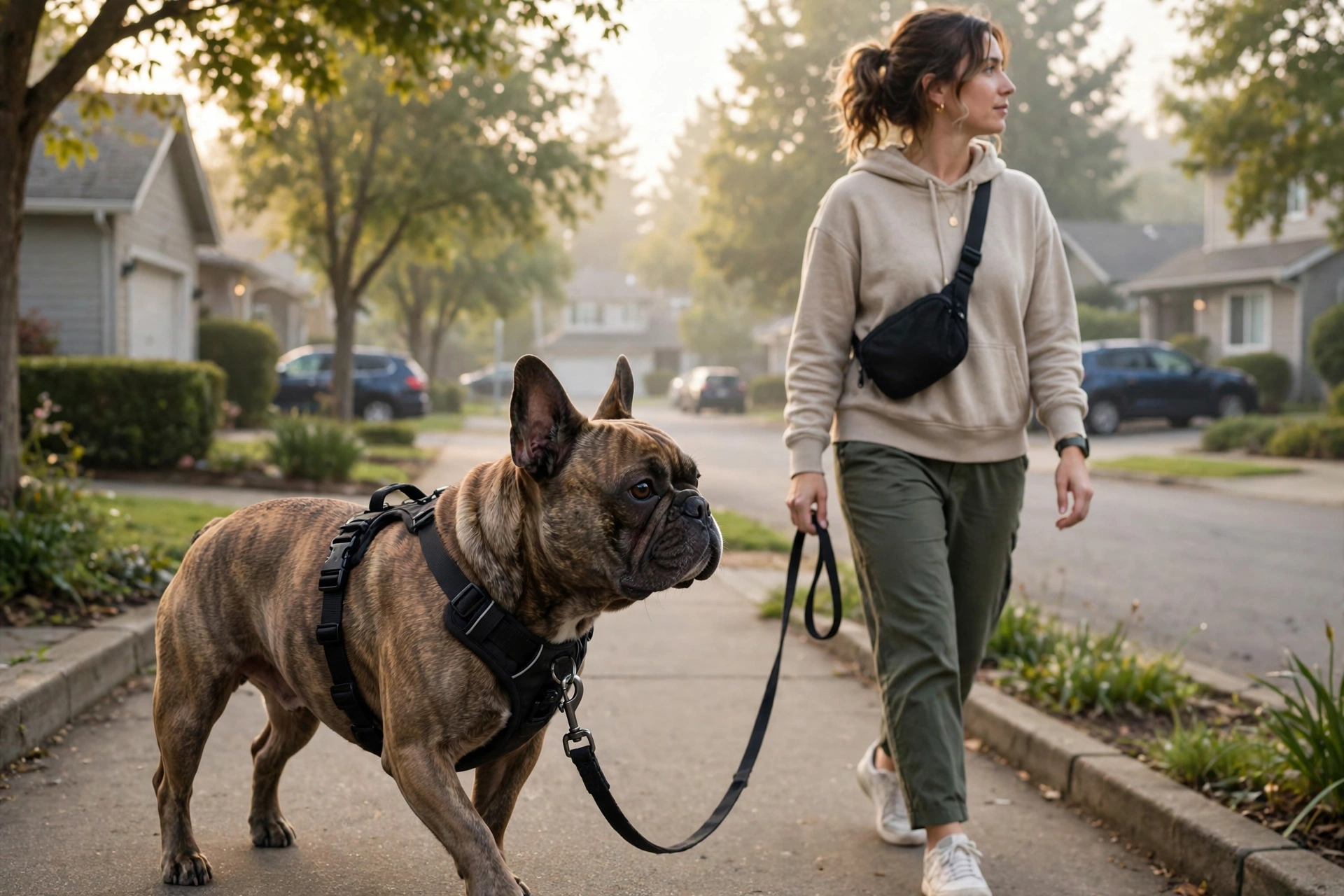
VCA Animal Hospitals states the rule plainly: dogs with BOAS should wear a harness that does not tug at the neck area, and a regular neck collar is not advisable because it can put undue pressure on the neck. Treat the collar as an ID-tag holder. The harness is where the leash clips, and a front-clip model adds steering without neck pressure.
Use a standard 4 to 6 foot leash. Retractable leashes make timing harder, and PetSmart classes require a buckle collar, head halter, or harness with a standard leash, with no choke or prong collars allowed. Fit the harness to the two-finger check, clear of the armpits and free at the shoulders.
Checklist: the training kit
– Front-clip harness, fitted before the first outdoor session
– Standard 4 to 6 foot leash, no retractable leash for training
– Treat pouch at the waist, so pay arrives fast
– Pea-sized, soft, high-value treats, counted in the day’s food
– Not on the list: prong, choke, slip, or shock collars, and bark collars
Training Around a Frenchie Body: Heat, Breathing, and Meals
French Bulldogs carry six times the risk of heat stroke of Labrador Retrievers in VetCompass research from the Royal Veterinary College, and exertion is the dominant trigger in that wider work. Train early morning or evening, indoors with air conditioning in summer, inside the 5 to 10 minute window, with shade, water, and rest built in. Our French Bulldog heat stroke guide covers warning signs in full.
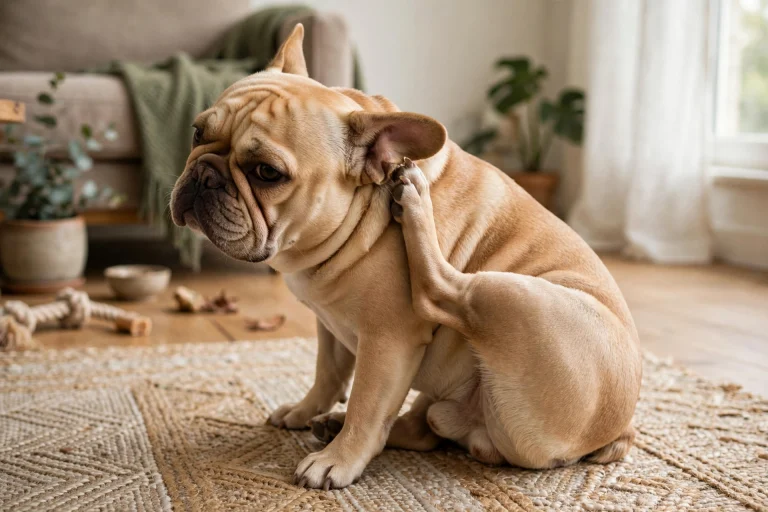
Excitement counts as exertion here. VCA notes BOAS signs worsen with exercise and excitement, and links the condition to retching, vomiting, and reflux. Keep arousal low for a dog already panting. Repeated gagging or retching in sessions is a vet conversation, not a training failure.
Train before meals, or well after them. A dog who is not full values food pay more, and a full stomach plus excitement and heavy panting is a poor mix in a breed with reflux on its list. That is practical guidance, not a medical rule.
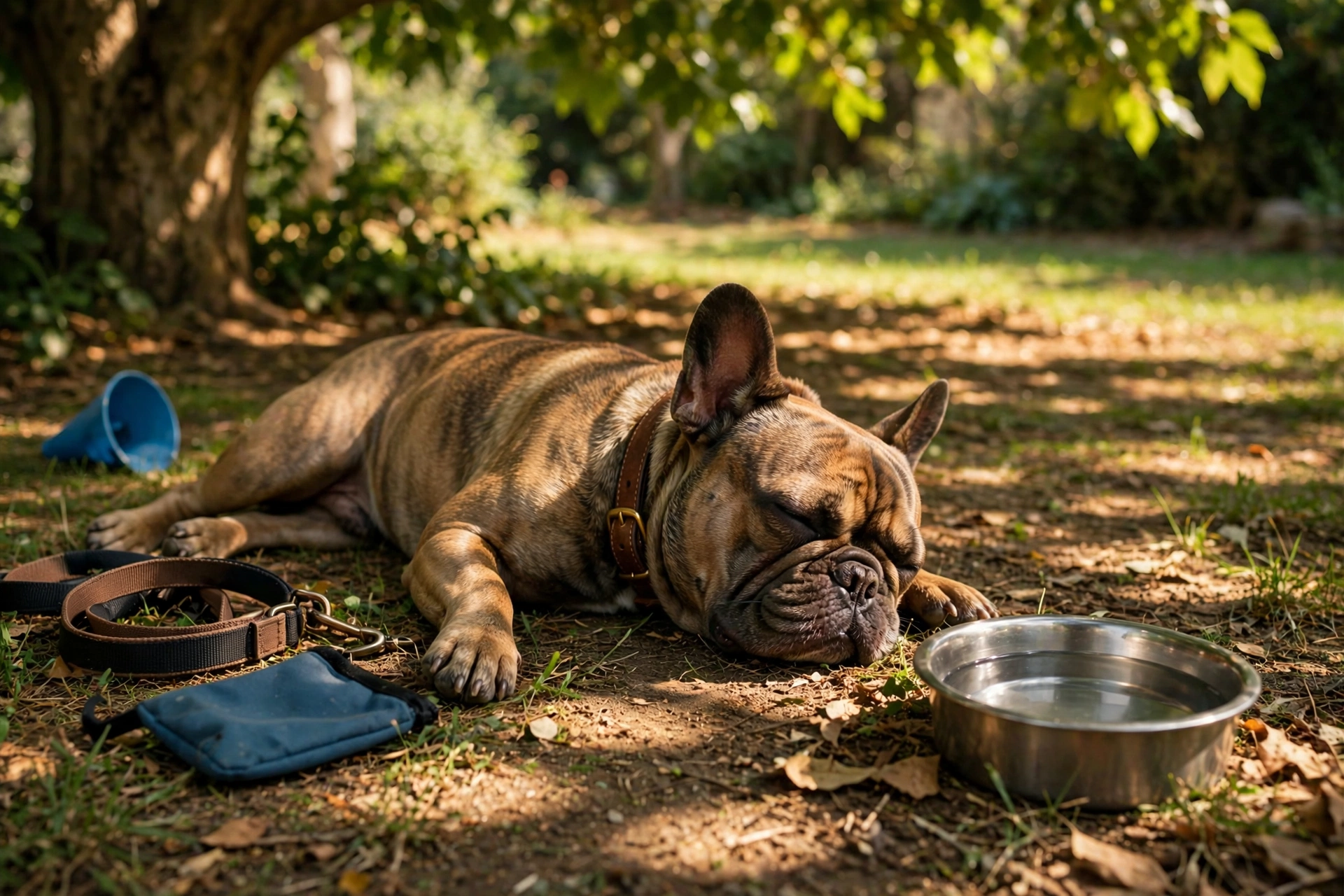
Quick tip: Stop the session if breathing gets loud or hard, if the puppy lags, seeks shade, or pants with a wide, strained mouth. Breathing ends the session, not the lesson plan.
Alone-Time Training: Preventing Separation Anxiety
A breed selected as a constant companion starts with the odds stacked toward finding alone time hard. The AKC makes being alone an explicit early goal, progressed gradually in a crate or another safe enclosed place.
The ASPCA structure is graduated absence: many short separations that produce no anxiety, then longer ones over weeks. Keep arrivals and departures low-key. Practise departure cues such as keys, coat, and shoes without leaving. Build independent rest into every day, on a mat or in the crate in another room. For mild cases, the ASPCA describes a long-lasting food puzzle given only when alone and removed on return. A dog who will not eat when left is giving you information.
Film your dog alone before labeling any problem. Panic signs include destruction at doors and exit points, distress within minutes of departure, toileting by a housetrained dog only when left, persistent barking with no outside trigger, fixed-pattern pacing, and frantic greetings. Rule out medical causes, incomplete housetraining, marking, boredom, and juvenile destruction first, as the ASPCA advises. A full protocol is a future cluster article. This is panic, and punishment has no role in fixing panic.
Checklist: alone-time warning signs
– Damage concentrated at doors, windows, and exits
– Barking or howling that starts soon after you leave
– Drooling, pacing, or trembling caught on camera
– Food puzzles untouched until you walk back in
Leash Reactivity: Why It Happens and the Beginner Move
Leash reactivity is barking, lunging, growling, whining, or fixating at dogs, people, bikes, or vehicles on leash. Many reactive dogs are fine off leash. The leash removes the normal options, moving away or moving closer to greet, so fear and frustration can escalate into the same picture. Trainers describe drivers as fear, frustration in a dog who wants to say hello, pain in sudden adult-onset cases, and learning, because the reaction makes the other dog go away. That is trainer consensus, built on the desensitization and counterconditioning methods AVSAB and the ASPCA endorse.
Manage first. Walk at quieter times, choose wide routes, and cross the street before your dog reacts, because every rehearsed explosion practices the problem. Then work under threshold, at the distance where your dog notices the trigger but can still eat and look back at you: trigger appears, mark, high-value treat, repeated calmly. Shrink distance only while the dog stays relaxed, over weeks. Teach an alternative job at home first, such as eye contact on cue, a practiced U-turn, or a treat scatter.
Corrections have no place here, and AVSAB bars aversive methods in behavior modification with no exceptions. Get qualified help for biting or near-biting, worsening reactivity, sudden adult onset, or if you feel unsafe. Sudden onset means the vet rules out pain first.
Quick tip: Find the distance where your dog can notice another dog, eat a treat, and look back at you. That distance is your classroom. Work there, not ten feet from the trigger.
Barking: Decode It Before You Train It
Frenchies are not a particularly vocal breed, per the AKC. A Frenchie who barks a lot is reporting something specific. The AKC lists attention-seeking, boredom, fear, excitement, frustration, and territorial behavior, and stresses that the reason comes first, because a bored dog needs something to do and an anxious dog needs confidence.
Any response pays attention-seeking barking, including petting, throwing a ball, and shouting. Yelling reads to the dog as you barking along. Turn or walk away, then pay the quiet behavior. To teach a quiet cue, wait for a second of silence, mark and treat, extend the silence gradually, and add the cue just before the predictable pause.
Manage self-rewarding triggers. Block the window view, because barking pays every time a passerby leaves. Do not leave the dog unattended in the yard to rehearse at every neighbor. Keep him away from the front door during arrivals and allow a greeting once he is calm. Leave it and wait-at-the-door games teach that patience pays. Bark, spray, and ultrasonic collars work by punishment, and this guide does not use them. Barking only when alone belongs in the separation section, and barking on leash in the reactivity section.
Do this, not that:
– Do reward the pause: mark the first second of quiet, pay it, then build the pause longer.
– Do block the window view for a territorial barker. Do not give him a front-row seat and then scold the show.
What Training Costs in 2026, and How to Choose Help
Training is not priced by breed, so these are general US figures, varying by city and credentials. Expect roughly $150 to $300 for a 6-week group or puppy course in 2026. PetSmart and Petco both sit at $149. Private training costs more: PetSmart lists $45 for 30 minutes and $89 for an hour, and independent trainers commonly run $100 to $150 per hour in national roundups, with behavior cases higher. Online starts at free AKC articles, then runs from about $10 a month for Pupford Academy, to $19 courses and a $99 puppy series at AKC Canine College, to about $34 a week for GoodPup live video coaching. Online is cheaper, but nobody is in the room to catch your timing.
Board-and-train needs a caution, not just a price. Two-week programs commonly run $3,000 to $4,000, within about $1,500 to $5,000 or more for 2 to 4 week stays. Dogs learn in context, so facility skills do not transfer automatically to you at home, and any program promising you need do nothing after pickup is a red flag. You cannot control methods you cannot see, and it is the wrong tool for separation anxiety, housetraining, and household manners. Sending a puppy away during the socialization window also trades away your highest-value weeks.
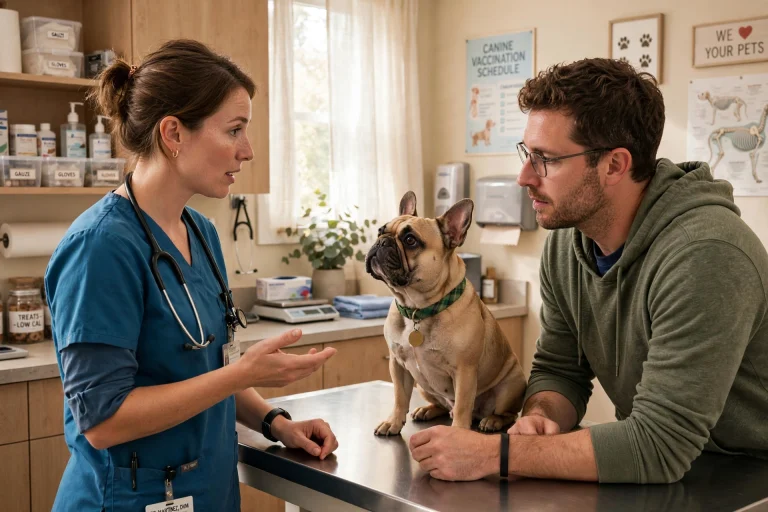
Training is unregulated, and anyone can use the title. Look for CPDT-KA, IAABC, or KPA-CTP for general training, CSAT for separation anxiety, and CAAB or a board-certified veterinary behaviorist for serious cases. The AKC GoodDog Helpline is a legitimate budget option.
| Format | Typical 2026 cost | Best for |
|---|---|---|
| Group or puppy class, 6 weeks | $149 at chains, $150 to $300 typical | Socialization and first cues |
| Private trainer | $89 an hour at PetSmart, $100 to $150 typical | One problem, faster feedback |
| Online courses and apps | Free to $99, about $34 a week live | Budget learning |
| Board-and-train, 2 to 4 weeks | About $1,500 to $5,000 or more | Rarely the right first move |
Checklist: questions that vet any trainer
– What methods and tools do you use, in writing? Prong, shock, or choke ends the call.
– What are your credentials, and who issued them?
– Do you guarantee results on a deadline? A yes is a red flag.
Frequently Asked Questions
Are French Bulldogs hard to train? Not unusually. The AKC describes a stubborn streak alongside a people-pleasing, food-motivated temperament. The dog trains well when pay is good and cues are clear.
When should I start training a Frenchie puppy? As soon as the puppy comes home, usually around 8 weeks, with name games, handling, and sit. Classes can begin at 7 to 8 weeks under the AVSAB vaccine rules above.
How long should a session last? Five to 10 minutes, per the AKC, ending on a positive note. Loud, hard breathing is the stop signal.
Should my Frenchie wear a collar or a harness? A harness for the leash, always. VCA advises against neck collar pressure for dogs with BOAS. The collar is for ID tags only.
Why does my Frenchie listen at home but not outside? Dogs do not generalize skills automatically. Kitchen sit and park sit are two different behaviors to the dog. Proof each cue in new places at easy difficulty first, with better pay.
Can I train an adult or rescue French Bulldog? Yes. Reward-based training works at any age, and an early start is easier, not mandatory. Teach the same cues in the same order, with trust, alone time, and handling high on the list.
Final Word
French bulldog training rewards the owner who works like the breed does: short bursts, good pay, and no interest in a fight. Teach the name, pay the sit, guard the socialization window, and let the harness and the schedule do the heavy lifting while your puppy learns that you are the most interesting thing in the room. Save this guide, pair it with our owner’s guide before your puppy class starts, and enjoy the small daily wins. They add up faster than you expect. Welcome to the good work.